


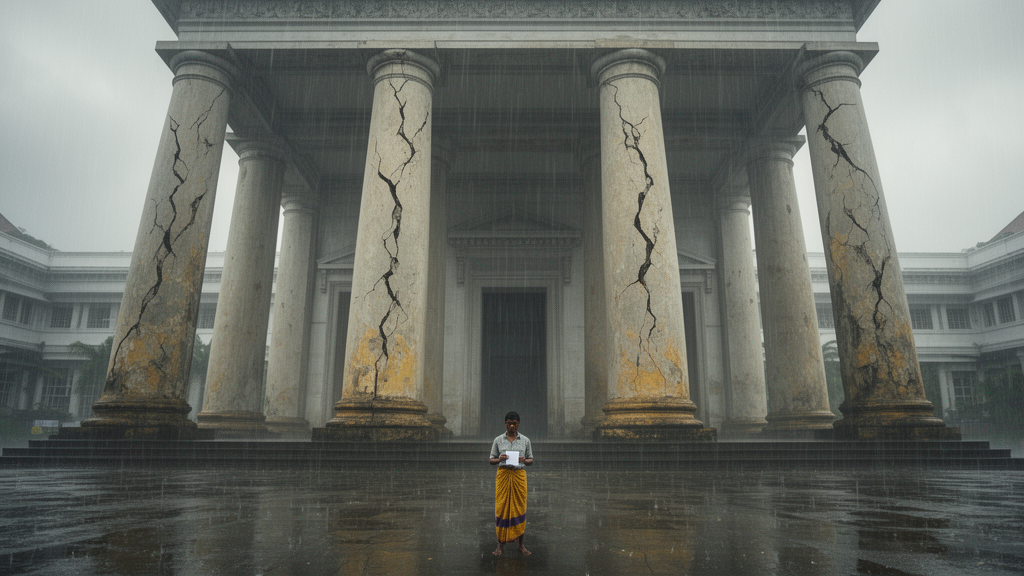
A new study of Sri Lanka’s political system has found measurable democratic erosion across every major institutional component of the country’s governance since 2015, with weaknesses in one democratic domain spilling over into the others. The research, published in the open-access journal SN Social Sciences, applies political scientist Wolfgang Merkel’s framework of Five Partial Regimes to post-2015 Sri Lanka and concludes that the island nation, once regarded as a democratic model in South Asia, has drifted toward what the framework terms a defective rather than embedded democracy. Authors Sachin S. Bulukale and Mohd Tahir Ganie, drawing on triangulated evidence from documentary analysis, secondary scholarship and quantitative indicators, report entrenched institutional weakness, systematic violations of fundamental rights, hybrid civil-military governance and a gradual but quantifiable decline in the quality of democratic governance, even as national elections continued to be held on schedule.
Merkel’s model, set out in his 2004 article ‘Embedded and Defective Democracies’, dissects democracy into five interdependent partial regimes: the electoral regime, political rights, civil rights, horizontal accountability and the effective power to govern. The framework was developed to address analytical gaps in earlier approaches. Scholars had noted that many post-communist states qualified as democracies under Robert Dahl’s polyarchy criteria despite functioning as ‘delegative democracies’, while indices such as the Freedom House Index were criticised for arbitrary thresholds that could not fundamentally distinguish liberal from illiberal democracy. Merkel’s central insight is that elections alone are a necessary but insufficient condition for democratic rule: the framework examines whether governing elites adhere to democratic and constitutional principles between elections, with each partial regime serving as a minimum condition for the others.
The study focuses on the period after 2015, when the defeat of Mahinda Rajapaksa and the election of the Sirisena-Wickremesinghe ‘Yahanpalana’ or good governance coalition initially raised expectations of democratic renewal. The authors use the Varieties of Democracy (V-Dem) dataset as their principal quantitative source, because it provides indicators for all five partial regimes on a continuous 0-to-1 interval scale, with expert assessments aggregated through Bayesian measurement models. To reduce dependence on a single data source, the analysis is triangulated with supplementary indicators matched to specific dimensions: the Perceptions of Electoral Integrity (PEI) index for electoral competition, the Global State of Democracy (GSoD) dataset, the Political Terror Scale (PTS) for state repression, and SIPRI data for military expenditure. The authors state that the objective is not to confirm democratic decline per se, but to trace how specific institutional disruptions alter the internal equilibrium among democratic components.
The electoral regime shows a pattern of recurring, irregular stress. Although presidential and parliamentary elections have been held regularly, all nine provinces, including the Tamil-majority Northern Province, have been without provincial legislatures since their terms expired, with elections repeatedly postponed since 2019 following the Provincial Council Elections (Amendment) Act of 2017. Critics cited in the study argue the delays are a strategy by successive governments to dismantle the provincial system and leave Tamil aspirations unresolved, a form of electoral erosion that Merkel’s model captures only partially. Documented violations rose from 1,258 cases in 2015 to 1,529 in the 2019 presidential election and 2,084 in the 2020 parliamentary election, when rejected votes reached 6.03 per cent. During the 2024 presidential campaign, the Centre for Monitoring Election Violence recorded 237 major and 183 minor violations, while the Election Commission received 4,945 complaints between July and September 2024, of which 4,804 concerned election law. In 2024, the Supreme Court found then President Ranil Wickremesinghe guilty of indefinitely delaying local polls; when local elections were finally held in 2025, 2,623 complaints were recorded and an SLPP candidate was killed.
Quantitative indicators track these disruptions. The V-Dem Electoral Democracy Index for Sri Lanka fell sharply to 0.558 in 2019 and stood at 0.57 in 2021, coinciding with rising violations, misuse of state resources and partisan journalism, before recovering to 0.664 in 2024. The PEI Contestation Score for the 2020 legislative election dropped roughly 4.24 points, from 45.94 at the 2019 presidential election to 41.7, indicating rapid deterioration in the equity of electoral competition. The 2024 rebound, recorded by both V-Dem (0.664) and PEI (47.89), coincided with reforms such as the Regulation of Election Expenditure Act of 2023, which limits campaign spending at local, provincial and national levels. The authors note, however, that the principle of universal suffrage has been hollowed out at the subnational level, where minority populations are strategically deprived of representation through politically motivated postponement rather than by any explicit legal act.
Political rights display a similarly uneven record in an ethnically stratified society. The study traces how Sinhala Buddhist majoritarian politics, consolidated through constitutional centralisation in the 1970s and the 26-year civil war from 1983, shaped a political culture in which ethnic nationalism rather than liberal principles defined substantive democracy. During the 2022 Aragalaya (‘Struggle’) protests, two student leaders were arbitrarily arrested under the Prevention of Terrorism Act of 1979, then President Wickremesinghe labelled protesters ‘terrorists’ and ‘fascists’, and in September 2022 the government invoked the Official Secrets Act to declare High Security Zones around key public offices, a measure inconsistent with UN human rights guidance on peaceful assembly. Muslim activists and politicians faced harassment and arbitrary arrest after the 2019 Easter Sunday bombings, with human rights lawyer Azath Salley among those detained. Freedom House data, rescaled to a 0-to-1 range, show political rights declining from 0.575 in 2019 to 0.55 in 2023 before recovering to 0.65 in 2024 following the National People’s Power victory. The Political Terror Scale corroborates the deterioration, rising from 2 in 2019 to 3 in 2020 and remaining unchanged through 2024, indicating extensive political imprisonment and increased repression.
Civil rights, grounded in the rule of law, are compromised by constitutional structure. Unlike India, where legislation must conform to fundamental rights, Sri Lanka’s Article 80(3) permits laws to exist without such consistency, and post-enactment judicial review is barred. Judicial review was abolished by the 1972 Constitution and restricted to the pre-enactment bill stage under the 1978 Constitution. In 2019, writer Shakthika Sathkumara and journalist Kusal Perera were charged under the ICCPR Act over their writing. The Online Safety Act, passed in January 2024 to criminalise ‘false’ and ‘harmful’ online speech, was challenged by parliamentarian M.A. Sumanthiran, but his application was dismissed because the constitution does not permit post-enactment judicial review. Minority rights were curtailed through a 2021 blanket burqa ban, the closure of more than 1,000 madrasas and compulsory cremation mandates. The Human Rights Commission of Sri Lanka recorded 2,845 complaints of torture and 675 concerning degrading treatment. V-Dem’s civil liberties index fell from 0.785 in 2019 to 0.671 in 2020 and 0.648 in 2021, while GSoD data show civil liberties declining from 0.65 in 2018 to 0.57 in 2021 and the rule of law index falling from 0.5 to 0.42 over the same period.
Horizontal accountability, the mutual checking of legislature, executive and judiciary, has fluctuated dramatically. The Nineteenth Amendment of 2015 initially diluted executive presidential powers, but the Twentieth Amendment of 2020 reversed course, granting the President sole discretion to appoint the chief justice and every Supreme and Court of Appeal judge, and rendering presidential impeachment largely impractical. UN Special Rapporteurs warned that the politicised appointment process risked undermining judicial independence. In 2023, when the Supreme Court ordered authorities not to withhold funds for postponed local elections, the judges were referred to the Parliamentary Ethics Committee, prompting international concern over the violation of separation of powers. V-Dem’s horizontal accountability index fell to 0.507 in 2020, while GSoD recorded the Effective Parliament index dropping from 0.56 in 2019 to 0.5 in 2020 and judicial independence falling from 0.68 to 0.57. The Twenty-first Amendment of 2022 restored some presidential accountability to Parliament, yet the authors describe a persistent struggle among the branches, consistent with ‘constitutional hardball’ in which technically legal manoeuvres incapacitate checks and balances.
The fifth regime, effective power to govern, reveals the study’s most striking theoretical finding. Sri Lanka’s armed forces more than doubled between 2005 and 2009 during the civil war’s final phase, and after 2009 elected governments deployed the military into civilian domains: the Urban Development Authority was placed under the Ministry of Defence, military officers handled land sales, NGO registration and ambassadorships, and roughly 30,000 acres in Mullaitivu district remained held by security forces. During the COVID-19 pandemic, public health decisions were made by a military-led operation centre headed by Lieutenant General Shavendra Silva, and in 2021 a major general was appointed Commissioner General of Essential Services during the economic emergency. In July 2026, Deputy Minister of Defence Aruna Jayasekara told Parliament that 1,662 acres of militarily occupied land in Palali, Jaffna Peninsula, would be permanently retained by the armed forces. Defence and public security allocations rose to LKR 539.2 billion in the 2023 Budget, about 1.78 per cent of GDP, while SIPRI data show military expenditure of roughly US$1.5 to 1.8 billion annually between 2016 and 2021, falling to about US$1 billion after the 2022 sovereign default before rebounding to approximately US$1.5 billion in 2025. Notably, V-Dem’s Military Dimension Index remains near zero throughout 2016 to 2024, indicating no military role in executive appointment or removal. The authors argue this exposes a limitation of Merkel’s framework: Sri Lanka’s militarisation is executive-driven rather than a usurpation by the military itself, a collateral model of governance that circumvents democratic accountability while formally satisfying the criterion of elected rule.
The study concludes that Sri Lanka’s trajectory exemplifies what Nancy Bermeo terms executive aggrandizement, in which elected executives weaken democratic constraints through legal, incremental steps rather than constitutional rupture, presenting such measures as a democratic mandate. The evidence shows cross-regime diffusion: the Twentieth Amendment’s expansion of executive power coincided with adverse effects on political and civil rights, the Aragalaya protests saw military involvement in managing civilian demonstrations, and local election postponements restricted participation and accountability. The authors argue that democratic resilience depends not merely on the strength of individual institutions but on their capacity to balance, reinforce and complement one another, and that robust institutional reforms amplifying liberty, equality, constitutionalism and accountability, alongside strengthened civic forces, are essential. Democracy, their analysis underscores, is not a secured achievement but a constant striving against illiberal threats.
Subject of Research: Democratic backsliding in post-2015 Sri Lanka assessed through Merkel's Five Partial Regimes framework
Article Title: Diagnosing democracy: applying Merkel’s Partial Regimes Model to post-2015 Sri Lanka
Article References: Bulukale, S. S., & Ganie, M. T. (2026). Diagnosing democracy: applying Merkel’s Partial Regimes Model to post-2015 Sri Lanka. SN Social Sciences, 6(11), 575. https://doi.org/10.1007/s43545-026-01869-9
Image Credits: AI Generated
DOI: 10.1007/s43545-026-01869-9
Keywords: Sri Lanka, democratic backsliding, Wolfgang Merkel, Five Partial Regimes, V-Dem, horizontal accountability, electoral regime, civil rights, civil-military relations, executive aggrandizement, Aragalaya protests, constitutional reform
Cite Scienmag News
Courtney Benton. (October 24, 2026). Five democratic pillars under strain: study maps Sri Lanka’s post-2015 backsliding. Scienmag. https://scienmag.com/five-democratic-pillars-under-strain-study-maps-sri-lankas-post-2015-backsliding/
Courtney Benton. "Five democratic pillars under strain: study maps Sri Lanka’s post-2015 backsliding." Scienmag, 24 October 2026, https://scienmag.com/five-democratic-pillars-under-strain-study-maps-sri-lankas-post-2015-backsliding/. Accessed 24 October 2026.
Courtney Benton. "Five democratic pillars under strain: study maps Sri Lanka’s post-2015 backsliding." Scienmag. October 24, 2026. https://scienmag.com/five-democratic-pillars-under-strain-study-maps-sri-lankas-post-2015-backsliding/


