


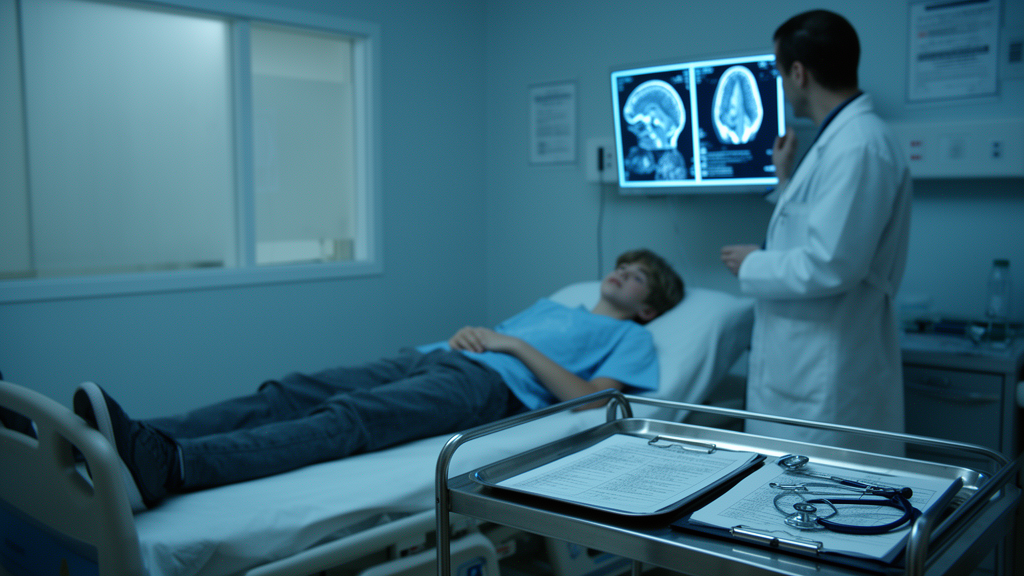
A 14-year-old girl who arrived at hospital with a sudden bilateral temporal headache, dizziness, and a 21-hour episode of stupor that had resolved on its own before admission was ultimately found to be suffering not from a brain infection, but from severe functional constipation, according to a case report published in BMC Pediatrics by Hongyu Liang and Chaoyang Li. The girl was alert but lethargic on arrival, with normal vital signs, a normal neurological examination, and an unremarkable head CT scan. Because her symptoms suggested a possible acute intracranial infection with presumed raised pressure inside the skull, clinicians began empirical treatment with the antiviral drug acyclovir and intravenous mannitol, an osmotic agent commonly used to lower intracranial pressure.
Subsequent investigations, however, failed to support either the suspected infection or the presumed elevated intracranial pressure. Cerebrospinal fluid analysis was normal, and the opening pressure measured during the procedure was 70 mmH2O, which the authors note falls below the pediatric reference range — although this measurement was taken after mannitol had already been administered, a detail that complicates its interpretation. Fundoscopic examination revealed no papilledema, the swelling of the optic disc that typically signals raised intracranial pressure, and brain MRI showed no infectious or structural abnormalities. Despite the mannitol therapy, the patient’s headache and lethargy persisted.
The diagnostic turning point came during hospitalization, when the girl developed severe constipation. An upright abdominal radiograph demonstrated extensive fecal retention and gaseous distension throughout the colon. The imaging also picked up an incidental finding: non-fusion of the posterior vertebral arches at the S1–S2 level of the sacrum, an anatomical variant the authors emphasize should not be over-interpreted without dedicated MRI evaluation. After the bowel was evacuated and mannitol was discontinued, the persistent headache and lethargy substantially improved, and the symptoms did not recur during three months of follow-up.
The authors frame the case as a diagnostic pitfall with two distinct lessons. First, nonspecific neurological manifestations in adolescents — headaches and impaired consciousness among them — remain a significant clinical challenge, and current routine tends to prioritize the investigation of infectious causes while functional gastrointestinal disorders are frequently overlooked during screening. In this case, the severe fecal retention was only identified after the neurological work-up had already been set in motion, and it was the resolution of symptoms following bowel evacuation that pointed to constipation as the likely driver of the presentation.
Second, the report highlights what the authors describe as underappreciated risks of empirical osmotherapy. When raised intracranial pressure is suspected, treatment with osmotic agents such as mannitol is often initiated without objective measurement of the pressure itself. Here, the cerebrospinal fluid opening pressure was not elevated, no papilledema was present, and the patient did not improve on mannitol — a pattern consistent with the treatment being both ineffective and potentially harmful in a patient whose pressure was not in fact raised. The authors conclude that decisions about osmotherapy should be based on objective intracranial pressure assessment, such as cerebrospinal fluid pressure measurements, rather than on a presumptive diagnosis alone.
As a single-case report, the findings describe one patient’s experience rather than a controlled comparison, and they cannot establish how frequently constipation mimics neurological illness or how often empirical mannitol causes harm in similar situations. The authors nonetheless recommend that clinicians include gastrointestinal evaluation in the work-up of adolescents with persistent, unexplained neurological symptoms, and they caution that incidental anatomical findings such as isolated posterior arch defects of the sacrum should not be given undue weight in the absence of dedicated imaging. For this patient, the combination of bowel evacuation, withdrawal of the unnecessary osmotic therapy, and three months without symptom recurrence closed a diagnostic story that had begun, misleadingly, with a headache that looked for all the world like an infection of the brain.
Subject of Research: A pediatric case report of severe functional constipation mimicking acute intracranial infection and the risks of empirical mannitol therapy
Article Title: Severe functional constipation masquerading as acute intracranial infection in an adolescent: a diagnostic pitfall and the risks of empirical mannitol therapy — a case report
Article References: Liang, H., & Li, C. (2026). Severe functional constipation masquerading as acute intracranial infection in an adolescent: a diagnostic pitfall and the risks of empirical mannitol therapy — a case report. BMC Pediatrics. https://doi.org/10.1186/s12887-026-07764-9
Image Credits: AI Generated
DOI: 10.1186/s12887-026-07764-9
Keywords: functional constipation, intracranial pressure, mannitol, case report, adolescent headache, pediatric neurology, diagnostic pitfall, osmotherapy, cerebrospinal fluid pressure, BMC Pediatrics, abdominal radiograph, empirical treatment
Cite Scienmag News
Ophelia Keating. (October 24, 2026). Severe Constipation Masqueraded as Brain Infection in a Teenager, Case Report Warns. Scienmag. https://scienmag.com/severe-constipation-masqueraded-as-brain-infection-in-a-teenager-case-report-warns/
Ophelia Keating. "Severe Constipation Masqueraded as Brain Infection in a Teenager, Case Report Warns." Scienmag, 24 October 2026, https://scienmag.com/severe-constipation-masqueraded-as-brain-infection-in-a-teenager-case-report-warns/. Accessed 24 October 2026.
Ophelia Keating. "Severe Constipation Masqueraded as Brain Infection in a Teenager, Case Report Warns." Scienmag. October 24, 2026. https://scienmag.com/severe-constipation-masqueraded-as-brain-infection-in-a-teenager-case-report-warns/


