


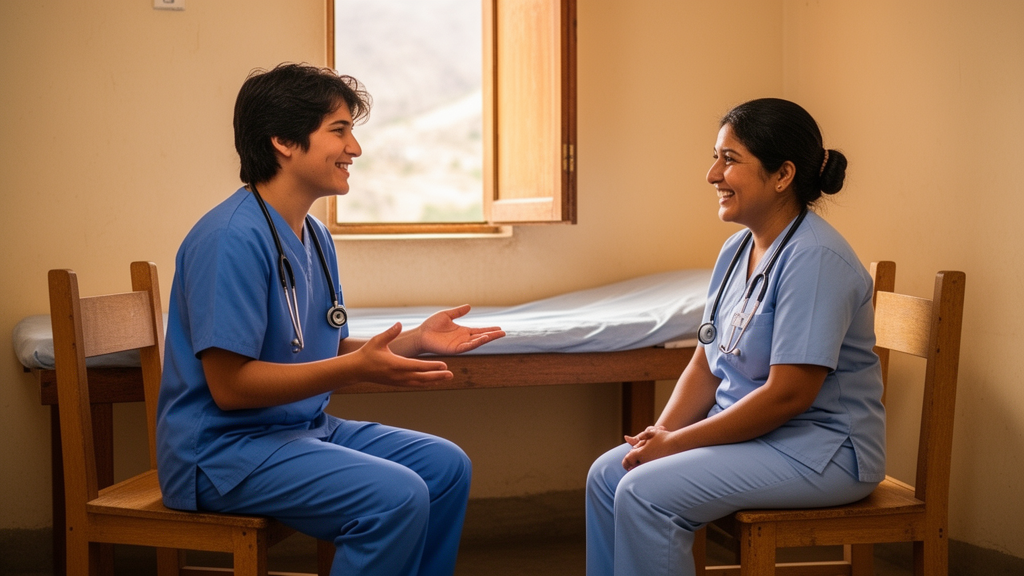
A one-hour online medical Spanish session delivered before a week-long medical mission to Peru was followed by a marked rise in volunteers’ self-rated comfort communicating with Spanish-speaking patients, according to a small pilot study published in BMC Medical Education. Among 16 participants who completed surveys both before and after the trip, median self-rated communication comfort climbed from 1 to 3 on the study’s scale, with a mean increase from 1.44 to 2.81. Fifteen of the 16 participants improved and one reported no change. The researchers used a two-sided exact Wilcoxon signed-rank test, yielding a p value below 0.001, and a matched-pairs rank-biserial effect size of 1.00, with a bootstrap 95% confidence interval for the mean difference running from 1.06 to 1.69.
The study, led by Samuel Chen, Darius Wang, Hannah Whittaker, David Oancea, Mark Sicilio, Heidy Frias and Robert M. Badeau of Texas A&M University, was a prospective, single-group, uncontrolled pre-post pilot. It was determined exempt by the Texas A&M University Institutional Review Board under Study 2026-0001, approved January 30, 2026. Volunteers on the short-term mission completed pseudonymous, self-linked surveys at three points: before attending a live, one-hour, online case-based medical Spanish session or viewing its recording; immediately after the session, an optional step completed by 10 attendees; and after returning from Peru. Of 31 eligible participants, 24, or 77.4%, completed the pre-trip survey, while 17, or 54.8%, completed the post-trip survey. Two duplicate post-trip submissions under a single participant code were resolved by retaining the first complete entry. Among post-trip respondents, 15 of 17, or 88.2%, reported having attended or watched the session.
A methodological caveat shaped the analysis from the outset. Because the pre-trip and immediate post-course survey items were not equivalently worded, the team restricted inferential analysis to the pre-trip to post-trip comparison. That comparison, self-rated comfort communicating in Spanish, pairs a baseline item about comfort taking a medical history with a post-trip item about general communication comfort. The authors designated it the single primary outcome because it was the most closely matched item pair in the dataset, not because the wording was identical. All other outcomes, including immediate post-course self-ratings and post-trip use, recognition and safety items, were treated as secondary or exploratory and reported descriptively with exact item-level denominators.
The follow-up data also revealed a pattern of differential attrition that the authors flagged as a limitation. The seven participants who did not complete the post-trip survey had higher baseline self-rated Spanish proficiency than completers, averaging 2.86 versus 2.18 on a 5-point scale, and they were disproportionately attending clinicians: three of the four attendings did not complete the post-trip survey. This suggests that follow-up varied by baseline experience, meaning the observed gains may partly reflect who stayed in the sample rather than the effect of the training itself.
Beyond the primary outcome, post-trip respondents reported frequent use of the phrases taught in the session, with a median rating of 4 out of 5 among 15 respondents, and rated the accompanying reference sheet as helpful, with a median of 4 out of 5 among 14 respondents. One of the 17 post-trip respondents reported experiencing or witnessing a communication-related near-miss. The authors cautioned that this was an unvalidated self-report item without a standardized definition or independent event ascertainment, so no conclusion about patient safety can be drawn from that single figure.
Language discordance between patients and providers is common on short-term global health engagements, and brief pre-departure language training is sometimes offered as preparation even where interpreters remain available. Whether such training is associated with self-reported gains in comfort and preparedness had not been well characterized before this study. The pilot addresses that gap by describing a concrete format: a single hour of case-based instruction, delivered live online or as a recording, before a one-week clinical engagement.
The authors were explicit that the design cannot separate the effect of the session from concurrent clinical exposure during the trip, from the effect of repeated assessment, or from differential follow-up. Because participants spent a week using Spanish in clinical settings after the training, any measured increase in comfort could stem from practice rather than instruction, or from the combination of both. The absence of a control group means no counterfactual exists against which the change can be benchmarked. For these reasons, the researchers characterized the findings as hypothesis-generating rather than confirmatory.
The study’s scope is correspondingly narrow: a single mission trip, a small volunteer cohort, self-linked pseudonymous surveys, and self-reported outcomes with substantial attrition. The authors concluded that larger, controlled studies using validated, equivalent measures and objective or patient-facing outcomes are needed before any conclusions about effectiveness, communication competence, or safety can be drawn. Until such studies exist, the pilot stands as a description of one feasible pre-departure training format and its self-reported correlates, not as evidence that one hour of medical Spanish improves care on short-term missions.
Subject of Research: Brief pre-departure medical Spanish training for a short-term medical mission to Peru: an uncontrolled pre-post pilot study
Article Title: Brief pre-departure medical Spanish training for a short-term medical mission to Peru: an uncontrolled pre-post pilot study
Article References: Chen, S., Wang, D., Whittaker, H., Oancea, D., Sicilio, M., Frias, H., & Badeau, R. M. (2026). Brief pre-departure medical Spanish training for a short-term medical mission to Peru: an uncontrolled pre-post pilot study. BMC Medical Education. https://doi.org/10.1186/s12909-026-10444-y
Image Credits: AI Generated
DOI: 10.1186/s12909-026-10444-y
Keywords: Brief, pre-departure, medical, Spanish, training, short-term, mission, Peru, uncontrolled, pre-post, pilot, scientific research
Cite Scienmag News
Courtney Benton. (October 24, 2026). One-hour medical Spanish session linked to higher self-rated comfort on Peru mission trip. Scienmag. https://scienmag.com/one-hour-medical-spanish-session-linked-to-higher-self-rated-comfort-on-peru-mission-trip/
Courtney Benton. "One-hour medical Spanish session linked to higher self-rated comfort on Peru mission trip." Scienmag, 24 October 2026, https://scienmag.com/one-hour-medical-spanish-session-linked-to-higher-self-rated-comfort-on-peru-mission-trip/. Accessed 24 October 2026.
Courtney Benton. "One-hour medical Spanish session linked to higher self-rated comfort on Peru mission trip." Scienmag. October 24, 2026. https://scienmag.com/one-hour-medical-spanish-session-linked-to-higher-self-rated-comfort-on-peru-mission-trip/


