

Saturday, October 24, 2026
Science
No Result
View All Result
  • Login
  • HOME
  • SCIENCE NEWS
  • CONTACT US
  • HOME
  • SCIENCE NEWS
  • CONTACT US
No Result
View All Result
Scienmag
No Result
View All Result
Home Science News Agriculture

Fungal Pathogens Behind Walnut Cankers Mapped Across Central Anatolia

October 24, 2026
in Agriculture
Roger Howard
By Roger Howard Scienmag Editorial Profile - Mycology
Reading Time: 3 mins read
0
Fungal Pathogens Behind Walnut Cankers Mapped Across Central Anatolia

Fungal Pathogens Behind Walnut Cankers Mapped Across Central Anatolia

65
SHARES
587
VIEWS
Share on FacebookShare on Twitter
ADVERTISEMENT

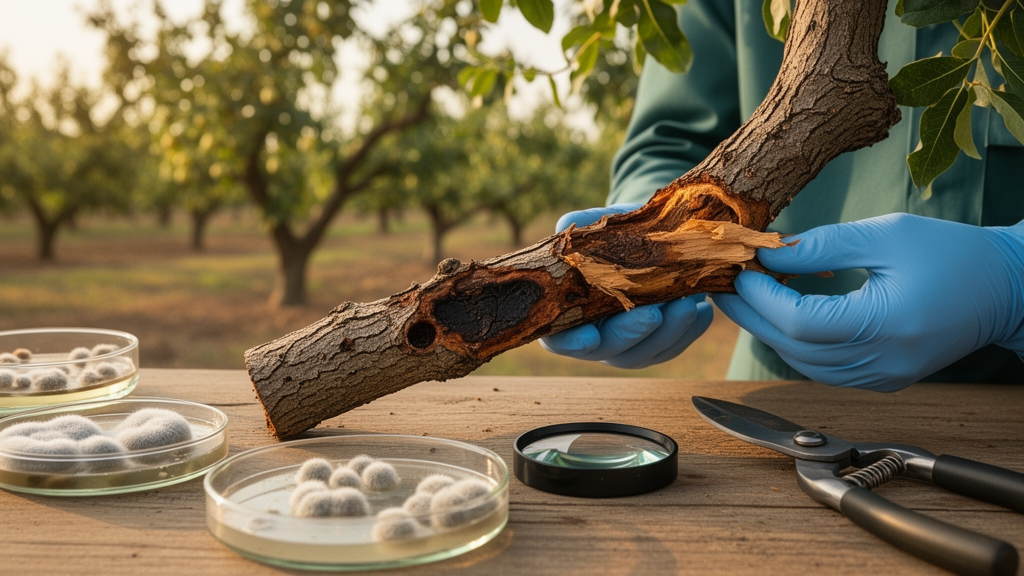
A large-scale survey of walnut orchards in Central Anatolia has documented how widespread and diverse the fungal disease complex behind cankers, twig dieback, and fruit rot is in the region. Researchers examined 30,501 trees across 265 orchards in eight Turkish provinces and found that 87.9 percent of orchards contained at least one symptomatic tree, with a pooled overall incidence of symptomatic trees of 16.0 percent. The study, published in BMC Plant Biology, investigated the prevalence, species composition, symptom associations, pathogenicity, and temperature-dependent growth of Botryosphaeriaceae fungi affecting walnut across the region.

The survey covered Aksaray, Kayseri, Kırıkkale, Kırşehir, Nevşehir, Niğde, Sivas, and Yozgat. Both the proportion of orchards with at least one symptomatic tree and the incidence of symptomatic trees varied significantly among provinces, indicating a spatially heterogeneous disease landscape. From trees showing perennial canker, twig dieback, or fruit rot symptoms, the researchers collected 1,283 tissue samples, from which 666 Botryosphaeriaceae isolates were obtained, corresponding to 51.9 percent of sampled tissues.

Molecular and morphological characterization identified five species: Diplodia seriata accounted for 37.4 percent of isolates, Neofusicoccum parvum for 29.0 percent, Botryosphaeria dothidea for 17.4 percent, Lasiodiplodia theobromae for 8.6 percent, and Lasiodiplodia pseudotheobromae for 7.7 percent. To confirm species boundaries, the team performed multilocus phylogenetic analyses of 56 representative isolates using three DNA loci: the internal transcribed spacer region (ITS), the beta-tubulin gene (TUB2), and the translation elongation factor 1-alpha gene (TEF1-α). These analyses supported the five species-level groups identified in the collection, providing a taxonomic framework for the isolates recovered from Central Anatolian walnuts.

Isolate-level species composition was significantly associated with both symptom type and province. That means the particular mix of fungal species recovered differed depending on whether the sampled tissue came from a canker, dieback, or fruit rot symptom, and also depending on which province the orchard was located in. The study design documents these associations rather than proving causal roles for each species in each symptom.

Pathogenicity was tested using 15 multilocus-confirmed isolates, three per species, inoculated onto both detached and attached walnut branches. All five species caused disease in these tests. The highest pathogenicity was generally observed in isolates of L. theobromae and L. pseudotheobromae, while the lowest was recorded in D. seriata isolates. The researchers also examined how mycelial growth responded to temperature, and species differences emerged: L. pseudotheobromae reached its highest growth at 30 degrees Celsius, and both L. theobromae and L. pseudotheobromae maintained higher growth at 35 degrees Celsius compared with the other species tested. The authors conclude that the Botryosphaeriaceae disease complex in Central Anatolian walnut orchards is widespread and heterogeneous, with spatial variation in isolate composition, and that the high pathogenicity of the tested Lasiodiplodia isolates and their comparatively strong in vitro growth at the upper end of the tested temperature range warrant further investigation.

Subject of Research: Botryosphaeriaceae species associated with canker, twig dieback, and fruit rot of walnut in Central Anatolia, Türkiye

Article Title: Species composition, distribution, and pathogenicity of Botryosphaeriaceae species associated with canker, twig dieback, and fruit rot of walnut in Central Anatolia, Türkiye

Article References: Eser, Y. K., & Endes, A. (2026). Species composition, distribution, and pathogenicity of Botryosphaeriaceae species associated with canker, twig dieback, and fruit rot of walnut in Central Anatolia, Türkiye. BMC Plant Biology. https://doi.org/10.1186/s12870-026-10197-2

Image Credits: AI Generated

DOI: 10.1186/s12870-026-10197-2

Keywords: walnut, Botryosphaeriaceae, Lasiodiplodia, Diplodia seriata, Neofusicoccum parvum, canker, twig dieback, fruit rot, Central Anatolia, plant pathology, phylogenetics, pathogenicity

Cite Scienmag News

Roger Howard. (October 24, 2026). Fungal Pathogens Behind Walnut Cankers Mapped Across Central Anatolia. Scienmag. https://scienmag.com/fungal-pathogens-behind-walnut-cankers-mapped-across-central-anatolia/

Roger Howard. "Fungal Pathogens Behind Walnut Cankers Mapped Across Central Anatolia." Scienmag, 24 October 2026, https://scienmag.com/fungal-pathogens-behind-walnut-cankers-mapped-across-central-anatolia/. Accessed 24 October 2026.

Roger Howard. "Fungal Pathogens Behind Walnut Cankers Mapped Across Central Anatolia." Scienmag. October 24, 2026. https://scienmag.com/fungal-pathogens-behind-walnut-cankers-mapped-across-central-anatolia/


Tags: BotryosphaeriaceaeBotryosphaeriaceae fungicankerCentral AnatoliaDiplodia seriatafruit rotfruit rot in walnutsfungal disease prevalence in walnutsfungal species diversity in walnutsLasiodiplodiamolecular identification of walnut pathogensNeofusicoccum parvumpathogenicityphylogeneticsplant disease survey in Turkeyplant pathologyspatial distribution of walnut diseasestemperature-dependent fungal growthtwig diebackwalnutwalnut canker diseaseWalnut fungal pathogenswalnut orchards in Central Anatoliawalnut twig dieback
Share26Tweet16
Previous Post

Scoping review maps landscape of Black health research in Canada

Next Post

Bamboo biochar strengthens cement-stabilized soft soil while locking away carbon dioxide in laboratory study

Related Posts

Counting Tobacco Plants From Row Lines: A Low-Cost Annotation Method for UAV Field Surveys
Agriculture

Counting Tobacco Plants From Row Lines: A Low-Cost Annotation Method for UAV Field Surveys

October 24, 2026
Biochar, Humic Acid and Rotation Ease Foxtail Millet Cropping Obstacles in Pot Study
Agriculture

Biochar, Humic Acid and Rotation Ease Foxtail Millet Cropping Obstacles in Pot Study

October 24, 2026
Digital farming spreads across Irish arable farms, but the data-driven frontier lags
Agriculture

Digital farming spreads across Irish arable farms, but the data-driven frontier lags

October 23, 2026
Fish Habitat Temperature Pre-Programs Surimi Gel Quality, Study Finds
Agriculture

Fish Habitat Temperature Pre-Programs Surimi Gel Quality, Study Finds

October 23, 2026
Corn Silk Waste Protein Turned Into Solid Fat Alternative by pH Trick
Agriculture

Corn Silk Waste Protein Turned Into Solid Fat Alternative by pH Trick

October 23, 2026
Light-Vibration Pretreatment and 75 °C Drying Boost Aroma of Machine-Harvested Green Tea
Agriculture

Light-Vibration Pretreatment and 75 °C Drying Boost Aroma of Machine-Harvested Green Tea

October 23, 2026
Next Post
Bamboo biochar strengthens cement-stabilized soft soil while locking away carbon dioxide in laboratory study

Bamboo biochar strengthens cement-stabilized soft soil while locking away carbon dioxide in laboratory study

  • Mothers who receive childcare support from maternal grandparents show more optimized

    Mothers who receive childcare support from maternal grandparents show more parental warmth, finds NTU Singapore study

    27656 shares
    Share 11059 Tweet 6912
  • University of Seville Breaks 120-Year-Old Mystery, Revises a Key Einstein Concept

    1061 shares
    Share 424 Tweet 265
  • Bee body mass, pathogens and local climate influence heat tolerance

    682 shares
    Share 273 Tweet 171
  • Researchers record first-ever images and data of a shark experiencing a boat strike

    546 shares
    Share 218 Tweet 137
  • Groundbreaking Clinical Trial Reveals Lubiprostone Enhances Kidney Function

    531 shares
    Share 212 Tweet 133
Science

Embark on a thrilling journey of discovery with Scienmag.com—your ultimate source for cutting-edge breakthroughs. Immerse yourself in a world where curiosity knows no limits and tomorrow’s possibilities become today’s reality!

RECENT NEWS

  • Bamboo biochar strengthens cement-stabilized soft soil while locking away carbon dioxide in laboratory study
  • Fungal Pathogens Behind Walnut Cankers Mapped Across Central Anatolia
  • Scoping review maps landscape of Black health research in Canada
  • Ten-Herb Chinese Formula Reshapes the Bone-Kidney Hormone Axis in Osteoporosis Rats

Categories

  • Agriculture
  • Anthropology
  • Archaeology
  • Athmospheric
  • Biology
  • Biotechnology
  • Blog
  • Bussines
  • Cancer
  • Chemistry
  • Climate
  • Earth Science
  • Editorial Policy
  • Marine
  • Mathematics
  • Medicine
  • Pediatry
  • Policy
  • Psychology & Psychiatry
  • Science Education
  • Science News
  • Social Science
  • Space
  • Technology and Engineering

Subscribe to Blog via Email

Enter your email address to subscribe to this blog and receive notifications of new posts by email.

Join 5,152 other subscribers

© 2025 Scienmag - Science Magazine

Welcome Back!

Login to your account below

Forgotten Password?

Retrieve your password

Please enter your username or email address to reset your password.

Log In
No Result
View All Result
  • HOME
  • SCIENCE NEWS
  • CONTACT US

© 2025 Scienmag - Science Magazine

Discover more from Science

Subscribe now to keep reading and get access to the full archive.

Continue reading