


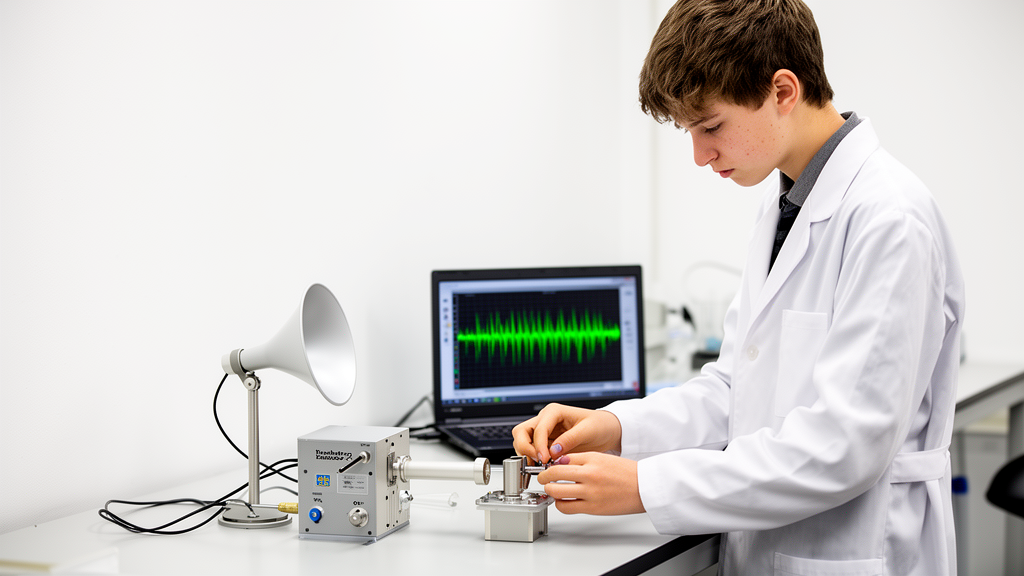
Farell Keiser, a student still attending high school, has achieved a rare distinction in the field of physics by serving as the first author on a peer-reviewed paper published in the journal Physical Review B. The study, conducted over three years at Bielefeld University, investigates the transient optical properties of zinc telluride, a material critical for generating and detecting terahertz radiation. This accomplishment is particularly notable because first authorship typically identifies the individual who made the central contribution to a scientific study, a role usually reserved for graduate students or established researchers. For a high-school student to hold this position in a leading international physics journal is exceptional, marking a significant milestone in early academic engagement.
The research was carried out within the Terahertz Physics Group led by Professor Dmitry Turchinovich at Bielefeld University. Keiser has been involved in this group for the past three years, participating in experimental research rather than a simplified project designed for younger students. According to Turchinovich, Keiser carried out real experiments, obtained original results, processed the data, and made the principal contribution to data analysis and the preparation of the manuscript.
The specific focus of the study is zinc telluride, or ZnTe, which has been one of the most widely used nonlinear crystals for over three decades. ZnTe is essential for generating and detecting terahertz radiation using ultrashort laser pulses. Terahertz radiation finds applications in a diverse range of scientific and technological fields, including nanoscience, astronomy, security technology, and telecommunications.
Keiser’s experimental work revealed that intense laser pulses can transiently change the optical properties of ZnTe in the terahertz range. These changes occur even under conditions that are routinely used for terahertz generation. By observing these transient changes, Keiser was able to describe and characterize them using an established theoretical model.
This approach allows for a more accurate physical description of how terahertz radiation is generated in ZnTe. The findings of the study have been recognized by the scientific community, with the paper being selected as an “Editors’ Suggestion” in Physical Review B. This editorial distinction is given to only a small number of contributions deemed particularly interesting and significant. The paper, titled “Time-dependent terahertz dielectric function of ZnTe under two-photon optical excitation at a wavelength of 800 nm,” was published on October 14, 2026, and includes co-authors Wentao Zhang, Dominik Johannesmann, Nicolas S. Beermann, Yuhao Meng, Hassan A. Hafez, and Savio Fabretti, alongside Keiser and Turchinovich.
In addition to the journal publication, Keiser presented his work at the international SPIE Photonics Europe conference in Strasbourg in April. He was awarded the Best Student Paper Award for his talk, titled “Transient THz dielectric properties of ZnTe under two-photon excitation.” This award is typically given to experienced doctoral researchers, making Keiser’s receipt of it while still in high school all the more remarkable. Professor Turchinovich noted that the award recognized a substantial piece of scientific work, confirming that the prize was not merely symbolic but reflected the genuine impact and quality of the research.
Keiser’s involvement in this research is facilitated by Bielefeld University’s “Studieren ab 15” program, which allows particularly motivated and high-achieving high-school students to attend regular university courses alongside their school education. Students in this program can take examinations and earn credits towards a later degree. However, Keiser has taken this a step further by actively participating in experimental research and publishing his findings in an international journal.
The study’s methodology involved experimental measurements of the terahertz dielectric function of ZnTe under two-photon optical excitation at a wavelength of 800 nm. By using ultrashort laser pulses, the researchers were able to observe the transient changes in the material’s properties. The data collected was then analyzed using theoretical models to understand the underlying physical mechanisms.
Subject of Research: Transient terahertz dielectric function of zinc telluride under two-photon excitation
Article Title: Still at school—and already first author
Article References: Still at school—and already first author. Original publication (Bibliographic details unavailable.)
Image Credits: AI Generated
DOI: Not provided
Keywords: terahertz radiation, zinc telluride, nonlinear optics, high-school research, Bielefeld University, Physical Review B, laser physics, dielectric function, Still, school, already, first
Cite Scienmag News
Katie Riggs. (October 23, 2026). High-School Student Leads Terahertz Physics Study. Scienmag. https://scienmag.com/high-school-student-leads-terahertz-physics-study/
Katie Riggs. "High-School Student Leads Terahertz Physics Study." Scienmag, 23 October 2026, https://scienmag.com/high-school-student-leads-terahertz-physics-study/. Accessed 23 October 2026.
Katie Riggs. "High-School Student Leads Terahertz Physics Study." Scienmag. October 23, 2026. https://scienmag.com/high-school-student-leads-terahertz-physics-study/


