


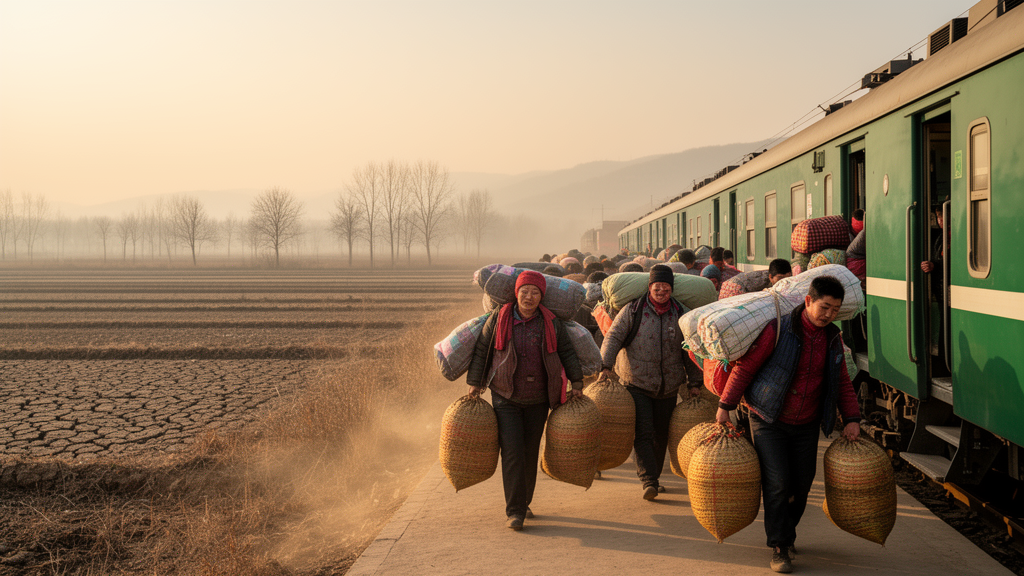
China operates the largest internal migration system on Earth, and a new systematic review argues that the movement of hundreds of millions of people within the country is shaped not only by wages but by a recurring annual cycle of environmental health stress. The review, published in the International Journal of Public Health by Wanqing Zheng of Sun Yat-sen University and Sara Akram of The University of Faisalabad, synthesizes 116 peer-reviewed studies and institutional reports published between 2001 and 2025. Its central finding is that environmental conditions exert a multidimensional, seasonally organized influence on internal migration, with outmigration from rural areas associated with air pollution, heat stress, water contamination, and agricultural instability during the winter, and with water and soil contamination added to that list in the summer. The effects were strongest among the rural poor and older individuals, while at urban destinations migrants encountered a further layer of occupational hazards, including silica dust and chemical exposures.
The scale of the phenomenon is difficult to overstate. By 2022, China’s floating population, defined as internal migrants living outside their place of household registration, had grown to more than 380 million people, roughly 27 percent of the country’s inhabitants, an increase of more than thirtyfold since 1980. Many of these migrants move on an annual or cyclical basis, leaving rural homes for urban destinations and returning again, typically in response to a particular seasonal, climatic, or construction-related event. The review distinguishes this seasonal or cyclical subset from the broader floating population and from environmental migrants, whose moves are significantly influenced by environmental exposure and its impact on livelihoods. The well-documented annual movement of older people to Hainan for climate and health reasons is cited as a representative example of environmentally initiated seasonal migration at the national scale.
To assemble the evidence, the authors searched PubMed, Web of Science, the China National Knowledge Infrastructure, Scopus, and Google Scholar, screening approximately 1,200 records and supplementing them with manual searches of reference lists. Studies were eligible only if the population lived in mainland China, at least one environmental exposure was quantified, such as PM2.5 exceeding World Health Organization guidelines or temperatures above 35 degrees Celsius, and at least one health or migration-related outcome was reported. The synthesis was guided by the PRISMA 2020 reporting guidelines, and quality was appraised with a modified Newcastle-Ottawa Scale and a JBI checklist, with higher-quality studies given more weight. The authors structured their analysis around five environmental health domains: air quality, thermal stress, water and soil contamination, agricultural instability, and occupational hazards at migration destinations.
Air quality emerges as the most well-documented stressor. In 2017, approximately 1.24 million deaths in China were attributable to outdoor particulate pollution, or 29 percent of global deaths from that cause. Winter coal heating drives PM2.5 concentrations in cities such as Beijing, Shijiazhuang, and Harbin to levels as high as 300 micrograms per cubic meter, nearly twenty times the WHO 2021 24-hour guideline of 15 micrograms per cubic meter. Long-term exposure to fine particulate matter is linked to increased risks of cardiovascular disease, stroke, chronic obstructive pulmonary disease, lung cancer, and lower respiratory infections. Across 272 Chinese cities, an increase of 10 micrograms per cubic meter in PM2.5 was associated with a 0.22 percent rise in daily all-cause mortality, while children in high-pollution areas show reduced lung function and increased asthma rates. Indoor air pollution from solid fuels, used by an estimated 175 million rural households for cooking and heating, was associated with roughly 900,000 deaths in 2013, and the estimated life expectancy difference between the north and south of the country is approximately 1.8 years.
Crucially, the review finds that since 2015 there has been growing direct evidence linking air pollution to migration decisions themselves. An analysis of the Chinese General Social Survey revealed that higher PM2.5 exposure in one’s place of origin was associated with increased migration, independent of income, and was highest during the winter heating season. Qualitative fieldwork in the industrial regions of Hebei Province found that mothers commonly moved temporarily with their children in winter because of respiratory health problems. A large body of empirical literature shows that air pollution is negatively correlated with settlement intention and destination choice in national surveys, city-pair studies, and push-pull frameworks. The authors emphasize that pollution-driven migration differs from labor-market-driven migration in that it is triggered by air quality episodes rather than by wages, and that it is skewed toward caregivers and children.
Thermal stress forms the second pillar of the seasonal calendar. Since 1960, average temperatures in China have increased by 0.22 to 0.33 degrees Celsius per decade, roughly twice the global average rate, and heat wave frequency has risen by approximately 60 percent over the last 20 years. Climate projections indicate that by 2050 there will be 10 to 20 days per year with physiologically hazardous outdoor conditions in major Chinese cities. Extreme temperatures cause heat exhaustion, heat stroke, dehydration, and the exacerbation of cardiovascular, renal, and respiratory disease, with outdoor workers such as farmers and construction laborers most at risk. Rice and wheat farmers in the Yangtze River Delta and the North China Plain work more than six hours outdoors each day during peak heat, a pattern associated with an increased prevalence of chronic kidney disease among agricultural workers. Heat also acts indirectly through crop yields: wheat yield loss is estimated at 3 to 8 percent for every 1 degree Celsius above the optimal temperature during flowering and grain filling, pushing farming households toward outmigration in the interval between harvesting one crop and planting the next.
Water and soil contamination add a slower-moving but persistent pressure. Nitrate is the most common water contaminant, affecting more than 60 percent of monitored wells in northern China, while arsenic in drinking water affects an estimated 19.6 million people, primarily in Inner Mongolia, Shanxi, and Xinjiang. The 2014 nationwide soil survey found that 16.1 percent of agricultural soils fell outside acceptable quality standards, with cadmium-contaminated rice in Hunan Province a prominent case; cadmium exposure can cause kidney damage and poor bone density and is associated with an increased risk of certain cancers. Children living near e-waste recycling centers in Guangdong and Zhejiang show elevated blood lead levels, in Guiyu averaging nearly three times the international guideline of 10 micrograms per deciliter. Water scarcity compounds these problems, with more than 150 million people in the Yellow River basin facing increasing scarcity from overexploitation, reduced glacial melt, and increased evaporation. Household water insecurity has been linked to poor sanitation, diarrhea, decreased food quality, and psychosocial stress, and water shortages before the spring monsoon help determine the timing of migration from arid areas.
Agricultural instability and destination hazards complete the picture. Farming systems have grown more fragile under warming and increasing flood and drought frequency, and the review reports that within-season rainfall variability appears more strongly related to migration decisions than long-term rainfall averages: an extreme rainfall event in a given agricultural season is correlated with an increased likelihood of outmigration in the subsequent season. Migration rates are statistically higher in areas of northern and northwestern China affected by desertification, including the Loess Plateau, Inner Mongolia, and the Tarim Basin. Yet migration does not remove environmental health risk; it relocates it. Construction activity in spring and summer is estimated to expose 50 million seasonal migrant workers to silica dust, noise-induced hearing loss, and heat exposure, while manufacturing workers in the Pearl River and Yangtze River deltas face organic solvents, heavy metals, noise, and repetitive strain. At Dongguan e-waste factories, peripheral nerve damage has been linked to solvent exposure, and more than 40 percent of workers with more than three years in the industry exhibit noise-induced hearing loss. In Guangdong, fewer than 30 percent of construction migrants could identify silica dust hazards, and fewer than half used the respirators provided.
The review also maps who is most exposed and most able to move. Rural women suffer more from indoor air pollution because they cook and perform housework, yet face higher barriers to migration because of childcare responsibilities, while male migrants engage in agricultural and pesticide-related tasks in the countryside. Children and older adults are more vulnerable to pollutant effects but less likely to migrate, and higher-income households have more resources to move or to protect themselves locally, for example with water filters, whereas lower-income households often lack both options, a dynamic the authors describe as a poverty-environment trap. These factors interlock: socioeconomic status influences exposure and mobility, gender shapes exposure through household roles, and age influences mobility directly. The five domains also interact, with winter air pollution coinciding with cold exposure in northern households, drought reducing both agricultural production and water supply, and migrants carrying health burdens from heavy metals or pesticides at origin into silica and chemical exposures at destination.
The resulting annual rhythm is strikingly predictable: outmigration in autumn after the harvest, as air pollution rises and demand for farm labor falls, and return migration in spring when land is being prepared. The authors argue that environmental health governance for migrants remains underdeveloped despite measurable policy gains, including the 2014 Air Pollution Action Plan, partial hukou reform, and the 2015 extension of pollution control to soil and water, and that the Healthy China 2030 initiative lacks a focus on environmental migrants. They propose coordinated air quality alerts during the November-to-March heating season in cities with PM2.5 above 100 micrograms per cubic meter, subsidized respiratory screenings, mandatory rest breaks and heat protection rules for outdoor workers, climate-resilient agricultural support and crop insurance in high-outmigration counties, and accelerated groundwater remediation with targeted blood lead screening in provinces such as Hunan and Guangdong. The review acknowledges limitations: most included studies are cross-sectional and area-level, cannot isolate environmental from economic factors at the individual level, and cannot establish causality, and a formal standardized risk-of-bias assessment was not possible given the heterogeneity of the 116 sources. Even so, the authors conclude that observed migration patterns arise from many interacting factors determined by socioeconomic vulnerability, and that protecting this population requires connecting environmental protection, migrant health services, and social equity.
Subject of Research: Environmental health determinants of seasonal internal migration in China
Article Title: Environmental health determinants among seasonal migrants in China: a multi-dimensional analysis
Article References: Zheng, W., & Akram, S. (2026). Environmental health determinants among seasonal migrants in China: a multi-dimensional analysis. International Journal of Public Health, 71, Article 1610170. https://doi.org/10.3389/ijph.2026.1610170
Image Credits: AI Generated
DOI: 10.3389/ijph.2026.1610170
Keywords: China, seasonal migration, environmental health, air pollution, PM2.5, heat stress, water contamination, soil pollution, agricultural instability, occupational hazards, floating population, systematic review
Cite Scienmag News
Ophelia Keating. (October 23, 2026). Seasonal Migration in China Follows a Calendar of Environmental Stress. Scienmag. https://scienmag.com/seasonal-migration-in-china-follows-a-calendar-of-environmental-stress/
Ophelia Keating. "Seasonal Migration in China Follows a Calendar of Environmental Stress." Scienmag, 23 October 2026, https://scienmag.com/seasonal-migration-in-china-follows-a-calendar-of-environmental-stress/. Accessed 23 October 2026.
Ophelia Keating. "Seasonal Migration in China Follows a Calendar of Environmental Stress." Scienmag. October 23, 2026. https://scienmag.com/seasonal-migration-in-china-follows-a-calendar-of-environmental-stress/


