


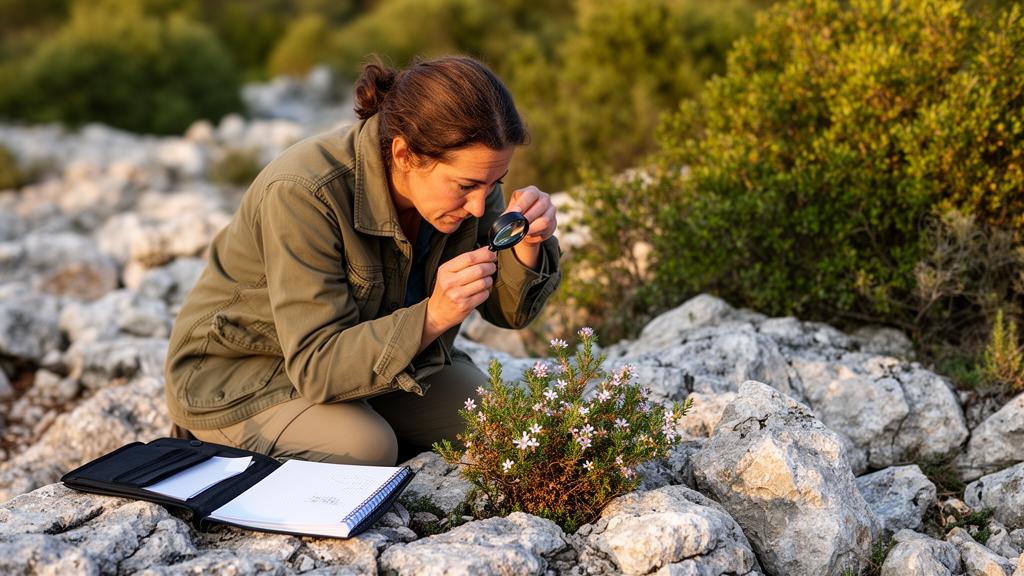
A plant that botanists have shuffled between genera and species for more than two centuries has finally received a stable identity. In a new taxonomic study, researchers show that the name long applied to an endemic umbellifer of the Iberian Peninsula actually belongs to a different species altogether, and they have formally renamed the plant as Lophosciadium rupestre. The work resolves a confusion that traces back to specimens gathered in Portugal between 1798 and 1800 by two of the most prolific describers of Iberian plants, Johann Centurius von Hoffmannsegg and Johann Heinrich Friedrich Link.
The problem centred on what the authors call, provisionally, Lophosciadium X: an umbellifer endemic to northwestern and central-western Iberia, belonging to the recently reinstated genus Lophosciadium, which includes four species in Spain and Portugal. Since the publication of the reference flora Flora iberica in 2003, this plant has been widely accepted under the name Ferulago capillaris, derived from the basionym Ferula capillaris Link ex Spreng. That name, however, turned out to be an unacknowledged junior synonym of Prangos trifida, a conclusion the team reached by examining the holotype, a specimen collected by Link and preserved in Sprengel’s herbarium at the Natural History Museum in Vienna.
The story begins with Hoffmannsegg and Link, who travelled in Portugal at the turn of the nineteenth century and jointly published the Flore Portugaise between 1809 and 1840. They rank among the authors who described the largest number of vascular plant taxa endemic to the Iberian Peninsula. Yet some of their Portuguese specimens, held in the collections of Carl Ludwig Willdenow in Berlin and Christian Konrad Sprengel in Vienna, were never critically revised in monographic works focused on the region, leaving a trail of misidentifications that persisted for generations.
Over the years, Lophosciadium X was misidentified under a remarkable series of names. It was recorded as Ferula nodiflora by Brotero in 1804, as Ferula ferulago by Henriques in 1885 and Sampaio in 1946, as Ferulago granatensis by multiple authors from Willkomm and Lange in 1880 onward, as Ferulago galbanifera, as Ferula sulcata, as Ferulago lutea by authors including Tutin in 1968, and even as Ferulago brachyloba by Aguiar in 2001. In 1971, Franco recognised the plant as a distinct Iberian endemic and invalidly published the combination Ferulago capillifolia, based on a nomen nudum, a name cited by Link in 1806 without any validating description.
The decisive evidence came from the Vienna holotype of Ferula capillaris, published posthumously by Sprengel in 1818 on the basis of a single specimen sent by Link. The specimen, consisting of leaf and inflorescence fragments, was collected near Tavira in the Algarve, most likely in April or May of 1799, as inferred from the Flore Portugaise and from reconstructions of the two botanists’ itinerary in Portugal. Although the type specimen and the accompanying colour plate from the Flore Portugaise lack fruits, which would be diagnostic, other characters proved decisive.
Those characters point firmly away from Lophosciadium X and toward Prangos trifida. The very slender leaf segments, the presence of leaves on the lateral branches, and the filiform bracts and bracteoles of the type specimen do not match the current concept of Ferulago capillaris, but they do agree with Prangos trifida. Phenology reinforces the identification: Lophosciadium X flowers mainly in June and July, whereas Prangos trifida blooms mostly between March and May, matching the flowering period described in the Flore Portugaise. Tavira itself is a classical locality for Prangos trifida in the Algarve, where the species was collected by Eugène Bourgeau in 1853 and Carlos Pau in 1903, and where it has recently been documented again by users of iNaturalist and the Flora-On platform.
With Ferula capillaris removed as a candidate name, the team turned to the oldest available names for Lophosciadium X: Peucedanum lusitanicum and Peucedanum rupestre, both published in 1820 in Roemer and Schultes’ Systema Vegetabilium and credited to Hoffmannsegg. Both names were validated by unpublished diagnoses penned by Willdenow, whose herbarium information, including Hoffmannsegg’s Portuguese collections annotated by Schlechtendal, had been entrusted to Roemer and passed on to Schultes. Because Willdenow did not author this part of the publication, he cannot be credited as author; under the nomenclatural code, the correct attribution is Hoffmanns. ex Schult.
Fruiting specimens unambiguously labelled as Peucedanum rupestre and Peucedanum lusitanicum, collected by Hoffmannsegg in Portugal and annotated by Schlechtendal, survive in Willdenow’s herbarium in Berlin. Since both names were published without a holotype, the authors designated lectotypes for each. Neither specimen carries a precise collection site, although Ferula rupestris, the later recombination of Peucedanum rupestre published in the Flore Portugaise, cites localities in the Serra da Estrela and near Bragança. The accompanying plate cited for that account was never published, which may explain why Sampaio considered Peucedanum rupestre a lost species that had never been detected again since the time of Hoffmannsegg and Link. The authors note that only a phylogeographic or isotopic analysis of the two type specimens might one day establish their exact geographic provenance.
In choosing between the two names of equal priority, the team selected Peucedanum rupestre as the basis for the new combination Lophosciadium rupestre. The species epithet rupestre was reused by Hoffmannsegg and Link in the Flore Portugaise in the current taxonomic sense, whereas Peucedanum lusitanicum is absent from that work. There is also circumstantial evidence that Peucedanum rupestre originated in northern Portugal, matching the known range of this Iberian endemic, while no comparable provenance information exists for Peucedanum lusitanicum. The new combination formally replaces Ferulago capillaris as applied in Flora iberica and subsequent literature.
The study also clarifies how Lophosciadium rupestre differs from its closest relative, Lophosciadium luteum of northwestern Africa, with which it was once considered conspecific. The Iberian species bears more rays in the main primary umbel, typically 15 and exceptionally up to 20 to 45, versus 10 to 15 and exceptionally up to 20, and it has wider commissural wings, measuring 1.3 to 2 millimetres compared with 0.8 to 1.2 millimetres. These morphological differences are supported by molecular phylogenetics: Lophosciadium rupestre is nested within the Iberian clade of the genus, which is sister to Lophosciadium luteum. The resolution of this nearly 200-year-old conundrum shows how herbarium specimens, historical plates, phenology and DNA-based trees can together give a long-confused endemic its rightful place in the flora of the Iberian Peninsula.
Subject of Research: Nomenclatural revision of the Iberian endemic umbellifer formerly known as Ferulago capillaris, now renamed Lophosciadium rupestre
Article Title: The identity of Ferula capillaris and a new combination in Iberian Lophosciadium ( Apiaceae , Apioideae )
Article References: Farminhao, J., Covelo, F., & Lyskov, D. (2026). The identity of Ferula capillaris and a new combination in Iberian Lophosciadium (Apiaceae, Apioideae). Annals of the Natural History Museum Vienna, 127, 187-196. https://doi.org/10.3897/anhmw.189319
Image Credits: AI Generated
DOI: 10.3897/anhmw.189319
Keywords: Lophosciadium, Apiaceae, nomenclature, lectotypification, Iberian Peninsula, Portugal, Prangos trifida, Ferulago capillaris, Hoffmannsegg, Link, plant taxonomy, endemic flora
Cite Scienmag News
Ophelia Keating. (October 23, 2026). Botanists untangle a 200-year-old naming mystery of a rare Iberian plant. Scienmag. https://scienmag.com/botanists-untangle-a-200-year-old-naming-mystery-of-a-rare-iberian-plant/
Ophelia Keating. "Botanists untangle a 200-year-old naming mystery of a rare Iberian plant." Scienmag, 23 October 2026, https://scienmag.com/botanists-untangle-a-200-year-old-naming-mystery-of-a-rare-iberian-plant/. Accessed 23 October 2026.
Ophelia Keating. "Botanists untangle a 200-year-old naming mystery of a rare Iberian plant." Scienmag. October 23, 2026. https://scienmag.com/botanists-untangle-a-200-year-old-naming-mystery-of-a-rare-iberian-plant/


