


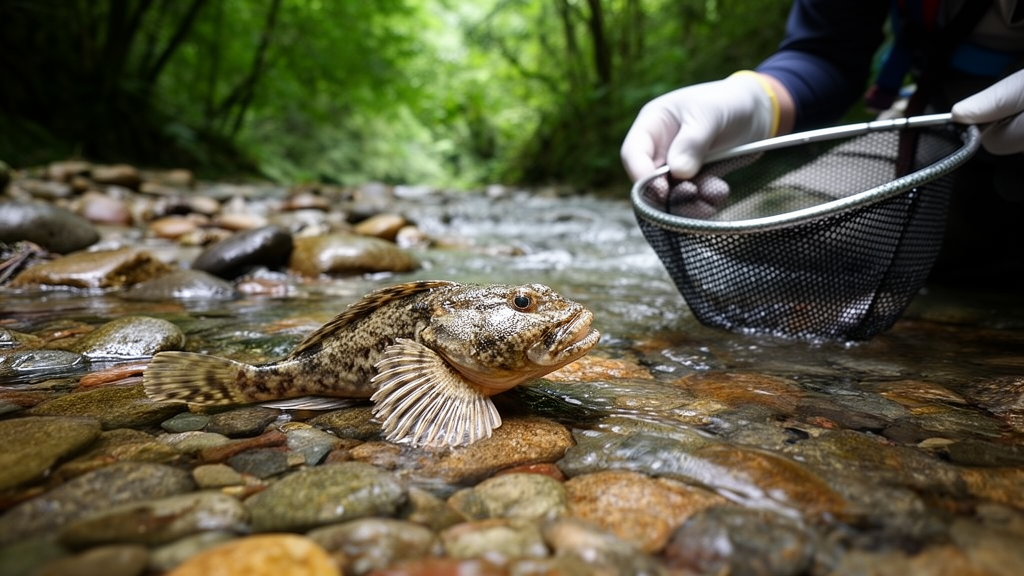
Three small, spiny fish collected off northeastern Taiwan more than two decades ago have turned out to be a species no one expected to find so far south. Researchers re-examining specimens stored at the Biodiversity Research Museum of Academia Sinica identified them as Marukawa’s sculpin, Marukawichthys ambulator, a fish previously known only from Japanese waters. The find, reported in a detailed taxonomic study, pushes the documented range of this little-known species roughly 1,080 kilometers southward, from the southernmost previous record off southwestern Satsuma Peninsula in Kagoshima Prefecture, Japan, to the waters off Yilan County in northeastern Taiwan.
The specimens themselves are not new discoveries in the field sense. They were collected on 7 July 2004 off Nan-fang-ao fishing port in Yilan, at coordinates of approximately 24 degrees 34 minutes 55 seconds North and 121 degrees 52 minutes 01 seconds East. Two cataloged lots exist in the museum: one holding two specimens measuring 113.0 and 124.4 millimeters in standard length, and a second holding a single specimen of 120.4 millimeters. Their significance became clear during a recent visit to the museum collections, when closer examination revealed diagnostic features matching those of M. ambulator rather than any fish recorded from Taiwanese waters before.
Marukawa’s sculpin belongs to the family Rhamphocottidae, a small group of marine fishes that currently includes just three genera and five recognized species. The genus Marukawichthys contains only two members: M. ambulator, described in 1931 from Toyama Bay in Japan, and M. pacificus, described in 1983 from the Emperor Seamount Chain in the central North Pacific. Diagnosing the genus relies on a handful of hard anatomical characters: the pelvic fins carry one spine and four soft rays, the spiny scales on the body form six rows, there are five preopercular spines, and a single spine sits on the posterodorsal face of the cleithrum, a bone of the pectoral girdle.
Most rhamphocottid species live in the cold temperate waters of the North Pacific Ocean. Until now, only one member of the entire family, Ereunias grallator, had been recorded from southern Taiwan, and even that record rested on a single specimen. The confirmation of M. ambulator from Taiwanese waters therefore represents a major extension not only for the species but for the known footprint of the family in the western Pacific.
Identifying the fish required a full anatomical work-up, following the standard counting and measuring protocols of Hubbs and Lagler with modifications by Yabe, who revised the genus in the 1980s. The researchers counted fin rays and scale rows, measured body proportions with digital calipers to the nearest 0.1 millimeter, and expressed the results as ratios of standard length and head length. Where possible, paired structures were recorded separately for the left and right sides of each fish, and suborbital depth was measured at the narrowest gap between the lower margin of the eye and the ventral margin of the lachrymal bone, the recess where the upper jaw fits.
The counts place the Taiwanese specimens squarely within M. ambulator. The dorsal fins hold nine or ten spines followed by thirteen or fourteen soft rays, with the anterior three or four soft rays unbranched. The pectoral fins carry fifteen rays on each side, of which the lower four are entirely free from the fin membrane, a striking and characteristic trait; the uppermost of these free rays is the longest and the rays become progressively shorter toward the ventral side. The pelvic fins show the diagnostic one spine and four soft rays, the anal fin carries eleven or twelve rays, and the gill rakers on the outer face of the first gill arch total twelve to thirteen, all short. Six branchiostegal rays support the gill membrane.
External anatomy reinforces the identification. The body is slightly compressed and elongated, with a large eye, a blunt snout that protrudes distinctly before the upper jaw, and an extremely narrow interorbital space only 14.7 times contained within head length in width. The head is armored with spines on the nasal, frontal, parietal, lachrymal, preopercle, and cleithrum bones, and the gular region, the underside of the head, is covered with small prickle-like scales. Six rows of enlarged scales run along each flank, each scale bearing a distinct recurved central spine. Even the dorsal surface of the eyes carries prickles. In preservation, the body is brownish with pale undersides and four dark blotches along the flank, the black dorsal fin is crossed by pale bands, and the pectoral fin shows four dark vertical bars.
The taxonomic comparison with Japanese material revealed small but consistent differences. The Taiwanese fish carry slightly more total gill rakers, twelve to thirteen versus ten to twelve in Japanese specimens, and fewer scales in the supralateral row, twenty-six to twenty-nine versus thirty-one to thirty-four, and in the infralateral row, thirteen to fifteen versus a fixed seventeen. Their heads are proportionally narrower, at 38.2 to 45.2 percent of head length versus 47.6 to 62.5 percent, and the maxillary bone is deeper relative to head length. The study attributes these differences most likely to the existence of geographically distinct populations. The authors also note a caution: because smaller scales occur at both ends of each scale row and can be hard to distinguish from ordinary body scales, some of the scale-count differences may partly reflect counting difficulty rather than true population divergence.
Despite these minor discrepancies, the core diagnostic features match: gular scales, a total of twelve to thirteen gill rakers, the extremely narrow interorbital, upper-jaw length of 2.8 to 2.9 times within head length, and the light brown body coloration of preserved specimens. On that basis, the three fish are identified as M. ambulator, and the record stands as the southernmost occurrence of the species anywhere in the world, verified by preserved voucher specimens deposited under catalog numbers ASIZP 64602 and ASIZP 64582 in Taipei.
For biogeographers, the extension is notable because M. ambulator has historically been documented at a series of Japanese localities, from its type area in Toyama Bay through Sagami Bay, Nagasaki, the Uji Islands in the East China Sea, the southwestern Satsuma Peninsula, and the Koshiki Islands off Kagoshima Prefecture. The species’ holotype, caught at depths of 70 to 300 meters off Toyama Bay, is presumed lost, making well-preserved comparative material increasingly valuable. The Taiwanese record underlines how museum collections, gathered years ago and stored patiently on shelves, can hold answers about ocean life that fieldwork alone has not yet reached. As with any single-site finding based on three specimens, the mechanism behind the range pattern, whether a resident southern population, larval transport by currents, or simply a historical gap in sampling, remains unresolved by the evidence at hand.
Subject of Research: Southward range extension of Marukawa's sculpin, Marukawichthys ambulator, based on museum specimens from northeastern Taiwan
Article Title: Southward range extension of the Marukawa’s sculpin, Marukawichthys ambulator ( Actinopterygii , Perciformes , Rhamphocottidae ), from Taiwan
Article References: Su, Y., Ho, H.-C., & Lee, Y.-C. (2026). Southward range extension of the Marukawa’s sculpin, Marukawichthys ambulator (Actinopterygii, Perciformes, Rhamphocottidae), from Taiwan. Acta Ichthyologica et Piscatoria, 56, 461-466. https://doi.org/10.3897/aiep.56.208933
Image Credits: AI Generated
Keywords: Marukawichthys ambulator, Rhamphocottidae, sculpin, Taiwan, range extension, taxonomy, morphology, meristics, museum specimens, North Pacific, biogeography, Yilan
Cite Scienmag News
Margaret Porter. (October 23, 2026). Sculpin Found 1,080 Kilometers South of Its Known Range in Taiwan. Scienmag. https://scienmag.com/sculpin-found-1080-kilometers-south-of-its-known-range-in-taiwan/
Margaret Porter. "Sculpin Found 1,080 Kilometers South of Its Known Range in Taiwan." Scienmag, 23 October 2026, https://scienmag.com/sculpin-found-1080-kilometers-south-of-its-known-range-in-taiwan/. Accessed 23 October 2026.
Margaret Porter. "Sculpin Found 1,080 Kilometers South of Its Known Range in Taiwan." Scienmag. October 23, 2026. https://scienmag.com/sculpin-found-1080-kilometers-south-of-its-known-range-in-taiwan/


