


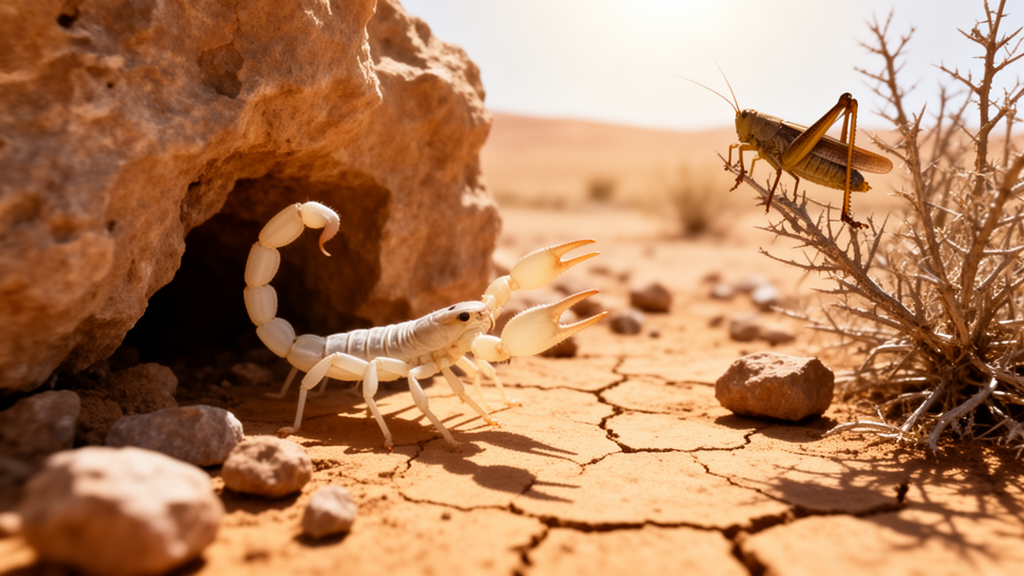
During a desert locust outbreak in Mauritania, researchers witnessed something they had never seen in more than fifteen years of Saharan fieldwork: a fattail scorpion, Androctonus amoreuxi, emerging from its burrow in the middle of a scorching afternoon to capture a marching desert locust nymph. The observation, reported as a natural history study, documents a typically strictly nocturnal predator hunting during the hottest part of the day, when air temperature in the shade stood at 33.5°C and the surface of sun-exposed sand reached 48.1°C. The episode was caught on video, and follow-up laboratory tests revealed that the scorpion could immobilize one locust nymph after another in rapid succession under bright daytime conditions, pointing to a striking flexibility in the foraging behavior of one of the desert’s most heat-averse hunters.
Desert locust outbreaks rank among the most spectacular biological phenomena in terrestrial ecosystems. During outbreaks, gregarious nymphs of the desert locust Schistocerca gregaria form dense marching bands in which local densities can exceed 5,000 individuals per 100 square meters. Such temporary superabundance of prey is known to attract diurnal generalist predators, which can shift their diets toward the suddenly abundant locusts. Far less is known, however, about how nocturnal arthropod predators respond to these resource pulses, or whether they show functional responses to them. Remarkably, despite the sheer quantity of prey available during an outbreak, few predators are known to collect and store locusts for later consumption, making the new observations all the more intriguing.
Desert scorpions are predominantly nocturnal predators that spend daylight hours inside burrows or other sheltered microhabitats, a strategy that allows them to avoid the lethal temperatures and desiccating conditions of arid environments. The fattail scorpion A. amoreuxi, a widespread Saharan species, normally emerges after sunset to capture arthropod prey. The researchers behind the new report state that across more than fifteen years of fieldwork in the Sahara Desert, they regularly observed this species foraging at night but never encountered it on the surface during daytime, with the sole exception of periods when desert locust outbreaks brought swarms of nymphs into the landscape.
The field observation took place in November 2025 near Akjoujt in Mauritania, West Africa, at a sandy desert site with sparse vegetation dominated by the perennial grass Panicum turgidum, which grows between 0.5 and 1.3 meters tall. At the time, gregarious last-instar desert locust nymphs were actively marching in a band through the study site. At approximately 15:00, the researchers observed a scorpion emerge from its burrow at the base of vegetation and seize a nymph. As the observer approached, a gregarious locust nymph jumped in an attempt to escape and was captured by the scorpion, which grasped the prey with its pedipalps and repeatedly stung it before attempting to carry the immobilized nymph back to its burrow.
The return journey exposed the strict thermal limits that still govern this unusual daytime hunt. When the scorpion briefly crossed sun-exposed ground, it rapidly dropped its prey and retreated. It then moved around the area, repeatedly contacting the dropped nymph and attempting to retrieve it, but when the nymph became entangled in vegetation and could not be freed, the scorpion abandoned the prey and entered its burrow. The envenomated locust lay on its side, showing leg movements but unable to walk. The researchers note that rather than indicating a relaxation of thermal constraints, this behavior suggests that daytime foraging remains strongly restricted to thermally buffered microhabitats such as the shade beneath vegetation, where the scorpion’s burrow was located.
Excavation of the burrow after the predation event added a second layer of discovery. When the researchers carefully dug out the burrow to capture the scorpion, they found a paralyzed but still-living locust nymph inside, approximately 50 centimeters from the burrow entrance. This finding hints at possible prey storage, a behavior that has received little attention in scorpions. The team had previously observed, in November 2022, an A. amoreuxi capturing and envenomating a fifth-instar desert locust nymph at dusk and dragging it into its burrow, but the 2025 encounter was the first time the species was documented hunting in full daylight during an outbreak.
To probe whether the daylight capture reflected a genuine capacity for daytime predation rather than a one-off anomaly, the researchers conducted a laboratory assay at the Centre National de Lutte Antiacridienne in Mauritania. After capture, the scorpion was kept individually for four days under semi-field conditions in a sand-filled 40-liter container in the shade, without food. On the evening before the test, the container was covered to provide a dark, sheltered environment. At approximately 14:00 the following day, the lid was removed and the scorpion was exposed to bright light exceeding 20,000 lux, mimicking daytime conditions. Live gregarious last-instar locust nymphs were then introduced one at a time over a two-hour period, with roughly five minutes between successive presentations.
The results were unambiguous. Under bright light, the scorpion readily attacked and stung all eight nymphs presented to it in succession. Every introduced nymph was rapidly immobilized following envenomation and initially remained alive. By the following day, all eight nymphs still appeared alive, and three showed slight leg movements. On day two, all individuals were completely immobile with no visible signs of movement, yet three retained a fresh and intact appearance even after five days. A second scorpion, captured at night during the field survey and tested with the same procedure, attacked and envenomated three locust nymphs, all of which became immobilized. Taken together, these trials show that A. amoreuxi can envenomate multiple locust nymphs over a short period, and that its venom keeps prey immobilized for well over 24 hours, with some individuals appearing fresh for several days.
The behavioral ecology behind the encounter may hinge on how locusts themselves cope with the heat. Previous work has recorded gregarious desert locust nymphs marching at air temperatures of 34.8°C and ground surface temperatures of 54.1°C, but under extremely hot conditions the nymphs frequently seek shade beneath vegetation or climb onto plants to reduce thermal stress. These thermoregulatory movements may increase the frequency with which marching nymphs pass close to scorpion burrows located under vegetation, creating windows of opportunity for scorpions to encounter abundant prey during otherwise restrictive midday conditions. In other words, the locusts’ own strategy for surviving the heat may deliver them directly to an ambush predator that would otherwise be sheltering underground.
The findings also carry a possible applied dimension. Scorpion venoms contain diverse insecticidal peptides and have attracted considerable interest as potential sources of bioinsecticides. The new observations demonstrate that A. amoreuxi venom can rapidly immobilize desert locust nymphs, providing an ecological basis for future studies investigating scorpion venom as a potential source of bioinsecticidal compounds for locust management, although such applications remain speculative at this stage. The authors caution that the field evidence rests on limited observations, and they emphasize that rare interactions like this one are unlikely to be documented by short-term ecological studies because they depend on the rare coincidence of exceptionally high prey abundance, suitable microhabitats, and an observer present at precisely the right moment. Long-term field observations, they argue, remain indispensable for documenting infrequent ecological events, and future laboratory experiments manipulating prey density, light intensity, and microhabitat temperature could test whether these factors drive daytime emergence in A. amoreuxi, deepening understanding of desert food webs and the adaptive predatory flexibility that resource pulses can reveal.
Subject of Research: Daytime predation on marching desert locust nymphs by the normally nocturnal scorpion Androctonus amoreuxi during an outbreak in Mauritania
Article Title: Daytime predation by a nocturnal scorpion on marching desert locust nymphs during an outbreak
Article References: Maeno, K. O., Benahi, A. S., & Jaavar, M. E. H. (2026). Daytime predation by a nocturnal scorpion on marching desert locust nymphs during an outbreak. Journal of Orthoptera Research, 35(2), 343-346. https://doi.org/10.3897/jor.35.209091
Image Credits: AI Generated
Keywords: desert locust, scorpion, Androctonus amoreuxi, Schistocerca gregaria, predation, Mauritania, Sahara, venom, prey storage, natural history, outbreak, thermoregulation
Cite Scienmag News
Gavin Prescott. (October 23, 2026). Nocturnal Scorpion Breaks Its Own Rules to Hunt Locusts at Midday During Outbreak. Scienmag. https://scienmag.com/nocturnal-scorpion-breaks-its-own-rules-to-hunt-locusts-at-midday-during-outbreak/
Gavin Prescott. "Nocturnal Scorpion Breaks Its Own Rules to Hunt Locusts at Midday During Outbreak." Scienmag, 23 October 2026, https://scienmag.com/nocturnal-scorpion-breaks-its-own-rules-to-hunt-locusts-at-midday-during-outbreak/. Accessed 23 October 2026.
Gavin Prescott. "Nocturnal Scorpion Breaks Its Own Rules to Hunt Locusts at Midday During Outbreak." Scienmag. October 23, 2026. https://scienmag.com/nocturnal-scorpion-breaks-its-own-rules-to-hunt-locusts-at-midday-during-outbreak/


