


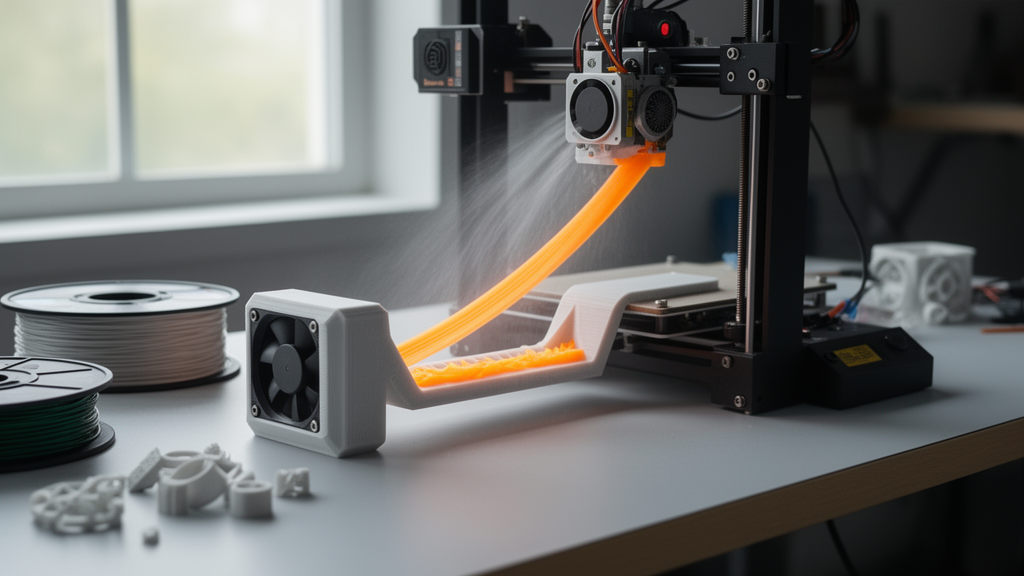
A team of researchers has unveiled a fully open-source, 3D-printed conveyor belt that cools freshly extruded polymer filament using nothing but forced air, cutting filament temperatures by roughly half and eliminating the need for the water baths that have long dominated laboratory-scale extrusion lines. The device, called the Air-Cooling Conveyor (ACC), was developed at IMDEA Materials Institute and described in a hardware design paper that includes every file, part, wiring diagram and assembly step needed to reproduce it. Built for around 230 euros, or roughly 265 US dollars, the system offers a dramatic cost contrast with the nearest commercial analog, a forced-air filament-cooling unit that retails at approximately 1,195 US dollars and ships as a closed, non-customizable kit.
The ACC arrives at a time when do-it-yourself instrument building is reshaping laboratory practice. Conveyor belts themselves have been part of material handling for roughly two centuries, evolving from manually operated wood-and-leather designs through the steam-powered systems of the early nineteenth century to the modern belts of the late 1800s, whose basic operating principles have barely changed even as efficiency and adaptability have improved enormously. What has changed recently is the accessibility of the tools used to build them. Desktop 3D printing allows rapid, low-cost fabrication and iteration of complex parts, and an active community of creators shares designs and knowledge freely. Combined with microcontrollers and single-board computers such as Arduino and Raspberry Pi, these technologies have made custom laboratory equipment attainable even for researchers without prior electronics experience.
The specific problem the ACC addresses concerns moisture. In pellet manufacturing, an initial mixture of polymer pellets is melted and extruded into a uniform, continuous filament, which is typically cooled in a water tank before being cut back into pellets or sent to another downstream operation such as collection, spooling or dimensional inspection. But certain polymers, notably polylactic acid (PLA), as well as various additives, are highly sensitive to moisture. Water contact can trigger hydrolytic degradation during subsequent thermal processing and degrade the final properties of the filament. Water baths offer high cooling capacity and fast solidification, but they introduce direct liquid contact, require water management and drying, and may be unsuitable for moisture-sensitive formulations. Commercial air-cooling devices avoid water, yet they are typically expensive, closed-source and difficult to customize.
The ACC sits between the extruder and the pelletizer, carrying the hot filament along a belt while a series of strategically distributed arches mounted above the track emit pressurized air, cooling the material by forced convection without any water contact. The architecture is deliberately modular: the minimum configuration measures 48.3 centimeters in length, while the validated build reached 82 centimeters using four extension modules, each adding 11.6 centimeters. The usable belt width is 9.5 centimeters. Because the total length can be extended without redesigning the whole system, laboratories can adapt the distance between the extruder and downstream equipment to fit different layouts. At the core of the device is a mechatronic control unit based on an Arduino UNO microcontroller, which regulates conveyor speed through a potentiometer interface, driving a DC motor optimized for high torque at low speed.
A crucial design choice addresses a subtle but persistent nuisance in filament handling: hot polymer sticking to the belt. The team selected a belt with an external layer of polytetrafluoroethylene (PTFE), whose extremely low adhesion reduces polymer sticking and simplifies cleaning. Residue accumulation is minimized by running the conveyor only after extrusion has stabilized and by wiping the belt periodically with a non-abrasive cloth once the system has cooled. If a particular formulation proves especially adhesive, the belt can be replaced independently of the printed structure. The design files themselves were produced in FreeCAD, a parametric solid-modeling environment convenient for assemblies and dimensional constraints, while the toothed pulleys were generated using OpenSCAD and an existing parametric pulley library that allows pitch, tooth number and shaft diameter to be modified in script.
The bill of materials is refreshingly ordinary. Structural parts were printed in PLA on a desktop Prusa CORE One+ fused filament fabrication printer, chosen for its balance of stiffness, low cost and dimensional stability. The control system combines an Arduino UNO, a 12-volt DC motor running at 50 revolutions per minute, and an L298N motor driver, all components widely used in open hardware projects for their reliability and availability. Standard M5 and M6 screws, nuts and square nuts standardize the mechanical connections across subassemblies. The drive transmission uses two MXL timing belts, and filament transport relies on a custom PTFE-coated conveyor belt 184.5 centimeters long. Excluding fasteners and the laboratory compressed-air infrastructure, the total cost comes to approximately 230 euros, with the custom belt at 75 euros representing the single largest expense.
The validation experiments provide the quantitative heart of the report. The ACC was positioned immediately downstream of a co-rotating twin-screw extruder, with molten filament deposited onto the belt entry point and carried beneath the ventilation arches before an output ramp guided it toward the pelletizer. All tests used the same configuration, the same compressed-air supply pressure of 2 bar and the same validated conveyor speed of approximately 1.8 centimeters per second, meaning the 82-centimeter belt path was traversed in 45 seconds. Cooling performance was quantified using infrared thermography across nine trials, three each for PLA, polyamide (PA) and polypropylene (PP), covering both the primary moisture-sensitive target polymer and higher-temperature technical polymers.
The results were consistent across all three materials. PLA filaments, entering at initial temperatures ranging from 80.3 to 119.0 degrees Celsius, left the conveyor at 41.2 to 53.9 degrees, an average temperature reduction of 48.63 degrees, equivalent to roughly 50.4 percent. Polyamide, a higher-temperature polymer with high water absorption, entered at 195 to 208 degrees and averaged a reduction of 106.77 degrees, or about 52.4 percent. Polypropylene, despite its notably low water absorption, still averaged a 102.40-degree drop, approximately 51.1 percent, which remains relevant for formulations containing water-sensitive additives, fillers, coatings or recycled fractions. Across all nine trials, percentage reductions fell in the range of 48 to 57 percent, with an overall average of 51.30 percent. Crucially, the cooled filament could be cut cleanly by the pelletizer without deformation or sticking.
The authors are candid about the limitations inherent in the compact, low-cost, PLA-printed construction. PLA has a glass transition temperature of roughly 55 to 60 degrees Celsius, so the printed parts lose mechanical stiffness when exposed to elevated temperatures. The structure must therefore not be placed in direct contact with the hot nozzle or with polymer streams above that practical thermal limit; the 60-degree ceiling refers to the printed structure rather than the instantaneous surface temperature of the transported filament. Maximum conveyor length and throughput are constrained by motor torque and belt stiffness, and belt and pulley alignment remain manual. For hotter workflows, users can increase the distance between the die and the conveyor entry point, add shielding, or reprint the same design in more heat-resistant materials such as PETG, ABS, ASA or polycarbonate, provided printer capability and dimensional tolerances are verified. The tested maximum load is under 500 grams, appropriate for lightweight filament only, and the system operates at a noise level of about 78 decibels, lower than the laboratory compressed-air source itself.
Beyond pelletization, the platform is designed to outlive its original purpose. By omitting the air circulation system, the same conveyor can serve as a lightweight transport stage for automated setups, machine-vision training or robotic pick-and-place experiments, an area where commercial solutions exist but come as closed kits tied to specific robot brands. The open architecture, based on an Arduino board rather than proprietary electronics, means the conveyor can integrate with cameras, thermal sensors, spoolers, robotic manipulators or in-line characterization systems from any vendor. All hardware files are distributed under the CERN Open Hardware Licence Version 2 (Weakly Reciprocal), with documentation and figures under Creative Commons Attribution-ShareAlike 4.0, and the complete dataset is available through Zenodo for long-term accessibility and version control. In a field where a single commercial cooling module costs five times the entire bill of materials, an 82-centimeter, fully documented, repairable cooling conveyor that halves filament temperature with compressed air alone is a compelling demonstration that open-source hardware can deliver professional-grade laboratory infrastructure at a fraction of the price.
Subject of Research: Open-source hardware design and validation of a 3D-printed air-cooling conveyor for post-extrusion polymer filament cooling
Article Title: Design of an open-source 3D-printed air-cooling conveyor for post-extrusion polymer filament processing
Article References: Calero-Lumbreras, L., Marcoux, G., Hernández-del-Valle, M., & Haranczyk, M. (2026). Design of an open-source 3D-printed air-cooling conveyor for post-extrusion polymer filament processing. HardwareX, Article e00851. https://doi.org/10.1016/j.ohx.2026.e00851
Image Credits: AI Generated
DOI: 10.1016/j.ohx.2026.e00851
Keywords: open-source hardware, 3D printing, polymer extrusion, filament cooling, PLA, forced convection, Arduino, conveyor belt, pelletization, moisture-sensitive polymers, infrared thermography, laboratory equipment
Cite Scienmag News
Denise Maddox. (October 23, 2026). Open-Source 3D-Printed Air-Cooling Conveyor Slashes Hot Filament Temperatures by Half. Scienmag. https://scienmag.com/open-source-3d-printed-air-cooling-conveyor-slashes-hot-filament-temperatures-by-half/
Denise Maddox. "Open-Source 3D-Printed Air-Cooling Conveyor Slashes Hot Filament Temperatures by Half." Scienmag, 23 October 2026, https://scienmag.com/open-source-3d-printed-air-cooling-conveyor-slashes-hot-filament-temperatures-by-half/. Accessed 23 October 2026.
Denise Maddox. "Open-Source 3D-Printed Air-Cooling Conveyor Slashes Hot Filament Temperatures by Half." Scienmag. October 23, 2026. https://scienmag.com/open-source-3d-printed-air-cooling-conveyor-slashes-hot-filament-temperatures-by-half/


