


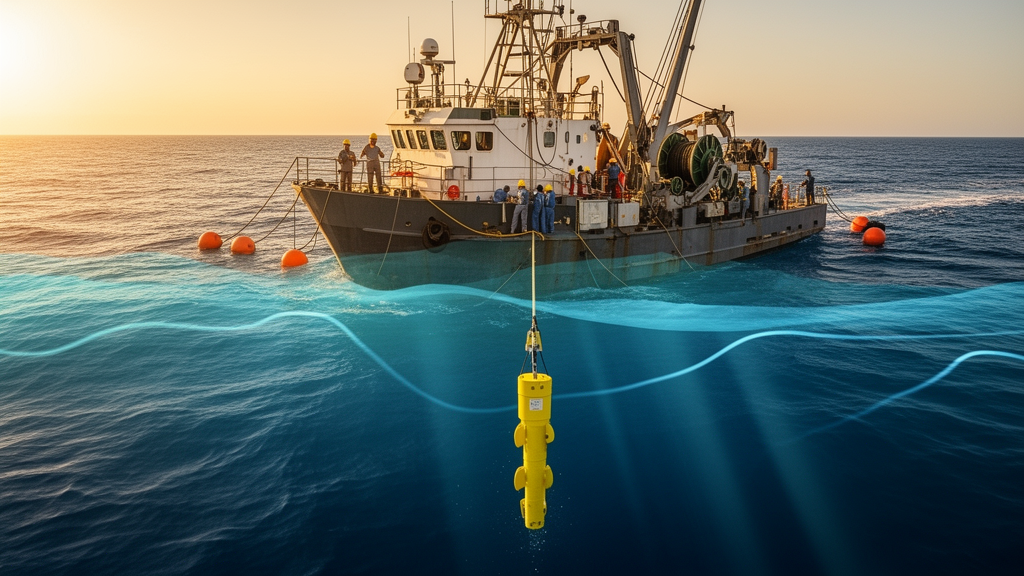
A three-year, $929,000 grant from the Office of Naval Research will fund a University of Rhode Island study of how ocean conditions shape the way sound travels over hundreds of miles beneath the sea surface. Lora Van Uffelen, associate professor of ocean engineering, leads the project, titled Acoustic Propagation and Geo-Positioning in Polar and Temperate Ocean Environments. Her team will examine the specific pattern of sound that arrives at a receiver after long journeys through the water, and how variability in the ocean alters that pattern and the positioning information it carries.
Van Uffelen’s research on acoustic propagation, the movement of sound waves through a medium such as water, holds promise for discovering more of the ocean’s interior, much of which remains unmapped. According to the National Oceanic and Atmospheric Administration, the ocean covers about 71 percent of Earth’s surface. She directs URI’s Ocean Platforms, Experiments and Research in Acoustics lab, which uses autonomous underwater vehicles as acoustic receiving platforms and for data collection. She said the work is highly specialized, requiring knowledge of physics, signal processing, oceanography and ocean engineering, and that there is considerable interest in the research.
A central focus of the project is the Arctic, a particularly difficult environment for acoustic research. The Arctic Ocean remains under-sampled because of logistical constraints and harsh conditions, and relatively little is known about how sound propagates there. Much of what is known is outdated, dating from work carried out during the Cold War era. The researchers will collaborate with the Scripps Institution of Oceanography in La Jolla, California, and the Nansen Environmental Remote Sensing Centre in Bergen, Norway. Postdoctoral researcher Luis Pomales Velázquez, who recently completed his doctorate at URI’s Graduate School of Oceanography under Van Uffelen in this field, is also part of the project.
The grant will support a push toward automation in underwater acoustic geo-positioning. Adaptive algorithms that compensate for the characteristics of the ocean environment can improve acoustic ranging and geo-positioning, and the new algorithms will be tested in both temperate and polar waters. Data gathered from mobile autonomous platforms will be used to better understand how sound can map the interior temperature of the ocean. Establishing techniques for acoustic data processing and automated real-time ranging would make oceanographic buoyancy floats a reliable tool for long-range acoustics.
Few floats currently operate in the Arctic Ocean, but valuable data has already been collected beneath the Arctic sea ice. Floats can work under the ice for months, collecting oceanographic profiles that are not transmitted until they surface. Because GPS and radio communication signals are unavailable underwater, acoustic methods can supply a geo-referenced position for these devices, which is important for assimilating their data into oceanographic models. The ability to interpret acoustic signals in real time from submerged platforms is of particular interest where satellite positioning cannot reach. Navies rely heavily on acoustic sensors and systems and on their performance in various ocean regions. Utilizing datasets from better-studied and more accessible areas, such as the northern Pacific, will support improved prediction models of acoustic propagation and help quantify how oceanographic variability affects acoustic ranging uncertainty. Van Uffelen’s work builds on a long history of research supported by ONR’s Ocean Acoustics program and will largely be performed in the recently opened ocean robotics lab on URI’s Narragansett Bay Campus, with additional travel for data collection and testing.
Subject of Research: Oceanographic variability effects on long-range acoustic propagation and underwater geo-positioning in polar and temperate oceans
Article Title: URI ocean engineering professor awarded ONR grant to investigate oceanographic variability impact on acoustics and geo-positioning
Article References: URI ocean engineering professor awarded ONR grant to investigate oceanographic variability impact on acoustics and geo-positioning. Original publication (Bibliographic details unavailable.)
Image Credits: AI Generated
DOI: Not provided
Keywords: acoustic propagation, Office of Naval Research, University of Rhode Island, Arctic Ocean, geo-positioning, autonomous underwater vehicles, buoyancy floats, ocean acoustics, underwater sensing, oceanographic variability, ocean, engineering
Cite Scienmag News
Violet Maxwell. (October 23, 2026). Navy grant funds study of how ocean variability shapes long-range sound travel. Scienmag. https://scienmag.com/navy-grant-funds-study-of-how-ocean-variability-shapes-long-range-sound-travel/
Violet Maxwell. "Navy grant funds study of how ocean variability shapes long-range sound travel." Scienmag, 23 October 2026, https://scienmag.com/navy-grant-funds-study-of-how-ocean-variability-shapes-long-range-sound-travel/. Accessed 23 October 2026.
Violet Maxwell. "Navy grant funds study of how ocean variability shapes long-range sound travel." Scienmag. October 23, 2026. https://scienmag.com/navy-grant-funds-study-of-how-ocean-variability-shapes-long-range-sound-travel/


