


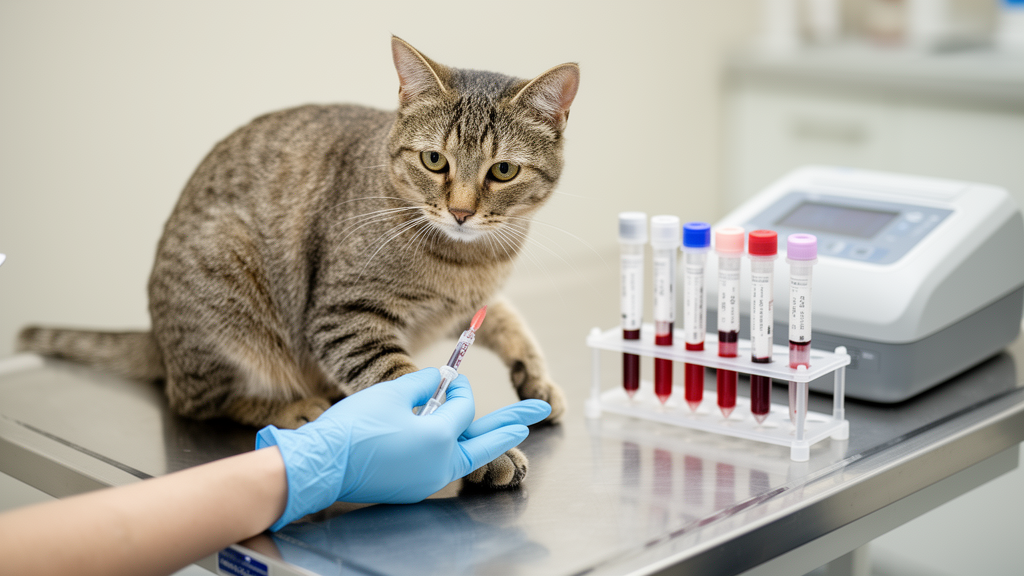
In a retrospective study of 5,743 episode-anchored veterinary visits involving 3,006 cats, routine blood-panel values were examined across seven clinically proposed creatinine strata to determine whether different patterns accompanied similar creatinine measurements and whether those patterns were associated with later changes in kidney-function markers. The analysis found that cats with similar creatinine concentrations did not necessarily have the same accompanying blood findings. No chronic kidney disease diagnoses were available, so the study could not classify cats by disease status or establish clinical outcomes. Instead, it focused on how blood markers, including urea nitrogen, phosphorus, symmetric dimethylarginine, albumin, globulin, serum amyloid A, neutrophils and lymphocytes, related to creatinine values and subsequent creatinine slopes.
The researchers initially reviewed a broad set of candidate variables and identified 33 calculable markers for screening. Three ratios—the blood urea nitrogen-to-creatinine ratio, phosphorus-to-creatinine ratio and symmetric dimethylarginine-to-creatinine ratio—remained associated with creatinine slopes when the baseline visit was included after correction for multiple testing with a false-discovery-rate procedure. When the baseline visit was removed and only subsequent visits were considered, however, none of the ratios met the same correction threshold. This distinction suggests that the apparent associations were partly coupled to shared baseline information rather than demonstrating a persistent relationship with later creatinine changes.
The analysis tested that interpretation by comparing the change in absolute correlations after removing the baseline visit across the three ratios and 27 other nonredundant markers. The reduction in correlation was greater for the three creatinine-normalized ratios than for the comparison markers, with a mean difference of 0.120 and a cat-cluster bootstrap 95% confidence interval of 0.038 to 0.198. The authors described the pattern as consistent with shared-baseline coupling: because the numerator and denominator of each ratio were measured at the same visit, their relationship with a slope calculated from that visit could be influenced by the baseline values themselves. The findings therefore caution against treating a ratio that tracks creatinine in a retrospective dataset as an independent predictor of future kidney-function trajectories.
In post hoc analyses restricted to the lower creatinine strata, labeled strata 1 and 2, the phosphorus-to-creatinine and symmetric dimethylarginine-to-creatinine ratios remained positively associated with creatinine after adjustment for age and baseline creatinine. Neither association met the false-discovery-rate correction, with both reported q-values equal to 0.072, so these results were exploratory rather than definitive. Component models did not show consistent added value from either ratio. By contrast, the blood urea nitrogen-to-albumin ratio mainly reflected current blood values and changes occurring within the same episode. Serum amyloid A, the neutrophil-to-lymphocyte ratio and the albumin-to-globulin ratio provided weaker descriptions of systemic patterns associated with creatinine, rather than strong or consistent signals of a future trend.
The study’s scope was limited by its retrospective design, the absence of chronic kidney disease diagnoses, and its reliance on episode-anchored clinical visits rather than a prospectively defined longitudinal cohort. The results do not show that adding these ratios to routine panels improves diagnosis, prognosis or clinical decision-making. They do show that blood-panel interpretation should account for the mathematical and statistical dependence among measurements: ratios can look informative because they include creatinine itself, yet their apparent association may fade when the baseline measurement is removed. The authors concluded that clinical observations and retrospective findings support considering accompanying systemic and electrolyte findings when assessing an individual cat, while prospective validation is still needed to determine whether interpreting these measures together improves clinical assessment.
Subject of Research: Retrospective analysis of feline blood-panel ratios and creatinine slopes
Article Title: Blood-panel patterns across feline creatinine strata and shared baseline effects on ratio associations
Article References: Shin, H., Kim, J. Y., Yun, J. E., Kang, S. R., Jang, J., & Kobayashi, M. (2026). Blood-panel patterns across feline creatinine strata and shared baseline effects on ratio associations. Frontiers in Veterinary Science, 13, 1972280. https://doi.org/10.3389/fvets.2026.1972280
Image Credits: AI Generated
DOI: 10.3389/fvets.2026.1972280
Keywords: feline medicine, creatinine, chronic kidney disease, blood urea nitrogen, phosphorus, symmetric dimethylarginine, veterinary diagnostics, retrospective cohort, blood-panel ratios, Blood-panel, patterns, across
Cite Scienmag News
William Thompson. (October 22, 2026). Feline blood-panel ratios show shared baseline effects on creatinine trends. Scienmag. https://scienmag.com/feline-blood-panel-ratios-show-shared-baseline-effects-on-creatinine-trends/
William Thompson. "Feline blood-panel ratios show shared baseline effects on creatinine trends." Scienmag, 22 October 2026, https://scienmag.com/feline-blood-panel-ratios-show-shared-baseline-effects-on-creatinine-trends/. Accessed 22 October 2026.
William Thompson. "Feline blood-panel ratios show shared baseline effects on creatinine trends." Scienmag. October 22, 2026. https://scienmag.com/feline-blood-panel-ratios-show-shared-baseline-effects-on-creatinine-trends/


