


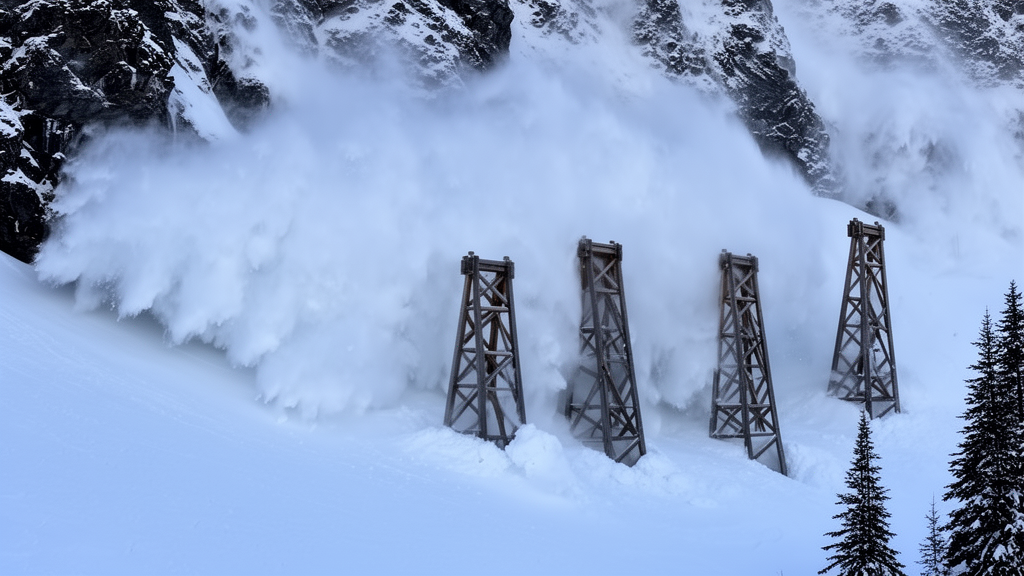
A fast snow avalanche can climb far up a narrow mast or tower without applying its strongest impact pressure over the same height. Three-dimensional simulations reported in Nature Hazards and Earth System Sciences show that the height reached by avalanche material and the vertical range of substantial impact pressure are physically different quantities. In inertia-driven flows, run-up can exceed 30 times the incoming flow depth, while the zone of significant pressure generally remains only about 1.5 to 2.5 times that depth. The distinction could change how avalanche loads—and the bending moments they create—are distributed along slender structures.
The study examined snow avalanches striking rigid, vertical, rectangular obstacles with a Material Point Method, a computational technique that follows material points through large deformation while solving their motion on a background grid. The authors ran 371 simulations, varying flow velocity, friction, cohesion and plastic compressibility. The incoming flow was 1.75 m deep, the obstacle was 1.75 m wide and velocities extended to 29 metres per second. Flow regime was classified with the Froude number, which compares inertia with gravity: values below one describe gravity-driven flow, whereas values above one indicate inertia-dominated behaviour. Most analyses focused on steady states because the idealized vertical flow front produced sensitive peaks at the moment of first impact.
Run-up began with the expected link to kinetic energy. In a nearly inviscid, fluid-like simulation, the height reached closely followed the velocity head, the equivalent height associated with converting the flow’s kinetic energy into potential energy under Bernoulli’s principle. Granular snow behaved differently because friction and cohesion both supported material at lower speeds and dissipated energy at higher speeds. At low Froude numbers, stronger internal resistance increased the quasi-static pile-up against the obstacle. Once inertial effects dominated, the same properties reduced the height reached by redirecting and dissipating flow energy. Plastic compressibility had a smaller influence than friction and cohesion in most cases.
The new analysis separates the vertical extent of meaningful loading from the visible climb of the avalanche. It defines “pressure height” as the height above the gliding surface where the smoothed impact-pressure profile falls below 5% of the pressure averaged over the incoming flow depth. Pressure profiles were calculated by dividing the simulated material into vertical bins and measuring streamwise stress immediately upstream of the obstacle. A 13-bin Savitzky–Golay filter, spanning about 1.5 m in height, was used to smooth the profiles. This definition identifies where appreciable force transmission ends rather than where the highest material particle eventually settles.
At Froude numbers below roughly two, pressure height and run-up height were of comparable magnitude. Above that threshold, they diverged. Run-up continued to increase with velocity, consistent with its strong dependence on the square of flow speed, but pressure height saturated at approximately 1.5 to 2.5 flow depths. Even the fluid-like baseline saturated, indicating that lateral escape around a narrow obstacle prevented a persistent hydraulic jump from pressing statically against the full accumulated material. Material was deflected upward while its streamwise momentum fell, allowing the visible pile to keep rising even as the force transferred to the structure weakened.
Granular simulations revealed an additional mechanism. A wedge-shaped dead zone formed near the base of the obstacle, separating moving snow from comparatively static material. Flow crossing this internal interface was redirected, concentrating impact pressure near the bottom. The formation and persistence of the dead zone depended mainly on avalanche rheology and obstacle geometry rather than incoming speed, helping explain why pressure height became nearly independent of velocity. Pressure also increased toward the obstacle base in both slow and fast cases, contrary to the nearly uniform distribution that a simple plug-flow momentum argument might suggest. Wider obstacles reduced lateral escape and sustained larger dead zones, making width effects especially important for pressure height in fast flows.
Using the simulations, the authors developed separate semi-empirical equations for run-up and pressure height. Both begin with a velocity-independent, gravity-driven contribution proportional to flow depth and effective internal friction, followed by an inertia-driven term based on the velocity head. For run-up, the inertial contribution continues to rise with the square of velocity, while dissipation increases exponentially with effective internal friction. For pressure height, that contribution is capped at a height determined by the Froude number at which saturation begins. The formulation therefore replaces guideline categories for loose and dense avalanches with a continuous rheological description while retaining the familiar structure of existing engineering equations.
The fitted models reproduced the numerical results with useful consistency. Across the assessed dataset, 92.9% of simulated run-up heights were predicted within 25% of the model value, and all assessed pressure-height values fell within the same tolerance. The simulations also linked familiar guideline dissipation factors to ranges of effective internal friction: approximately 0.45 to 0.65 for dry, loose avalanche material and 1.0 to 1.5 for dense avalanche material. The proposed approach nevertheless remains semi-empirical rather than a complete analytical solution for a three-dimensional impact problem, and its strongest support comes from idealized, approximately steady dense flows with plug-like velocity profiles.
Relative obstacle width produced another important qualification. The width correction used in existing guidelines was broadly adequate for obstacles wider than the flow was deep, but its strong reduction for narrower structures was not supported by the simulations. Run-up was only weakly sensitive to width, whereas pressure height was more sensitive in inertia-driven regimes. For obstacles narrower than the flow depth, the authors recommended keeping the normalized correction at or above about 0.7, corresponding to a value of one when referenced to equal obstacle width and flow depth. This finding is directly relevant to cableway masts and transmission towers, for which the ratio of obstacle width to avalanche depth can be below one.
An application to a published circular-mast example illustrated how the new measure redistributes rather than uniformly raises or lowers structural actions. At 30 metres per second, the method produced a base shear of 866 kilonewtons and a base moment of 2,570 kilonewton-metres, respectively 19% and 28% below the corresponding Swiss guideline values. At 10 metres per second, it instead gave base actions 15% to 25% above the Swiss guideline results because a velocity-independent pressure contribution remained. The comparison was approximate and the fast case lay near the edge of the method’s stated applicability. The simulations also omitted powder snow, sheared and unsteady inflow, temperature and liquid-water coupling, and obstacle shapes other than rectangles, so laboratory and field validation remain important before implementation in design practice.
Subject of Research: Numerical investigation of avalanche run-up and impact-pressure height on narrow obstacles
Article Title: Distinguishing run-up height from pressure distribution during avalanche impact on narrow obstacles: mechanisms and semi-empirical prediction from three-dimensional simulations
Article References: Kohler, M. J., Gaume, J., Ancey, C., & Sovilla, B. (2026). Distinguishing run-up height from pressure distribution during avalanche impact on narrow obstacles: mechanisms and semi-empirical prediction from three-dimensional simulations. Natural Hazards and Earth System Sciences, 26(10), 5167-5184. https://doi.org/10.5194/nhess-26-5167-2026
Image Credits: AI Generated
DOI: 10.5194/nhess-26-5167-2026
Keywords: snow avalanches, impact pressure, run-up height, narrow obstacles, avalanche engineering, material point method, snow rheology, Froude number, structural loading, three-dimensional simulations, Distinguishing, run-up
Cite Scienmag News
Sloane Callahan. (October 22, 2026). Fast avalanches may hit tall but not load tall. Scienmag. https://scienmag.com/fast-avalanches-may-hit-tall-but-not-load-tall/
Sloane Callahan. "Fast avalanches may hit tall but not load tall." Scienmag, 22 October 2026, https://scienmag.com/fast-avalanches-may-hit-tall-but-not-load-tall/. Accessed 22 October 2026.
Sloane Callahan. "Fast avalanches may hit tall but not load tall." Scienmag. October 22, 2026. https://scienmag.com/fast-avalanches-may-hit-tall-but-not-load-tall/


