


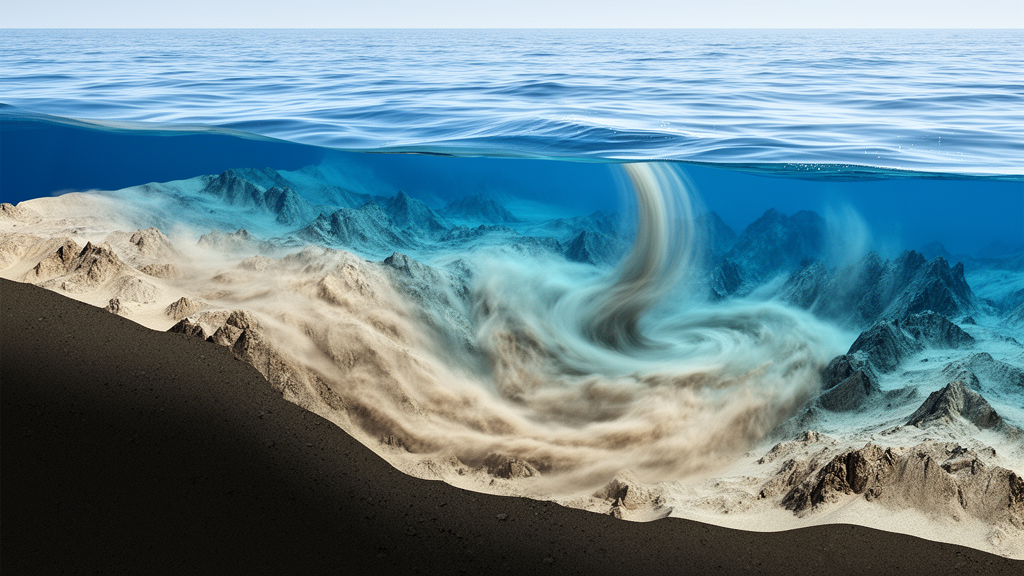
A high-resolution survey along the Oman–United Arab Emirates margin shows that dense, salty water leaving the Persian/Arabian Gulf changes shape and composition as it crosses a steep bathymetric step and rough, pockmarked seafloor in the Gulf of Oman. The outflow begins as a compact layer only 10–30 m thick, then expands to as much as about 200 m while becoming progressively less salty, cooler, less oxygen-rich and less alkaline. The observations indicate that the abrupt shelf transition initiates a hydraulic adjustment, while seafloor roughness subsequently promotes localized overturning, dilution, sediment resuspension and eventual separation of the plume from the bottom.
Researchers combined 51 conductivity-temperature-depth profiles collected offshore Fujairah between 9 and 18 July 2025 with high-resolution multibeam bathymetry and remotely operated vehicle imagery. The CTD instrument recorded vertical structure at about 4 Hz, with a median downcast speed near 0.35 metres per second. No water samples were collected to adjust the CTD measurements, although quality-control checks showed that profiling stops had no significant effect on salinity or density. The survey resolved four principal water masses: Arabian Sea High-Salinity Water in the upper layer, Indian Ocean Central Water below it, the Persian/Arabian Gulf outflow at intermediate depth and Indian Ocean Deep Water at the bottom. The Gulf outflow was distinguished by high salinity and moderate temperature, reaching 39.8 grams of absolute salinity per kilogram and 27 °C.
Across the relatively flat, shallow shelf at depths below about 130 m, the outflow was most strongly concentrated and remained close to the seabed. Its upper boundary stood roughly 50–100 m above the bottom, although the dense layer itself was generally only 10–30 m thick. Near the shelf edge, the plume was comparatively coherent, with a Persian/Arabian Gulf water fraction reaching about 0.7, salinity near 39.0 grams per kilogram, temperature around 26 °C, dissolved oxygen around 3.0 millilitres per litre and pH about 8.51. The water column above the layer was strongly stratified, and the plume had a sharp upper interface, but the survey did not establish that this stratification caused the core to remain coherent.
At the boundary between stable and unstable shelves, the seafloor dropped abruptly in an area associated with the northern extension of the Batinah Offshore Normal Fault. The attached layer expanded rapidly from roughly 20 m to about 170 m thick, and the strongest coherent core began to weaken. The calculated critical velocity rose from approximately 0.15–0.20 metres per second upstream of the step to about 0.8 metres per second at the transition and 0.8–1.0 metres per second farther downstream. Compared with independent historical current estimates of roughly 0.2–0.55 metres per second, these values are consistent with a shift from near-critical or supercritical flow to subcritical flow, although the survey did not measure current speed directly and the historical estimates were not collected at the same time.
The abrupt thickening, transient negative density stratification and enhanced overturn signals at the bathymetric step collectively support a hydraulic-jump interpretation. The density inversions occurred during the transition, where the bottom-attached layer adjusted to the changing depth. Because the study had neither acoustic Doppler current profiler measurements nor turbulence microstructure profiles, it used hydrographic overturn proxies rather than direct measurements of turbulent dissipation or absolute diffusivity. Quality-controlled Thorpe-scale analysis indicated larger vertical displacement of unstable density parcels near the step and across the rough shelf. Corresponding estimates of a diapycnal diffusivity proxy reached as high as 0.03 square metres per second near station 32 at approximately 150–200 m depth. These figures were explicitly treated as relative mixing indicators because their absolute uncertainties are large and the analysis depended on CTD-resolved density structure.
Beyond the initial step, the unstable shelf contained crescent-shaped and elongated pockmarks, erosional features and other irregularities. A geometric index comparing local seabed relief with plume thickness exceeded one immediately downstream, meaning that roughness elements were comparable to the height of the flow. The strongest overturn and mixing proxies tended to occur where this ratio was high, alongside rapid plume thickening, a declining Gulf-water fraction, increased turbidity and lower oxygen and pH. The spatial agreement supports a role for roughness in generating wakes and near-bed turbulence, although the index does not directly measure form drag, bottom stress or turbulent dissipation. The flow was diluted and reorganized rather than simply broken apart in one uniform step, with the most pronounced changes clustered around the transition and roughest sectors.
As mixing continued, the outflow lost its close attachment to the seabed and developed into a broader intermediate-depth plume. On the lower shelf and upper slope, where depths exceeded 370 m, the near-bottom signal became weak or disappeared. Representative downstream properties declined to around 37.2 grams per kilogram salinity, 22 °C, 2.0 millilitres per litre of oxygen and pH 8.35, compared with about 39.0 grams per kilogram, 26 °C, 3.0 millilitres per litre and pH 8.51 over the stable shelf. The sharp density interface at the top of the original layer was eroded, although a weaker and broader stratification reappeared farther offshore as the detached plume adjusted toward its intermediate-depth path. A high-turbidity bottom layer expanded from about 20 m above the flat shelf to more than 400 m above the upper slope, consistent with resuspension and transport of eroded material.
Remotely operated vehicle observations provided an independent ecological record of this hydrodynamic transition. At about 284 m depth, where the outflow remained attached, the seabed was exposed or only semi-consolidated and supported a conspicuous community dominated by sessile suspension feeders, including branching azooxanthellate corals and octocorals. At about 360 m depth, beyond the principal detachment zone, imagery showed a flatter, soft-sediment seabed with sparse epifauna and locally abundant cerianthid tube anemones. The change from coral-bearing hard substrate to fine-sediment assemblages coincided with weakening near-bottom hydrographic signatures. The correspondence is consistent with stronger shear and particle resuspension under attached flow, followed by lower-energy conditions and sediment accumulation beneath detached flow, although the imagery alone cannot quantify the strength of bottom currents.
The observations also show that the warm, salty Gulf outflow can occupy a layer above cooler, fresher deep water. In parts of the plume, particularly where it detaches from the seabed, these temperature and salinity relationships favour salt fingering. Turner-angle analysis indicated susceptibility to this double-diffusive process, but it did not quantify its heat or salt flux. Double diffusion operates within statically stable stratification and is therefore distinct from the density inversions and overturning recorded near the bathymetric step. The study interprets the sudden transformation at the step as primarily associated with hydraulic adjustment and overturning, with rough topography modulating subsequent mixing and double diffusion providing a slower background contribution to interface erosion.
The findings have implications for the Arabian Sea Oxygen Minimum Zone because Persian/Arabian Gulf water exports comparatively oxygenated water from the Gulf at intermediate depths. The mapped plume retains elevated near-bottom oxygen over parts of the shelf, while oxygen declines downstream as the outflow mixes with ambient water and is subject to consumption. The survey therefore links a spatial change in the outflow’s attachment and mixing to its potential contribution to ventilation of the upper oxycline. However, the study was a non-synoptic observational survey of one margin and did not directly measure turbulent dissipation, current speed or future climate responses. Because outflow density depends on Gulf temperature and evaporation, the authors note that modest climatic shifts could alter lift-off depth, pathway geometry and downstream oxygen delivery, but the present observations do not quantify that response.
Subject of Research: Observational study of Persian/Arabian Gulf outflow transformation over rough Gulf of Oman shelf bathymetry
Article Title: Hydrographic transformation of the Persian/Arabian Gulf outflow over rough shelf bathymetry in the Gulf of Oman
Article References: Abdelmaksoud, A., Al-Suwaidi, A. H., Bruss, G., Samimi-Namin, K., & Ali, M. Y. (2026). Hydrographic transformation of the Persian/Arabian Gulf outflow over rough shelf bathymetry in the Gulf of Oman. Ocean Science, 22(5), 3369-3383. https://doi.org/10.5194/os-22-3369-2026
Image Credits: AI Generated
Keywords: Persian/Arabian Gulf outflow, Gulf of Oman, dense water overflow, bathymetric roughness, ocean mixing, plume detachment, hydrographic mapping, multibeam bathymetry, benthic communities, Arabian Sea ventilation, Hydrographic, transformation
Cite Scienmag News
Violet Maxwell. (October 22, 2026). Gulf outflow transforms after crossing Oman–UAE bathymetric step. Scienmag. https://scienmag.com/gulf-outflow-transforms-after-crossing-oman-uae-bathymetric-step/
Violet Maxwell. "Gulf outflow transforms after crossing Oman–UAE bathymetric step." Scienmag, 22 October 2026, https://scienmag.com/gulf-outflow-transforms-after-crossing-oman-uae-bathymetric-step/. Accessed 22 October 2026.
Violet Maxwell. "Gulf outflow transforms after crossing Oman–UAE bathymetric step." Scienmag. October 22, 2026. https://scienmag.com/gulf-outflow-transforms-after-crossing-oman-uae-bathymetric-step/


