


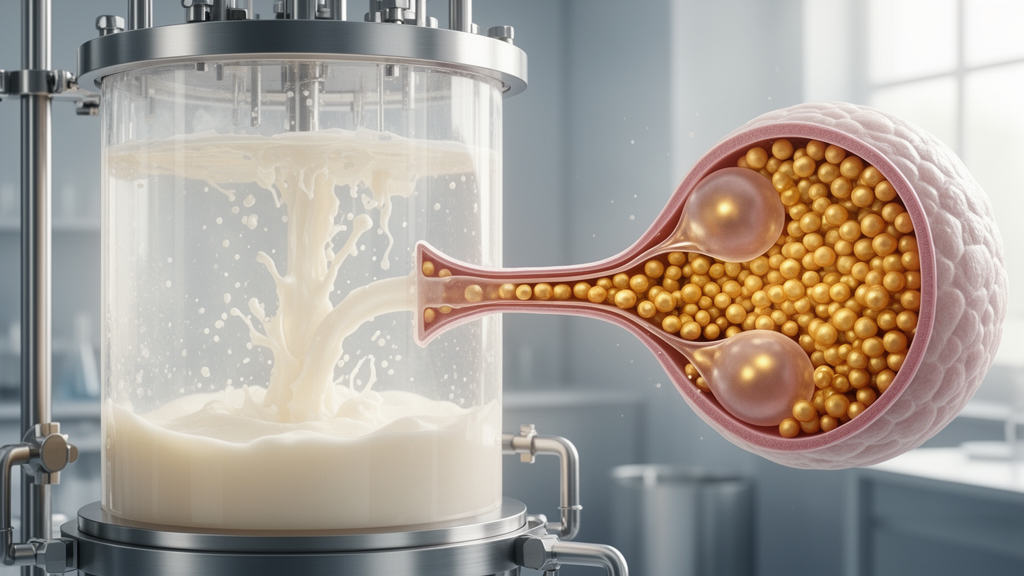
Genetically engineered Pichia pastoris yeast can produce and release bovine κ-casein, the cheese-making protein that stabilizes milk proteins and enables rennet to trigger curd formation, but a new study shows that the yeast both generates the protein and attacks it. Multicopy strains increased production, while experiments with secretion, protease-deficient hosts, mass spectrometry and cellular fractionation exposed persistent degradation, extensive O-linked glycosylation and incomplete delivery to the culture medium. The work offers a detailed map of the obstacles that must be overcome before precision-fermented κ-casein can become a practical alternative to animal-derived dairy protein.
κ-Casein occupies the surface of casein micelles, the assemblies that transport calcium and phosphate in milk and provide much of the structure of cheese and other dairy products. During cheese making, the enzyme chymosin cleaves κ-casein between Phe105 and Met106, releasing a hydrophilic fragment called the caseinomacropeptide. This destabilizes the micelle and initiates the gelation that forms curd. The researchers selected κ-casein because its cleavage is central to renneting, and because producing it without animals could reduce reliance on conventional dairy agriculture. They also stressed that the usefulness of recombinant protein depends on whether its modification pattern and integrity resemble those of the native material.
The investigators used Pichia pastoris, now formally known as Komagataella phaffii, as the production host. This yeast is established in industrial fed-batch fermentation and can perform eukaryotic post-translational modifications, while secretion could simplify downstream processing by eliminating the need to break open cells and recover intracellular protein. The bovine κ-casein A coding sequence was codon-optimized for the yeast, stripped of its native signal peptide and fused to an α-mating-factor prepro leader used to direct secretion. Several constructs also carried an eight-histidine tag at either end so that tiny quantities of the product could be isolated by nickel affinity chromatography and identified with antibodies and peptide sequencing.
In shake-flask cultures at pH 3, Western blotting detected secreted κ-casein from single-copy and multicopy strains, but the protein appeared as a broad smear around 38 kilodaltons rather than a sharply defined band. The theoretical mass of κ-casein A is 18,974 daltons, and extensive modification can increase both apparent mass and smear. Densitometry against a bovine κ-casein reference produced rough estimates of 28 milligrams per liter for the single-copy strain, 89 milligrams per liter for a strain with about seven expression-cassette copies and 133 milligrams per liter for one with about 17 copies. The authors described these as calculated values that should not be interpreted as highly precise measurements. The rising estimates were consistent with a gene-dosage effect, although uncharacterized insertion sites could also have influenced the results.
Multicopy production remained advantageous in a methanol-fed bioreactor. The approximately 17-copy strain generated a substantially stronger κ-casein signal than a single-copy reference under the same imaging conditions, and quantitative PCR showed no clear loss of expression copies during cultivation. The bioreactor experiments nevertheless produced low concentrations of intact, secreted protein. Rough mass-spectrometry-based calculations placed single-copy production on the order of 10 milligrams per liter, similar to some shake-flask results and far below the productivity commonly associated with this yeast in other recombinant processes. The authors said this unexpectedly low output may indicate physiological limitations imposed specifically by κ-casein expression, although they did not establish the mechanism.
Protein analysis showed that secretion was only the beginning of the problem. N-terminal sequencing of material purified from bioreactor cultures repeatedly identified internal κ-casein fragments, including products consistent with cleavage after basic residues in the protein. An N-terminally tagged construct also produced prominent low-molecular-weight species, suggesting that its tag had been removed or the protein had been fragmented. Protease inhibitors added during purification did not change the pattern, making degradation during that procedure an unlikely explanation. The researchers instead associated some fragment retention during chromatography with a histidine-rich sequence in κ-casein that may bind the nickel resin, and they considered secretory stress and the protein’s intrinsically disordered structure possible contributors to its vulnerability.
To identify the enzymes responsible, the team tested a yapsin 1 knockout and a double knockout lacking yapsin 1 and vacuolar protease A. Deleting yapsin 1 removed the cleavage events previously found in the wild-type host, supporting a role for that cell-wall aspartyl protease. Yet it did not solve the integrity problem: a new cleavage appeared farther upstream in κ-casein, demonstrating that additional proteolytic activity was involved. The double knockout also failed to preserve the full-length protein and generated many intense bands below about 20 kilodaltons. It appeared to accumulate more κ-casein signal, but it grew more slowly and reached roughly half the biomass of the other strains, while comparisons were also confounded by different parental backgrounds, unknown copy numbers and different integration sites. The authors therefore cautioned against interpreting the apparent yield advantage as a firm productivity result.
Chemical analysis showed that Pichia added extensive O-linked sugar to the recombinant protein, producing heterogeneous glycoforms and further inflating its apparent molecular weight. Most protein bands stained positively with periodic acid–Schiff reagent, and their mobility fell markedly after treatment with an α-mannosidase capable of removing Pichia O-linked mannose residues. The bands remained smeared, consistent with incomplete glycan removal, residual degradation or both. Mass spectrometry generally produced poor-quality spectra, although one spectrum showed a broad peak near 25 kilodaltons and did not resolve separate glycoforms. No phosphorylated κ-casein peptides were detected. These findings matter because glycosylation and phosphorylation can alter a protein’s physical behavior, and the study did not test whether the recombinant κ-casein performed the required renneting function in cheese making.
Other experiments identified a second delivery bottleneck. κ-casein accumulated in the periplasmic space of some strains, indicating that it had crossed the cell membrane but had not fully traversed the cell wall into the broth. The researchers suggested that engineering cell-wall properties or improving secretion could increase extracellular recovery, while the intrinsically disordered protein might also aggregate or self-assemble inside cells. Cytoplasmic production was tested as an alternative, but it yielded little protein and still appeared degraded, so retaining κ-casein inside the yeast did not exchange secretion problems for a clearly better process. The next steps identified by the study are identification of the remaining proteases, optimization of temperature, pH and medium composition, testing of alternative secretion leaders and protein fusions, and engineering of the cell wall. The result is not a finished cheese ingredient, but a detailed experimental diagnosis of why a potentially scalable fermentation platform still struggles to deliver intact κ-casein.
Subject of Research: Precision-fermentation bottlenecks in recombinant bovine κ-casein production using Pichia pastoris
Article Title: Precision fermentation of κ-casein using Pichia pastoris
Article References: Iaria, L., Flipse, N., Bijl, E., Hettinga, K., & Werten, M. W. T. (2026). Precision fermentation of κ-casein using Pichia pastoris. Frontiers in Bioengineering and Biotechnology, 14, Article 1946745. https://doi.org/10.3389/fbioe.2026.1946745
Image Credits: AI Generated
DOI: 10.3389/fbioe.2026.1946745
Keywords: precision fermentation, Pichia pastoris, κ-casein, protein secretion, proteolysis, O-glycosylation, cheese production, bioreactors, Precision, fermentation, casein, Pichia
Cite Scienmag News
Denise Maddox. (October 22, 2026). Engineered yeast produces cheese-making protein but exposes secretion bottlenecks. Scienmag. https://scienmag.com/engineered-yeast-produces-cheese-making-protein-but-exposes-secretion-bottlenecks/
Denise Maddox. "Engineered yeast produces cheese-making protein but exposes secretion bottlenecks." Scienmag, 22 October 2026, https://scienmag.com/engineered-yeast-produces-cheese-making-protein-but-exposes-secretion-bottlenecks/. Accessed 22 October 2026.
Denise Maddox. "Engineered yeast produces cheese-making protein but exposes secretion bottlenecks." Scienmag. October 22, 2026. https://scienmag.com/engineered-yeast-produces-cheese-making-protein-but-exposes-secretion-bottlenecks/


