

Thursday, October 22, 2026
Science
No Result
View All Result
  • Login
  • HOME
  • SCIENCE NEWS
  • CONTACT US
  • HOME
  • SCIENCE NEWS
  • CONTACT US
No Result
View All Result
Scienmag
No Result
View All Result
Home Science News Technology and Engineering

Lab test finds modified graphite lowers hydrogen permeation but not blistering

October 22, 2026
in Technology and Engineering
Denise Maddox
By Denise Maddox Scienmag Editorial Profile - Mechanical Engineering
Reading Time: 2 mins read
0
Lab test finds modified graphite lowers hydrogen permeation but not blistering

Lab test finds modified graphite lowers hydrogen permeation but not blistering

65
SHARES
587
VIEWS
Share on FacebookShare on Twitter
ADVERTISEMENT

An experimental sealing composite made from thermoplastic polyurethane, ethylene propylene diene monomer, modified graphite and EPDM-g-MAH showed improved hydrogen-barrier performance under laboratory conditions, but visible blistering remained after rapid decompression. The optimized formulation, designated G5, combined TPU, EPDM, modified graphite and EPDM-g-MAH at a mass ratio of 90/10/5/2. Researchers evaluated its hydrogen permeation at temperatures of 25–85 °C and pressures of 1–3 MPa, measured differential-pressure permeation at 10 MPa, and assessed hydrogen uptake and volume change following exposure at 20 MPa and rapid decompression.

The study found that the hydrogen permeability of G5 increased as temperature rose and, within the tested 1–3 MPa range, as pressure increased. At 25 °C and 10 MPa, its permeability coefficient was 0.794 × 10⁻⁹ mol·m/(m²·s·MPa), lower than that measured for neat TPU. The comparison supports an improvement in hydrogen-barrier performance for the tested composite formulation. The experiment concerned a laboratory composite rather than a complete industrial sealing component, and the reported results apply to the temperatures, pressures and formulations examined.

After exposure to hydrogen at 20 MPa followed by rapid decompression, G5 showed lower measured post-exposure hydrogen uptake and less swelling than the other tested composites. These two measurements indicated that the optimized material retained less hydrogen and underwent a smaller relative volume change under that test procedure. The improvement was not sufficient to prevent visible blistering following rapid decompression. The findings therefore distinguish reduced permeation, hydrogen uptake and swelling from the material’s continuing susceptibility to visible damage under the reported decompression conditions.

Temperature and pressure were tested as variables in the permeation experiments, while the high-pressure exposure and decompression procedure provided a direct assessment of retained hydrogen, relative volume change and visible surface damage. Across those measurements, the evidence shows that the G5 formulation performed better than neat TPU on hydrogen permeability and better than the other tested composites on post-exposure uptake and swelling. At the same time, the surviving blisters show that lowering permeability did not completely suppress rapid-decompression damage. The study is an experimental evaluation of a specific TPU/EPDM/modified-graphite material system at the stated test conditions, rather than a general demonstration of composite performance under every operating environment.

Subject of Research: Laboratory evaluation of hydrogen permeation and rapid-decompression damage in a TPU/EPDM/modified-graphite sealing composite.

Article Title: High-pressure hydrogen permeation and rapid-decompression behavior of TPU/EPDM/modified-graphite sealing composites

Article References: Mou, W., Li, X., He, G., You, J., & Zhou, C. (2026). High-pressure hydrogen permeation and rapid-decompression behavior of TPU/EPDM/modified-graphite sealing composites. Journal of Materials Science. https://doi.org/10.1007/s10853-026-13893-4

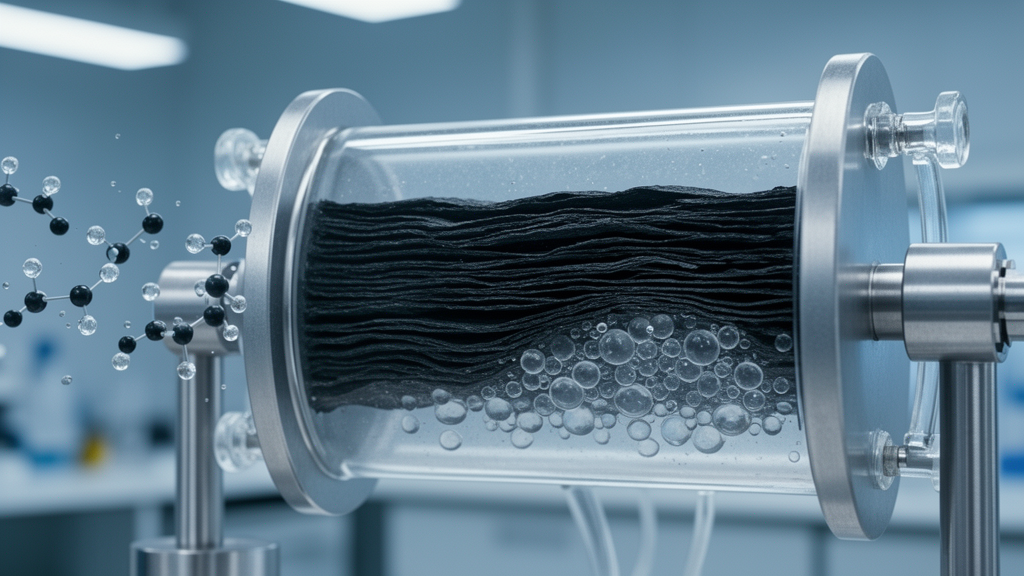
Image Credits: AI Generated

DOI: 10.1007/s10853-026-13893-4

Keywords: hydrogen permeation, TPU composite, EPDM, modified graphite, rapid decompression, hydrogen sealing, polymer swelling, hydrogen uptake, blistering, materials testing, High-pressure, hydrogen

Cite Scienmag News

Denise Maddox. (October 22, 2026). Lab test finds modified graphite lowers hydrogen permeation but not blistering. Scienmag. https://scienmag.com/lab-test-finds-modified-graphite-lowers-hydrogen-permeation-but-not-blistering/


Denise Maddox. "Lab test finds modified graphite lowers hydrogen permeation but not blistering." Scienmag, 22 October 2026, https://scienmag.com/lab-test-finds-modified-graphite-lowers-hydrogen-permeation-but-not-blistering/. Accessed 22 October 2026.

Denise Maddox. "Lab test finds modified graphite lowers hydrogen permeation but not blistering." Scienmag. October 22, 2026. https://scienmag.com/lab-test-finds-modified-graphite-lowers-hydrogen-permeation-but-not-blistering/

Tags: blisteringcomposite materials for hydrogen storageeffects of rapid decompression on hydrogen uptakeEPDMEPDM-g-MAH impact on hydrogen resistanceethylene propylene diene monomer compositeshigh pressurehydrogenhydrogen blistering and material degradationhydrogen permeationhydrogen permeation reductionhydrogen sealinghydrogen uptakelaboratory evaluation of hydrogen barrier materialslaboratory testing of hydrogen permeationmaterials testingmodified graphitemodified graphite in sealing compositesperformance of sealing composites under high-pressure hydrogenpolymer swellingrapid decompressiontemperature and pressure dependence of hydrogen permeabilitythermoplastic polyurethane hydrogen barrierTPU composite
Share26Tweet16
Previous Post

Research report: Artificial intelligence (AI) anxiety and nurses’ turnover intention during healthcare digital transformation: the mediating role of occupational fatigue

Next Post

Selective orientation correction lowers VIO error without full-state UKF backend cost

Related Posts

Optimized fast radiative transfer improves FY-3F water-vapor channel simulations
Earth Science

Optimized fast radiative transfer improves FY-3F water-vapor channel simulations

October 22, 2026
Selective orientation correction lowers VIO error without full-state UKF backend cost
Technology and Engineering

Selective orientation correction lowers VIO error without full-state UKF backend cost

October 22, 2026
Machine learning predicts self-reported anger improvement in teens
Technology and Engineering

Machine learning predicts self-reported anger improvement in teens

October 22, 2026
Pure-culture study links fatty-acid breakdown to methane in one archaeon
Medicine

Pure-culture study links fatty-acid breakdown to methane in one archaeon

October 22, 2026
Expert Interviews Shape Human Insider Threat Framework in Three Sectors
Science News

Expert Interviews Shape Human Insider Threat Framework in Three Sectors

October 22, 2026
Nickel-Doped MoS2 Nanoparticles Improve Supercapacitor Electrode Performance
Technology and Engineering

Nickel-Doped MoS2 Nanoparticles Improve Supercapacitor Electrode Performance

October 22, 2026
Next Post
Selective orientation correction lowers VIO error without full-state UKF backend cost

Selective orientation correction lowers VIO error without full-state UKF backend cost

  • Mothers who receive childcare support from maternal grandparents show more optimized

    Mothers who receive childcare support from maternal grandparents show more parental warmth, finds NTU Singapore study

    27656 shares
    Share 11059 Tweet 6912
  • University of Seville Breaks 120-Year-Old Mystery, Revises a Key Einstein Concept

    1061 shares
    Share 424 Tweet 265
  • Bee body mass, pathogens and local climate influence heat tolerance

    682 shares
    Share 273 Tweet 171
  • Researchers record first-ever images and data of a shark experiencing a boat strike

    546 shares
    Share 218 Tweet 137
  • Groundbreaking Clinical Trial Reveals Lubiprostone Enhances Kidney Function

    531 shares
    Share 212 Tweet 133
Science

Embark on a thrilling journey of discovery with Scienmag.com—your ultimate source for cutting-edge breakthroughs. Immerse yourself in a world where curiosity knows no limits and tomorrow’s possibilities become today’s reality!

RECENT NEWS

  • Optimized fast radiative transfer improves FY-3F water-vapor channel simulations
  • Urban Habitat Mosaics Structure Invasive Termite Gene Flow Without Genetic Erosion
  • Selective orientation correction lowers VIO error without full-state UKF backend cost
  • Lab test finds modified graphite lowers hydrogen permeation but not blistering

Categories

  • Agriculture
  • Anthropology
  • Archaeology
  • Athmospheric
  • Biology
  • Biotechnology
  • Blog
  • Bussines
  • Cancer
  • Chemistry
  • Climate
  • Earth Science
  • Editorial Policy
  • Marine
  • Mathematics
  • Medicine
  • Pediatry
  • Policy
  • Psychology & Psychiatry
  • Science Education
  • Science News
  • Social Science
  • Space
  • Technology and Engineering

Subscribe to Blog via Email

Enter your email address to subscribe to this blog and receive notifications of new posts by email.

Join 5,151 other subscribers

© 2025 Scienmag - Science Magazine

Welcome Back!

Login to your account below

Forgotten Password?

Retrieve your password

Please enter your username or email address to reset your password.

Log In
No Result
View All Result
  • HOME
  • SCIENCE NEWS
  • CONTACT US

© 2025 Scienmag - Science Magazine

Discover more from Science

Subscribe now to keep reading and get access to the full archive.

Continue reading