


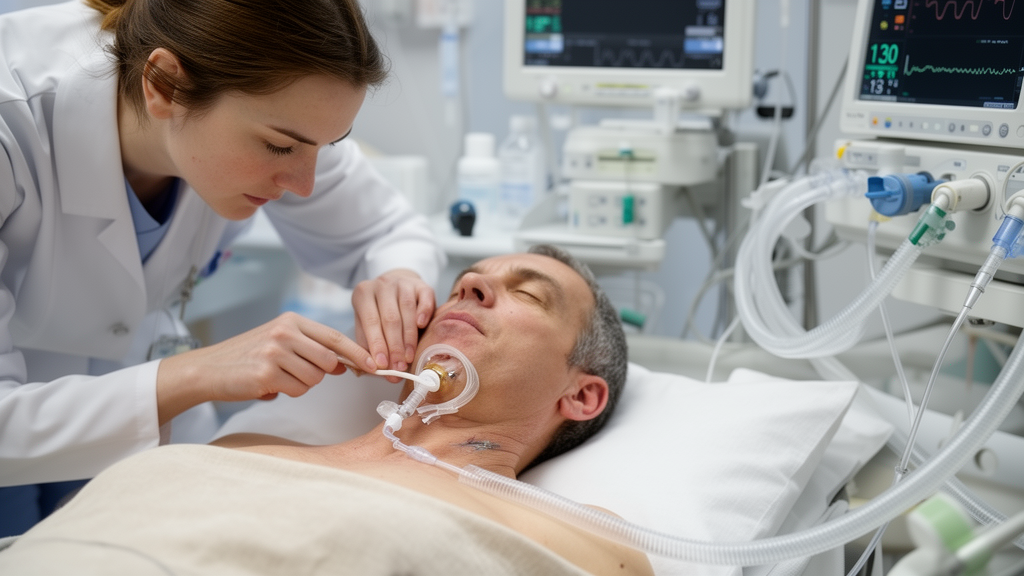
A ventilator-dependent 74-year-old woman with a long-term tracheostomy developed an audible upper-airway leak when the pilot balloon and one-way valve detached completely from her cuff inflation system. The failure coincided with a ventilator leak alarm and a reduction in displayed tidal volume. Clinicians could not replace the defective tube without exposing the patient to substantial airway risks, so they used a case-specific temporary maneuver to access the remaining inflation line, inject air and then occlude it. The maneuver stopped the alarm at that observation, but it did not restore normal cuff function, permit objective pressure measurement or prevent recurrent leakage, according to the case report.
The episode occurred during the woman’s ninth hospital admission at an intensive care unit in China. She had chronic respiratory dysfunction and type II respiratory failure and required long-term tracheostomy and mechanical ventilation. Her medical history included coronary artery disease, heart failure, Parkinson disease, sequelae of cerebral infarction, diabetes and hypertension. The affected device was a cuffed percutaneous dilatational tracheostomy tube with a 7.0-mm internal diameter and a 10.5-mm external diameter. It had been inserted in March 2021 and last replaced in August 2023.
On the morning of February 26, 2024, an intensive care nurse heard the new leak while the patient was receiving mechanical ventilation. A ventilator alarm sounded at the same time, and displayed tidal volume decreased. Inspection of the external assembly showed that the blue pilot balloon, including its Luer one-way valve, had detached entirely and was no longer present. A residual segment of inflation line nevertheless remained connected to the tracheostomy tube. The combination of physical findings and ventilator changes supported failure of the cuff inflation system rather than an isolated equipment malfunction.
Replacing the tube was considered, but bedside examination by an otolaryngology team identified granulation tissue below the tracheostomy stoma. The surrounding area was clean and had no obvious secretions, yet removal appeared potentially difficult. The specialists warned that exchange could produce bleeding, aspiration, respiratory difficulty or loss of the airway. Chest computed tomography documented post-tracheostomy changes, bronchitis, bilateral pneumonia resembling earlier imaging, bilateral pleural effusions and adjacent incomplete lung expansion, but did not report peri-tracheostomy granulation or airway narrowing. No event-specific bronchoscopy was documented, so the airway-risk assessment was clinical rather than bronchoscopic.
Intensive care and otolaryngology clinicians explained both the consequences of continuing with the failed cuff system and the hazards of immediate exchange to the family. After informed shared decision-making, the team and family chose to defer replacement, retain the existing tube and continue ventilatory support under close observation. The report emphasizes that family preference was not itself the clinical justification. Bridge management was considered temporarily acceptable because the specialist assessment indicated that immediate exchange carried substantial patient-specific risks, while the teams remained prepared to escalate if ventilation or oxygenation could not be maintained.
To obtain temporary access to the cuff, a nurse inserted the needle supplied with a 1-mL syringe into the lumen of the residual inflation line using a 5-mL syringe. Air was introduced incrementally, and after approximately 3 mL had been delivered, the audible leak and ventilator leak alarm were no longer present at that observation. The needle was removed and the residual line occluded with a straight haemostatic clamp to limit air escape. Because both the pilot balloon and one-way valve were absent, the usual cuff-manometer connection did not exist and intracuff pressure could not be measured by the standard method.
The injected volume was specific to this event rather than a target, and it cannot establish that a safe cuff pressure, clinical efficacy or procedural safety had been achieved. A fixed quantity of air cannot reliably be translated into a known pressure across different tube designs and anatomical conditions. The maneuver also did not reconstruct either missing component or restore a durable seal. Its potential hazards include uncontrolled intracuff pressure, overinflation, cuff rupture, damage to the inflation line, inadvertent air loss, loss of positive-pressure ventilation and airway injury. Accordingly, the authors describe the technique as an exceptional bridge for a single high-risk case, not as a recommended bedside procedure.
The available records did not provide a controlled assessment of the intervention. They contained routine hourly observations rather than measurements designed as immediate paired pre- and post-procedure comparisons. At 07:00, oxygen saturation was 99%, heart rate 79 beats per minute, respiratory rate 19 breaths per minute and blood pressure 112/46 mmHg; peak and mean airway pressures were approximately 21 and 11 cmH₂O, respectively, with displayed tidal volume of about 491 mL. The 08:00 ventilator record noted P-SIMV mode, positive end-expiratory pressure of 5 cmH₂O, inspired oxygen fraction of 50%, airway pressures of approximately 20 and 11 cmH₂O and displayed tidal volume of about 466 mL. At 09:00, oxygen saturation was 100% and respiratory rate was 14 breaths per minute. Delivered and exhaled tidal volumes were not recorded as paired measurements, minute ventilation was unavailable, and no arterial blood gases were linked specifically to the failure and intervention.
Intermittent leakage continued through the hospital stay, demonstrating that the bridge did not produce normal or sustained cuff function. On February 29, the patient remained on P-SIMV ventilation with positive end-expiratory pressure of 5 cmH₂O and an inspired oxygen fraction of 50%; oxygen saturation was 100%, but air leakage around the tracheostomy was still recorded. At discharge on March 6, she still required P-SIMV, now with positive end-expiratory pressure of 6 cmH₂O and an inspired oxygen fraction of 60%. Air leakage was described as obvious, with episodic tachypnea and continued sputum production. The defective tube remained in place, and no reliable post-discharge follow-up was available. Because the device was not removed, the investigators could not inspect it or determine why the pilot balloon detached.
The single retrospective case offers no proof that the maneuver is effective, reproducible, safe or generalizable. It lacked intracuff-pressure measurement, event-specific arterial blood gases, paired ventilator measurements and complete complication surveillance. Staff retrospectively recalled that cuff reinflation was commonly needed two to four times daily, usually with about 3 mL of air, but those estimates were not contemporaneous quantified data. The transferable lesson is therefore not the injected volume or needle-and-clamp technique. It is the need to recognize cuff-system failure promptly, combine patient findings with ventilator information and physical inspection, obtain early airway expertise, assess whether exchange is feasible and involve the family in an informed decision. Definitive management still requires replacement of an irreparable tracheostomy tube whenever it can be done safely.
Subject of Research: Management of pilot-balloon detachment in a ventilator-dependent tracheostomy patient
Article Title: Case report: complete pilot balloon detachment in a ventilator-dependent patient with high-risk tracheostomy exchange
Article References: Lai, X., Huang, Y., Hu, M., & Huang, L. (2026). Case report: complete pilot balloon detachment in a ventilator-dependent patient with high-risk tracheostomy exchange. Frontiers in Medicine, 13, Article 1994056. https://doi.org/10.3389/fmed.2026.1994056
Image Credits: AI Generated
DOI: 10.3389/fmed.2026.1994056
Keywords: tracheostomy, mechanical ventilation, pilot balloon, cuff failure, airway management, case report, intensive care, tracheostomy exchange, airway leak, Case, report, complete
Cite Scienmag News
Ophelia Keating. (October 22, 2026). Pilot balloon detachment forces risky decision in ventilated tracheostomy patient. Scienmag. https://scienmag.com/pilot-balloon-detachment-forces-risky-decision-in-ventilated-tracheostomy-patient/
Ophelia Keating. "Pilot balloon detachment forces risky decision in ventilated tracheostomy patient." Scienmag, 22 October 2026, https://scienmag.com/pilot-balloon-detachment-forces-risky-decision-in-ventilated-tracheostomy-patient/. Accessed 22 October 2026.
Ophelia Keating. "Pilot balloon detachment forces risky decision in ventilated tracheostomy patient." Scienmag. October 22, 2026. https://scienmag.com/pilot-balloon-detachment-forces-risky-decision-in-ventilated-tracheostomy-patient/


