

Thursday, October 22, 2026
Science
No Result
View All Result
  • Login
  • HOME
  • SCIENCE NEWS
  • CONTACT US
  • HOME
  • SCIENCE NEWS
  • CONTACT US
No Result
View All Result
Scienmag
No Result
View All Result
Home Science News Medicine

Systematic review finds no simple link between neighbourhood resources and late-life depression

October 22, 2026
in Medicine
Glenn Wilkins
By Glenn Wilkins Scienmag Editorial Profile - Clinical Psychology
Reading Time: 3 mins read
0
Systematic review finds no simple link between neighbourhood resources and late-life depression

Systematic review finds no simple link between neighbourhood resources and late-life depression

65
SHARES
587
VIEWS
Share on FacebookShare on Twitter
ADVERTISEMENT

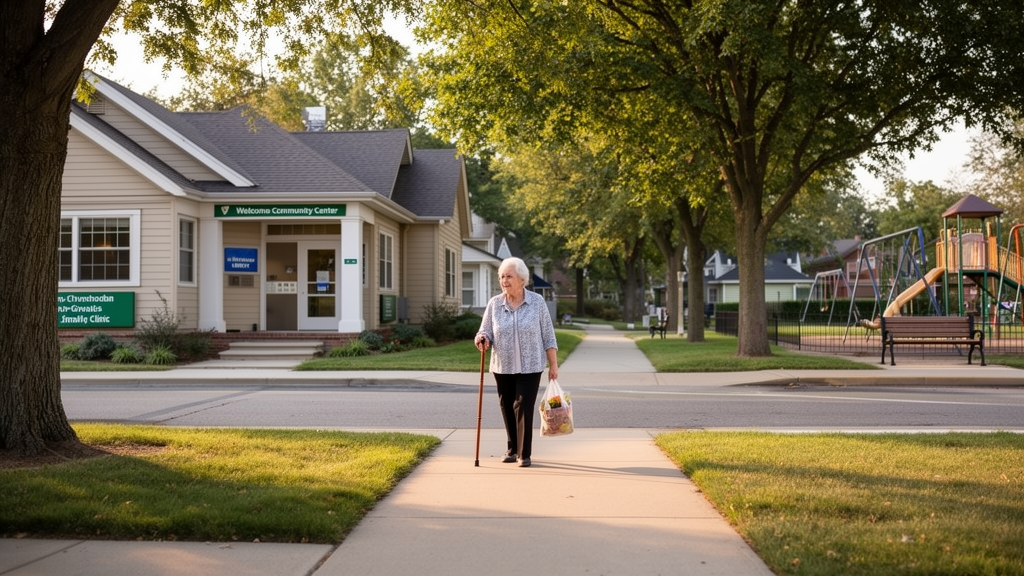
A systematic review of 16 observational studies found no consistent pattern connecting material neighbourhood resources or formal community services with fewer depressive symptoms among community-dwelling adults aged 60 and older. Across the evidence, some studies reported inverse associations, others found no relationship, and several identified positive associations. Certainty in both domains was rated very low because of serious concerns about risk of bias, inconsistency, indirectness and imprecision.

The review, published in BMC Geriatrics, focused on whether the availability or accessibility of local material resources—such features of the built and socioeconomic environment—and formal community service resources were associated with depression or depressive symptoms in later life. It included 12 cross-sectional studies and four longitudinal studies. Ten studies supplied core evidence about material resources, including one mixed or hybrid study, while five examined formal community services. Six studies also contributed exploratory analyses of mediation or effect modification, although some contributed evidence to more than one part of the review.

The researchers searched PubMed, Embase, Web of Science, Scopus, PsycINFO and the China National Knowledge Infrastructure from each database’s inception through 22 March 2026, without language restrictions. They restricted eligibility to quantitative observational studies of community-dwelling adults aged at least 60. Risk of bias was assessed with design-specific versions of the Newcastle–Ottawa Scale. Because the studies differed substantially in their concepts, measurements, populations and settings, the team used a structured synthesis without meta-analysis, following the Synthesis Without Meta-analysis guideline. The researchers also assessed certainty of evidence using the Grading of Recommendations Assessment, Development and Evaluation approach.

Material-resource findings varied not only by the type of resource but also by spatial scale, population subgroup and temporal component. The results therefore did not support a simple “more resources, less depression” model. Formal community service-resource findings were similarly mixed and context dependent. However, some longitudinal studies linked greater reported service availability with lower levels of depressive symptoms at a subsequent assessment. The source evidence does not establish that increasing services would cause a reduction in depression, and the review’s overall conclusion remains limited by the very low certainty of the body of research.

Exploratory mediation and effect-modification results were also inconsistent. No mediator or modifier emerged with sufficiently consistent support to support a firm conclusion. These analyses should therefore be treated as hypothesis-generating rather than as evidence of a proven pathway. The geographic base of the evidence was another constraint: most studies came from East Asia, with limited representation from other regions. Combined with the observational designs, the concentration of research in a small number of settings, the risk-of-bias concerns and imprecision in some estimates, this limits how broadly the findings can be generalized.

The review shifts attention away from the assumption that neighbourhood conditions and community services have uniform, uniformly beneficial associations with mental health in old age. Instead, it shows that reported relationships depend on how resources are defined and measured, whom and where they are studied, and when outcomes are assessed. The evidence is strongest as a caution against interpreting any single association as universal or causal: observational findings ranged in opposite directions, and the certainty assessment identified major weaknesses throughout both principal domains of the review.

Subject of Research: Systematic review of neighbourhood and community-service resources in relation to depression among older adults

Article Title: Material neighbourhood resources, formal community service resources, and depression in older adults: a systematic review

Article References: Chen, H., Eungpinichpong, W., Asawaphureekorn, S., Saranrittichai, K., Xie, Y., & Wang, X. (2026). Material neighbourhood resources, formal community service resources, and depression in older adults: a systematic review. BMC Geriatrics. https://doi.org/10.1186/s12877-026-08463-x

Image Credits: AI Generated

DOI: 10.1186/s12877-026-08463-x

Keywords: late-life depression, neighbourhood resources, community services, older adults, systematic review, observational studies, social determinants, evidence synthesis, depressive symptoms, health geography, Material, neighbourhood

Cite Scienmag News

Glenn Wilkins. (October 22, 2026). Systematic review finds no simple link between neighbourhood resources and late-life depression. Scienmag. https://scienmag.com/systematic-review-finds-no-simple-link-between-neighbourhood-resources-and-late-life-depression/


Glenn Wilkins. "Systematic review finds no simple link between neighbourhood resources and late-life depression." Scienmag, 22 October 2026, https://scienmag.com/systematic-review-finds-no-simple-link-between-neighbourhood-resources-and-late-life-depression/. Accessed 22 October 2026.

Glenn Wilkins. "Systematic review finds no simple link between neighbourhood resources and late-life depression." Scienmag. October 22, 2026. https://scienmag.com/systematic-review-finds-no-simple-link-between-neighbourhood-resources-and-late-life-depression/

Tags: bias and methodological challenges in aging depression researchbuilt environment and mental health outcomescommunity service impact on elderly depressioncommunity servicesdepressive symptomseffects of local material resources on elderly well-beingevidence quality in environmental influences on mental healthevidence synthesisformal community services and depression in older adultshealth geographyimpact of neighborhood socioeconomic status on late-life depressionlate-life depressionlate-life depression risk factorsmaterialneighbourhoodneighbourhood resourcesneighbourhood resources and mental healthobservational studiesobservational studies on aging and depressionolder adultssocial determinantssocioeconomic environment and depression in seniorssystematic reviewsystematic review of community resources and mental health
Share26Tweet16
Previous Post

Three IVF stimulation protocols show similar live-birth rates in low-reserve patients

Next Post

Caffeine intake not significantly linked to current asthma in U.S. youth

Related Posts

Caffeine intake not significantly linked to current asthma in U.S. youth
Medicine

Caffeine intake not significantly linked to current asthma in U.S. youth

October 22, 2026
Research report: Process evaluation of a nurse-led transitional care model (Cardiolotse) within a randomized controlled trial aiming to improve care coordination for patients with cardiovascular diseases in Germany
Medicine

Research report: Process evaluation of a nurse-led transitional care model (Cardiolotse) within a randomized controlled trial aiming to improve care coordination for patients with cardiovascular diseases in Germany

October 22, 2026
Reanalysis links two snail gene regions to schistosome resistance
Medicine

Reanalysis links two snail gene regions to schistosome resistance

October 22, 2026
Paediatric esketamine evidence points to context-specific doses, not universal safety threshold
Medicine

Paediatric esketamine evidence points to context-specific doses, not universal safety threshold

October 22, 2026
Pig stress study maps long noncoding RNA across blood, saliva and brain
Medicine

Pig stress study maps long noncoding RNA across blood, saliva and brain

October 22, 2026
Urinary haloacetic acid concentrations and asthenozoospermia risk: a case–control study in China
Medicine

Urinary haloacetic acid concentrations and asthenozoospermia risk: a case–control study in China

October 22, 2026
Next Post
Caffeine intake not significantly linked to current asthma in U.S. youth

Caffeine intake not significantly linked to current asthma in U.S. youth

  • Mothers who receive childcare support from maternal grandparents show more optimized

    Mothers who receive childcare support from maternal grandparents show more parental warmth, finds NTU Singapore study

    27656 shares
    Share 11059 Tweet 6912
  • University of Seville Breaks 120-Year-Old Mystery, Revises a Key Einstein Concept

    1061 shares
    Share 424 Tweet 265
  • Bee body mass, pathogens and local climate influence heat tolerance

    682 shares
    Share 273 Tweet 171
  • Researchers record first-ever images and data of a shark experiencing a boat strike

    546 shares
    Share 218 Tweet 137
  • Groundbreaking Clinical Trial Reveals Lubiprostone Enhances Kidney Function

    531 shares
    Share 212 Tweet 133
Science

Embark on a thrilling journey of discovery with Scienmag.com—your ultimate source for cutting-edge breakthroughs. Immerse yourself in a world where curiosity knows no limits and tomorrow’s possibilities become today’s reality!

RECENT NEWS

  • Machine learning forecasts bluetongue outbreaks up to six months ahead
  • Caffeine intake not significantly linked to current asthma in U.S. youth
  • Systematic review finds no simple link between neighbourhood resources and late-life depression
  • Three IVF stimulation protocols show similar live-birth rates in low-reserve patients

Categories

  • Agriculture
  • Anthropology
  • Archaeology
  • Athmospheric
  • Biology
  • Biotechnology
  • Blog
  • Bussines
  • Cancer
  • Chemistry
  • Climate
  • Earth Science
  • Editorial Policy
  • Marine
  • Mathematics
  • Medicine
  • Pediatry
  • Policy
  • Psychology & Psychiatry
  • Science Education
  • Science News
  • Social Science
  • Space
  • Technology and Engineering

Subscribe to Blog via Email

Enter your email address to subscribe to this blog and receive notifications of new posts by email.

Join 5,151 other subscribers

© 2025 Scienmag - Science Magazine

Welcome Back!

Login to your account below

Forgotten Password?

Retrieve your password

Please enter your username or email address to reset your password.

Log In
No Result
View All Result
  • HOME
  • SCIENCE NEWS
  • CONTACT US

© 2025 Scienmag - Science Magazine

Discover more from Science

Subscribe now to keep reading and get access to the full archive.

Continue reading