


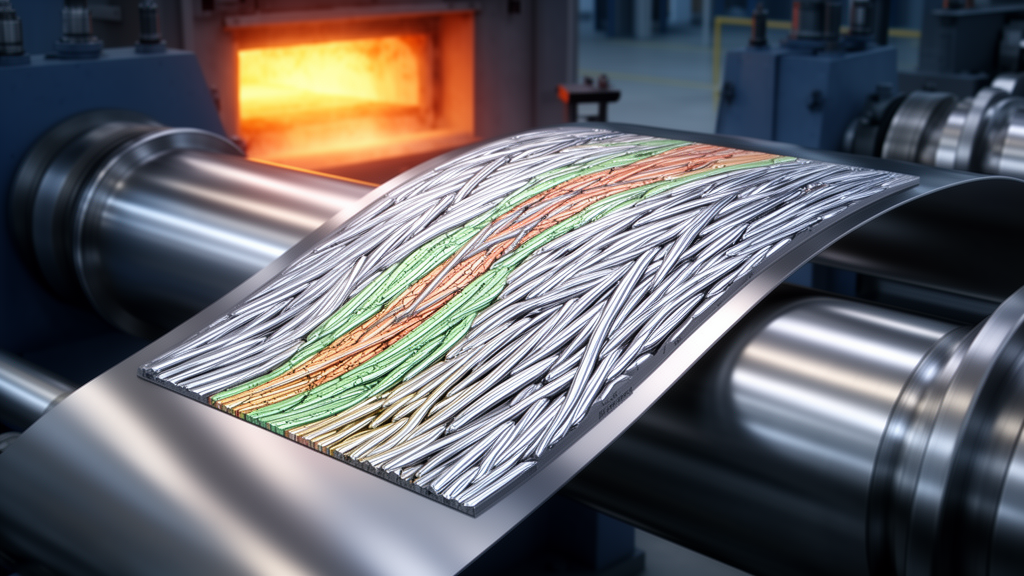
A comprehensive review of automotive-grade medium-manganese steel concludes that its sought-after combination of high strength, ductility, formability and crash performance depends not only on chemical composition and phase balance, but also on the orientation of its microscopic crystals. The authors identify crystallographic texture as a central design variable, linking specific grain alignments to deformation, fracture and the behavior of retained austenite during loading. Their synthesis covers ferritic, austenitic and duplex steels containing 3–12 wt% manganese, including evidence from orientation distribution functions, electron backscatter diffraction and other microstructural analyses.
The review is a synthesis of existing research rather than a new materials trial, so its conclusions identify broad processing and alloying relationships that still require industrial-scale validation. Texture describes the statistical preference of grains in a metal to adopt particular crystallographic orientations relative to the sheet’s rolling, transverse and normal directions. In rolled steels, orientations are commonly grouped into fibers named after Greek letters, including the alpha fiber aligned with the rolling direction and the gamma fiber associated with the sheet normal.
Individual components carry distinct implications. The gamma fiber, represented by {111} planes parallel to the sheet normal, supports plastic strain ratios and deep drawability, while the cube component, {001}<100>, can promote isotropy and dimensional accuracy but may also facilitate cleavage or delamination along vulnerable planes. The brass and Goss components participate in deformation twinning and recrystallization, making the balance among all these orientations central to controlling sheet behavior.
The three principal microstructural classes develop texture differently. Ferritic medium-manganese steels, containing about 3–6 wt% manganese, consist mainly of an alpha-ferrite matrix with small amounts of retained or reverted austenite. They generally develop pronounced cube and alpha-fiber orientations during rolling, with cube texture becoming especially prominent after intercritical annealing; their minor austenite contributes relatively weak gamma-fiber texture.
This structure provides high yield strength and dimensional stability, but limited ductility unless retained austenite transforms to martensite under stress through the transformation-induced plasticity, or TRIP, effect. Austenitic grades, generally containing 9–12 wt% manganese, are stabilized by manganese, nickel and carbon partitioning. Their stacking-fault energy is described as being high enough to suppress martensitic transformation while permitting mechanical twinning, allowing twinning-induced plasticity, or TWIP, to rotate grains toward {111} and {110} orientations and strengthen the gamma fiber.
Duplex steels, with roughly 6–9 wt% manganese, combine ferrite and austenite and occupy an intermediate compositional range. Intercritical annealing can create fine reverted-austenite networks and promote carbon partitioning into austenite, allowing TRIP and TWIP mechanisms to operate together. The ferritic phase develops cube and alpha-fiber orientations, while reverted austenite contributes gamma-fiber components; twinning introduces additional {111} and {110} orientations.
According to the review, this complementary texture can support a favorable balance of strength and ductility because the ferrite and martensitic constituents strengthen the material while austenite transformation and twinning sustain plastic deformation. The comparison is mechanistic rather than a guarantee of identical performance, because the reviewed compositions and processing routes differ in phase fraction, grain size, carbon distribution and thermal history. Alloying elements modify texture by changing phase stability, stacking-fault energy, diffusion and recrystallization behavior.
Manganese stabilizes austenite and supports gamma-fiber development, but the review also reports that excessive manganese can promote segregation and adversely affect corrosion resistance. Nickel preferentially partitions into austenite, delaying martensitic transformation and refining grains; an addition of about 1 wt% is described as sufficient to improve gamma-fiber intensity, retained-austenite stability and twin boundaries, although higher content raises cost and may over-stabilize austenite. Carbon diffuses into austenite during intercritical annealing, increasing room-temperature stability and favoring balanced gamma-fiber and cube textures.
Concentrations of approximately 0.2–0.3 wt% are described as generally favorable, whereas excessive carbon can form carbide networks that reduce toughness and disrupt texture uniformity. Aluminum and silicon counterbalance manganese in different ways. Aluminum is a strong ferrite stabilizer that shifts the intercritical annealing window upward, suppresses cementite formation and promotes cube texture in ferrite.
The review identifies roughly 0.2–0.3 wt% aluminum as a favorable range for balancing gamma-fiber and cube components, carbide suppression and toughness, while warning that too much aluminum can leave insufficient austenite for TRIP and TWIP. Silicon inhibits cementite precipitation, retains carbon in solid solution and supports a stable, uniform gamma fiber. It also works with aluminum to moderate phase fractions and texture anisotropy.
An approximate 0.3–0.5 wt% silicon range is presented as favorable; excessive additions may cause segregation, brittle phases and long delays in recrystallization. These ranges are review-level guidelines rather than universal prescriptions because the cited studies use different compositions and processing schedules. Thermal and mechanical processing determines which texture survives or emerges.
Higher annealing temperatures can increase recrystallization, reduce peak texture intensity and produce more independently oriented grains, as observed in a reviewed Fe-6.78Mn-3.92Al-0.18C steel annealed at 700, 750 and 800 °C. During tensile deformation, its FCC alpha fiber remained substantial, while a brass component shifted partly toward a Goss-brass twin orientation associated with the TRIP effect. Cold rolling creates stored deformation energy and a fine initial structure: one studied material had an average grain size of about 0.88 micrometers after cold rolling, with approximately 67% low-angle grain boundaries. Its BCC phase showed a strong rolling-direction alpha fiber, while the FCC phase displayed a strong {110} orientation.
Such stored energy and the phase constitution of the starting sheet strongly affect how austenite reverts and how textures evolve during subsequent annealing. Deformation rate and temperature add another layer of control. At a low strain rate of 1.33 × 10⁻⁴ s−1, a high TRIP contribution in the same Fe-6.78Mn-3.92Al-0.18C steel was associated with a greater fraction of low-angle boundaries, while a martensitic brass orientation was reported to facilitate transformation more than other components.
Separate orientation analysis found a persistent misorientation peak near 42.8 degrees, corresponding to a Kurdjumov–Sachs relationship and supporting strain-induced martensite formation. That peak was sharper at room temperature and a strain rate of 10−3 s−1 than at elevated temperature or higher rates, where transformation saturation and grain rotation caused deviations. These observations show that texture does not evolve passively: phase transformation, twinning, slip, grain rotation and loading conditions continually reshape it, with different strains activating distinct crystallographic pathways.
Texture also affects fracture and must be considered alongside benefits to forming. The FCC phase showed smoother crack paths and a broader orientation distribution, consistent with stronger slip and twinning activity, while most retained-austenite grains were oriented along <101>. This complementary behavior illustrates why no single orientation is ideal.
Strong {111} textures can support formability and high resistance to some crack paths, but excessive cube-fiber intensity can create delamination concerns, and {001} planes can provide low-resistance transgranular cleavage paths in body-centered-cubic ferrite. Texture engineering therefore seeks a controlled distribution of orientations rather than simply the strongest possible component. Despite the breadth of the reviewed evidence, important gaps remain before texture control can be transferred reliably from laboratory sheets to vehicles.
Current models do not yet accurately represent the combined effects of TRIP, TWIP, austenite reversion and industrial processing conditions, partly because in situ observations of these dynamic processes remain limited. Laboratory findings need validation in pilot-scale continuous annealing and hot-press forming, and long-term cyclic loading has not been studied sufficiently to establish how reverted-austenite stability and texture evolve under service. Welding can weaken the gamma fiber in heat-affected zones, while the relationship between grain-boundary character, corrosion and mechanical durability remains poorly understood.
The review therefore calls for real-time characterization, multiscale models linking chemistry to texture, systematic optimization of manganese, nickel, carbon, aluminum and silicon, and corrosion-mechanical testing. Its central message is that medium-manganese steel is not a single material recipe: performance emerges from the coupled choreography of phase constitution, alloy chemistry, processing history and crystallographic orientation.
Subject of Research: Texture evolution and mechanical performance in automotive-grade medium-manganese steel
Article Title: A comprehensive review on development of texture in automotive-grade medium manganese steel
Article References: Mohapatra, S., Pradhan, R., Mahapatra, B. N., & Swain, P. K. (2026). A comprehensive review on development of texture in automotive-grade medium manganese steel. Frontiers in Materials, 13, Article 1954859. https://doi.org/10.3389/fmats.2026.1954859
Image Credits: AI Generated
DOI: 10.3389/fmats.2026.1954859
Keywords: medium-manganese steel, crystallographic texture, automotive materials, austenite reversion, TRIP effect, TWIP effect, intercritical annealing, alloy design, metal forming, mechanical anisotropy, comprehensive, review
Cite Scienmag News
Denise Maddox. (October 21, 2026). A comprehensive review on development of texture in automotive-grade medium manganese steel. Scienmag. https://scienmag.com/a-comprehensive-review-on-development-of-texture-in-automotive-grade-medium-manganese-steel/
Denise Maddox. "A comprehensive review on development of texture in automotive-grade medium manganese steel." Scienmag, 21 October 2026, https://scienmag.com/a-comprehensive-review-on-development-of-texture-in-automotive-grade-medium-manganese-steel/. Accessed 21 October 2026.
Denise Maddox. "A comprehensive review on development of texture in automotive-grade medium manganese steel." Scienmag. October 21, 2026. https://scienmag.com/a-comprehensive-review-on-development-of-texture-in-automotive-grade-medium-manganese-steel/


