


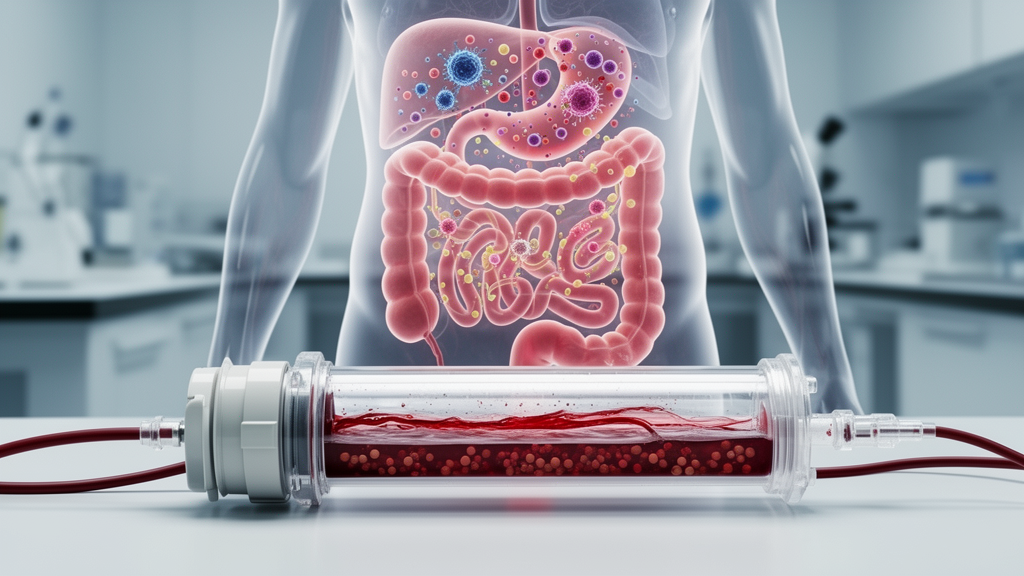
Dialysis does more than remove accumulated toxins from the blood. A 2026 narrative review argues that it also disrupts a connected kidney–gut–immune–nutrition network, altering microbial communities, weakening intestinal defenses, intensifying inflammation and impairing the metabolism that protects muscle. The authors describe distinct patterns in hemodialysis and peritoneal dialysis and propose a composite biomarker, the Microbiome–Immune–Nutrition Index, or MIN Index, to identify which biological systems are most disrupted in an individual patient. The proposal remains conceptual: no pilot cohort, derived weights, thresholds or external validation currently exist.
Kidney failure creates an unusual internal environment. As renal clearance declines, nitrogenous waste accumulates and changes the chemistry of the gut lumen. Protein-bound toxins such as indoxyl sulfate, p-cresyl sulfate and trimethylamine N-oxide can reach concentrations 10 to 50 times those in healthy controls, according to the review. These compounds are not simply passengers carried by the blood. Indoxyl sulfate activates the aryl hydrocarbon receptor and promotes oxidative stress, while microbial metabolism of tryptophan and tyrosine supplies additional precursors for toxin production. The resulting chemical environment favors pathobionts and disadvantages commensal organisms, including short-chain-fatty-acid producers such as Faecalibacterium and Roseburia.
That shift has structural consequences for the intestine. Butyrate normally supplies energy to colon cells and signals through receptors involved in metabolic and immune regulation. As butyrate-producing bacteria decline, epithelial integrity and anti-inflammatory signaling may weaken. Uremic toxins can also disturb tight-junction proteins, including occludin, claudin-1 and zonula occludens-1. The resulting permeability permits lipopolysaccharide and other microbial products to enter the circulation. Studies summarized in the review link this endotoxemia with higher C-reactive protein and interleukin-6, lower residual kidney function and the low-grade inflammation that characterizes maintenance dialysis. Metabolomic studies also report depleted short-chain fatty acids and altered tryptophan and bile-acid pathways, although most comparisons remain observational.
Immune dysfunction follows two apparently contradictory directions. Pattern-recognition receptors including Toll-like receptor 4, NOD2, NLRP3 and RIG-I respond to microbial products by activating nuclear factor-kappa B and mitogen-activated protein kinase signaling, increasing inflammatory cytokines such as interleukin-6, tumor necrosis factor alpha and interleukin-1 beta. At the same time, uremia impairs neutrophil phagocytosis, monocyte oxidative burst, dendritic-cell antigen presentation and aspects of antibody defense. Altered T-cell and monocyte populations, expansion of myeloid-derived suppressor cells and exhausted T-cell markers have also been described. The result is a state resembling “immunological paralysis”: persistent immune activation alongside reduced capacity to contain infection. The cellular evidence is less extensive than the cytokine evidence and still needs systematic characterization in dialysis-specific cohorts.
Nutrition and muscle are woven into the same feedback system. Protein-energy wasting combines loss of muscle and other body stores with inadequate energy availability. The review reports that muscle mass declines two to three times faster in kidney disease than during normal aging and that malnutrition affects an estimated 18% to 75% of dialysis populations, depending on how it is defined. Inflammation can suppress appetite, activate the ubiquitin-proteasome system and alter myostatin, insulin-like growth factor and JAK–STAT signaling. Restrictive diets may reduce potassium and phosphorus but also limit fiber diversity and the substrates required by saccharolytic bacteria. Evidence connecting dysbiosis to sarcopenia is still mainly cross-sectional or mechanistic: it cannot yet establish whether microbial change causes muscle loss, follows malnutrition and inactivity, or shares inflammation as an upstream driver.
Hemodialysis and peritoneal dialysis place different kinds of stress on this network. Hemodialysis produces rapid fluctuations in toxins and fluid, and rapid ultrafiltration can contribute to intradialytic hypotension and myocardial stunning. Blood repeatedly contacts artificial membranes, activating complement and circulating leukocytes. The review reports more pronounced depletion of butyrate-producing organisms, enrichment of Proteobacteria and Fusobacteria, and generally greater endotoxemia. Peritoneal dialysis is continuous and often preserves residual kidney function and hemodynamic stability for longer, but continuous absorption of glucose adds calories and can worsen insulin resistance, dyslipidemia and adiposity. Glucose degradation products and advanced glycation end-products promote peritoneal inflammation, fibrosis, neoangiogenesis and eventual ultrafiltration failure. Its microbial profile includes amplification of Enterobacteriaceae and depletion of Bifidobacterium and Lactobacillus, though the peritoneal literature is smaller and more vulnerable to confounding by diet, shared environments, medications and other illnesses.
Multi-omics methods offer a way to examine these systems together. Metagenomics and metatranscriptomics characterize microbial genes and active pathways, while metabolomics measures circulating and fecal metabolites, and proteomics, lipidomics and single-cell transcriptomics can characterize immune states. Network analysis and supervised machine learning may detect coordinated signatures that single-domain tests miss. One case-control CKD study cited in the review found that gut microbial functional profiles, including carbohydrate-active enzyme genes, predicted early disease more accurately than serum-metabolite or immune-cell models alone and correlated with circulating amino acids and immune-cell clusters. Such findings demonstrate analytical promise, not a validated patient-classification system. The proposed MIN Index would combine 16S sequencing or metagenomics, multiplex immune assays, biochemical measurements, body composition, functional testing and dietary assessment, with modality-specific weights estimated from outcomes such as infection, hospitalization, cardiovascular events, technique failure and mortality.
Developing that framework would require evidence rather than conceptual polish. The authors suggest a derivation cohort of at least 300 to 500 hemodialysis and peritoneal dialysis patients followed for 12 to 24 months, followed by external validation in a separate population. Sampling would need to cover diet, diabetes, residual kidney function, antibiotics, iron, phosphate binders, proton-pump inhibitors and other medications that can alter microbial communities. Because high-dimensional data invite overfitting, weights derived in one cohort would have to be tested without refitting in another. The index would also have to demonstrate added value over cheaper measures such as the Malnutrition–Inflammation Score, albumin or C-reactive protein, using outcomes that patients experience rather than biomarker changes alone. Its inputs would need to be collected within a defined window, and the test–retest stability of repeated microbiome measurements would need to be established because diet, infection and antibiotics can alter gut composition within days.
Therapeutic ideas remain largely ahead of clinical proof. Fiber-rich and plant-based diets may support short-chain-fatty-acid production, but potassium and phosphorus restrictions complicate implementation, especially in regions where vegetarian diets are already common. Probiotic and prebiotic trials have reported modest improvements in toxins, bowel function or inflammatory markers, generally in small cohorts without demonstration of fewer infections, hospitalizations or deaths. Fecal microbiota transplantation improved kidney and inflammatory measures in a rat model and has early human evidence outside dialysis, but transmission risks, donor screening, uncertain durability and the uremic environment complicate use in frail patients. Omega-3 fatty acids and polyphenols may influence inflammatory pathways, but clinical results are inconsistent. Advanced high-volume hemodiafiltration improves middle-molecule clearance and has produced favorable mortality results in one trial, yet its direct effects on the gut axis remain unmeasured. The review consequently supports carefully monitored research rather than routine use of an unvalidated index or unproven microbiome-based treatment.
Closing the gap will depend on larger, more diverse and longer studies. Most available evidence comes from small, single-center or cross-sectional investigations, often in Western populations, while healthcare access, diet, genetics, environmental exposure and medication use differ markedly across regions. Standardized stool collection, sequencing, bioinformatics and metadata reporting are needed so results can be pooled; common repositories and international consortia could make that possible. Longitudinal cohorts beginning before dialysis could establish whether dysbiosis precedes or follows uremia, infection and malnutrition, while randomized trials of combination interventions could test whether altering several linked domains is more effective than targeting one. The central proposal is therefore not that a single score can immediately guide dialysis care, but that dialysis outcomes may become more predictable if researchers model the gut, immune system, nutrition and residual kidney function as the interacting system they are. The MIN Index offers a structured hypothesis for that work, with its clinical value still to be demonstrated.
Subject of Research: Kidney–gut–immune–nutrition interactions and risk stratification in hemodialysis and peritoneal dialysis
Article Title: Beyond solute clearance: the kidney–gut–immune–nutrition axis in hemodialysis and peritoneal dialysis and a proposed framework for integrated risk stratification
Article References: Rawat, A., Prasad, N., Rawat, P., Ahmed, S., Kumar, B., Singh, A., Nayak, T., & Kushwaha, R. S. (2026). Beyond solute clearance: the kidney–gut–immune–nutrition axis in hemodialysis and peritoneal dialysis and a proposed framework for integrated risk stratification. Frontiers in Nutrition, 13, Article 1931760. https://doi.org/10.3389/fnut.2026.1931760
Image Credits: AI Generated
DOI: 10.3389/fnut.2026.1931760
Keywords: dialysis, gut microbiome, uremic toxins, immune dysregulation, protein-energy wasting, multi-omics, hemodialysis, peritoneal dialysis, risk stratification, clinical nutrition, Beyond, solute
Cite Scienmag News
Jerry Hayes. (October 21, 2026). Review: Dialysis disrupts gut–immune–nutrition network beyond solute clearance. Scienmag. https://scienmag.com/review-dialysis-disrupts-gut-immune-nutrition-network-beyond-solute-clearance/
Jerry Hayes. "Review: Dialysis disrupts gut–immune–nutrition network beyond solute clearance." Scienmag, 21 October 2026, https://scienmag.com/review-dialysis-disrupts-gut-immune-nutrition-network-beyond-solute-clearance/. Accessed 21 October 2026.
Jerry Hayes. "Review: Dialysis disrupts gut–immune–nutrition network beyond solute clearance." Scienmag. October 21, 2026. https://scienmag.com/review-dialysis-disrupts-gut-immune-nutrition-network-beyond-solute-clearance/


