


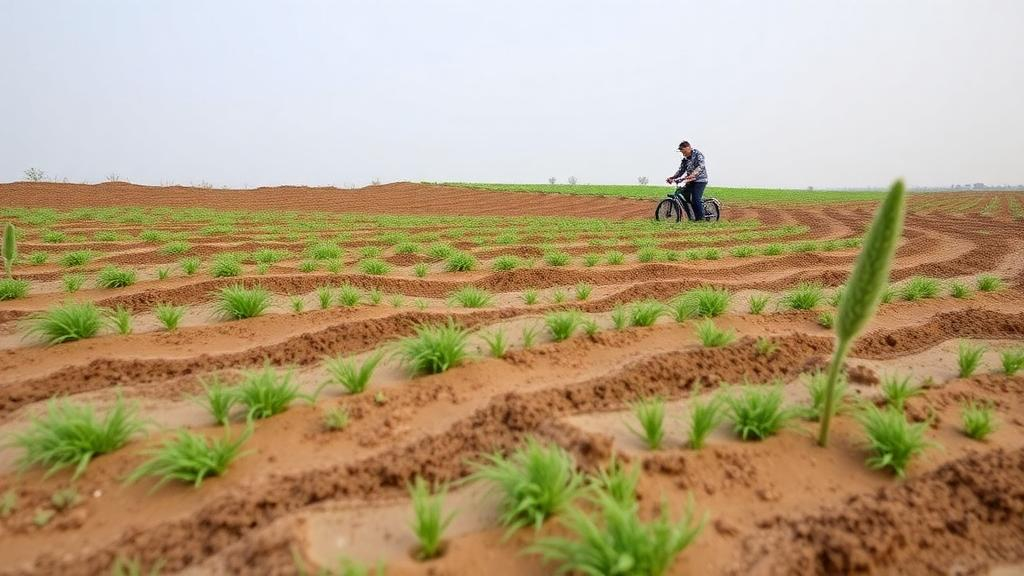
A peer-reviewed review of more than 70 years of soil conservation in China reports that the area affected by soil erosion declined by about 28% between 1985 and 2023, while the estimated annual volume of eroded soil fell by roughly 47%. The analysis, published in the journal International Soil and Water Conservation Research, also finds that major national outcomes commonly required 10 to 20 years of sustained work, illustrating the substantial lag between conservation interventions and measurable environmental recovery.
China’s experience spans landscapes with very different erosion processes and restoration constraints, including the Loess Plateau, northern deserts and the Qinghai-Tibet Plateau. The review divides national efforts into three stages. During the “Exploration Stage” from the 1950s through the 1980s, conservation focused on terracing, sediment-trapping dams, grass planting and afforestation. In the “Integrated Management Stage” from the 1980s through the 2000s, efforts expanded to manage small watersheds while linking erosion control with farming, rural livelihoods and economic development. Since the 2000s, the “Ecological Restoration and Sustainable Development Stage” has emphasized ecological restoration and sustainability, supported by stronger legislation, nationwide projects and closer oversight of construction. The review portrays this progression not as the result of one successful technique, but as a gradual expansion in the scale, coordination and monitoring of conservation policy.
National soil-conservation projects have spread across China since 2005, while satellite observations and other data systems have increasingly been used to identify erosion and track project development. The review’s central lesson is that durable results depend on combining engineering measures, ecological restoration, legal frameworks and attention to local livelihoods. Corresponding author Xing Yang said China’s experience shows that soil conservation succeeds when these elements are addressed together because no single measure can address the different forms of erosion found across varied landscapes. The reported decreases in affected area and eroded-soil volume are national-scale observations associated with decades of intervention; the review does not isolate the effect of any individual policy or restoration method.
Timing remains a defining feature of the evidence. Yang noted that the strongest decline in erosion area occurred years before the largest reduction in erosion volume, indicating a delay between intervention and its full effect. Restoration in fragile environments can be technically demanding, and unresolved erosion is increasingly concentrated in arid, high-altitude and otherwise vulnerable areas. The review also identifies competition among governments, farmers, businesses and the public as a potential complication in implementation. It therefore emphasizes ongoing monitoring and policy adjustment alongside long-term funding, scientific assessment and public participation. The findings offer transferable principles for countries confronting land degradation, but the scale and duration of China’s program—and its decades of national coordination—limit direct comparisons with shorter interventions elsewhere. The central conclusion is that launching conservation projects may begin a recovery process, whereas meaningful reductions in erosion generally require sustained implementation, local adaptation and patience.
Subject of Research: Historical review of China’s soil-conservation policies, erosion trends and long-term restoration outcomes
Article Title: China’s 70-year soil conservation journey shows why environmental recovery takes time
Article References: China’s 70-year soil conservation journey shows why environmental recovery takes time. Original publication (Bibliographic details unavailable.)
Image Credits: AI Generated
DOI: Not provided
Keywords: soil conservation, soil erosion, China, land restoration, environmental monitoring, ecological recovery, policy coordination, climate adaptation, year, soil, conservation, journey
Cite Scienmag News
Margaret Porter. (October 21, 2026). China’s 70-year soil conservation record shows recovery can take decades. Scienmag. https://scienmag.com/chinas-70-year-soil-conservation-record-shows-recovery-can-take-decades/
Margaret Porter. "China’s 70-year soil conservation record shows recovery can take decades." Scienmag, 21 October 2026, https://scienmag.com/chinas-70-year-soil-conservation-record-shows-recovery-can-take-decades/. Accessed 21 October 2026.
Margaret Porter. "China’s 70-year soil conservation record shows recovery can take decades." Scienmag. October 21, 2026. https://scienmag.com/chinas-70-year-soil-conservation-record-shows-recovery-can-take-decades/


