


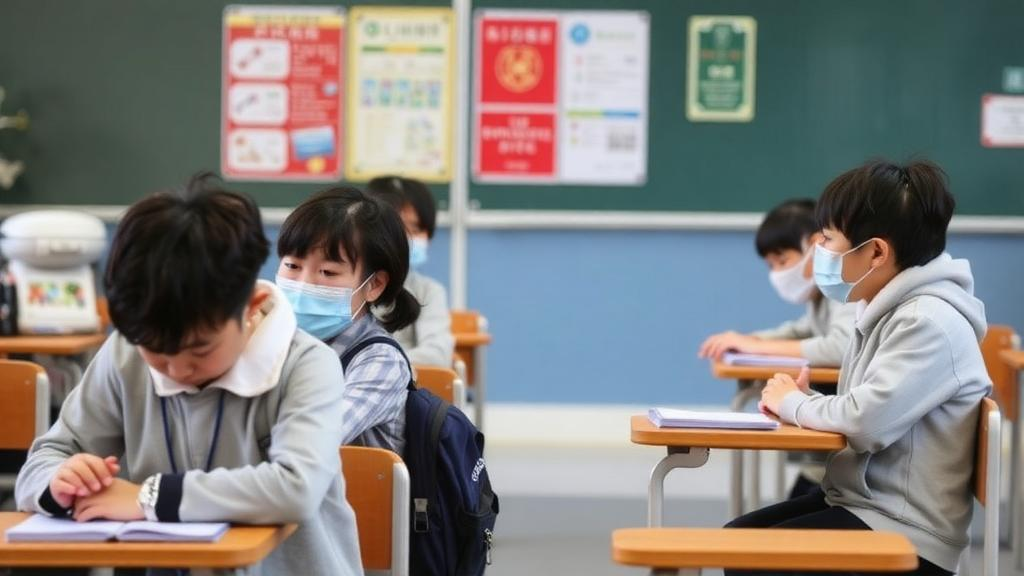
Suspending affected classes before local public-health intervention was associated with fewer new norovirus cases, fewer classes becoming affected and a shorter interval between intervention and outbreak resolution in schools and kindergartens managed by the Xi’an Center for Disease Control and Prevention. An analysis of outbreaks recorded from October 2020 through February 2023 included 61 outbreaks, of which 44, or 72.13%, met the study criteria and had complete data. The comparison was observational, so it supports an association between pre-intervention closures and outbreak outcomes rather than proving that closures alone caused the differences.
Researchers assembled comparison groups at a one-to-one ratio, matching outbreaks by institutional type, location and the number of cases recorded when the local CDC responded. Outbreaks in which classes had been suspended before CDC intervention formed the class-closure group, while outbreaks without such closures formed the non-closure group. The investigators compared subsequent cases, newly affected classes, time from intervention to outbreak end, overall outbreak duration, terminal attack rate and other relevant measures.
Paired Wilcoxon signed-rank tests found significantly fewer new cases in the closure group, with Z = −3.313 and P = 0.001, and fewer newly affected classes, with Z = −1.992 and P = 0.046. The interval between CDC intervention and the end of the outbreak was also shorter in the closure group, with Z = −2.392 and P = 0.017. Terminal attack rate did not differ significantly, with Z = −1.161 and P = 0.245, and overall outbreak duration also showed no significant group difference, with Z = −1.189 and P = 0.234.
Thus, the results linked pre-intervention class suspension with fewer subsequent cases, less spread into additional classes and a shorter interval after CDC intervention, but not with a measurably different terminal attack rate or total outbreak duration. The study does not establish that suspension was superior to every other possible response strategy or that it could replace other outbreak-control measures. Multivariable linear regression identified several factors associated with lower cumulative case numbers.
These included outbreaks reported by government employees, adequate ventilation at the outbreak site, public ownership of the institution, class suspension before CDC intervention and no more than 15 cases at the time of CDC response. Public institutions, especially kindergartens, were associated with lower cumulative case numbers in the model. Shorter overall outbreak durations were associated with CDC intervention within 48 hours of the first case’s onset, suspension of classes before CDC intervention and public ownership of the institution, particularly in kindergartens and primary schools.
The investigators described closure within 48 hours of first-case onset as the optimal timing and identified the most effective intervention condition as one in which no more than 15 cases had occurred. These results came from statistical models applied to the outbreaks in this study population, rather than from a randomized comparison of different closure schedules. The research was limited to educational settings under the jurisdiction of the Xi’an CDC and to outbreaks with complete data that satisfied the investigators’ criteria.
The inclusion of closures that had occurred before CDC intervention, together with the matched comparison design, complicates interpretation of the causal role of closure. The measured associations were clearest for fewer new cases and newly affected classes, while terminal attack rate and overall duration did not differ significantly between groups. The findings identify class suspension before CDC response, the timing of intervention, initial case numbers, ventilation, reporting channels and institutional characteristics as variables associated with outbreak outcomes in Xi’an.
Whether these relationships hold in other regions or under different class-closure policies was not evaluated in the supplied study.
Subject of Research: Association between class closures before CDC intervention and norovirus outbreak outcomes in Xi’an educational settings
Article Title: Evaluating the effect of class closure strategies on norovirus outbreaks in educational settings
Article References: Zhang, H., Huang, A.-Y., Ning, S.-Q., Lu, M.-W., & Yu, L.-F. (2026). Evaluating the effect of class closure strategies on norovirus outbreaks in educational settings. BMC Public Health. https://doi.org/10.1186/s12889-026-29899-1
Image Credits: AI Generated
DOI: 10.1186/s12889-026-29899-1
Keywords: norovirus, school outbreaks, kindergartens, class closures, Xi’an, CDC intervention, ventilation, outbreak duration, observational study, Evaluating, effect, class
Cite Scienmag News
Kristina Jarvis. (October 21, 2026). Class closures associated with fewer norovirus cases in Xi’an schools. Scienmag. https://scienmag.com/class-closures-associated-with-fewer-norovirus-cases-in-xian-schools/
Kristina Jarvis. "Class closures associated with fewer norovirus cases in Xi’an schools." Scienmag, 21 October 2026, https://scienmag.com/class-closures-associated-with-fewer-norovirus-cases-in-xian-schools/. Accessed 21 October 2026.
Kristina Jarvis. "Class closures associated with fewer norovirus cases in Xi’an schools." Scienmag. October 21, 2026. https://scienmag.com/class-closures-associated-with-fewer-norovirus-cases-in-xian-schools/


