


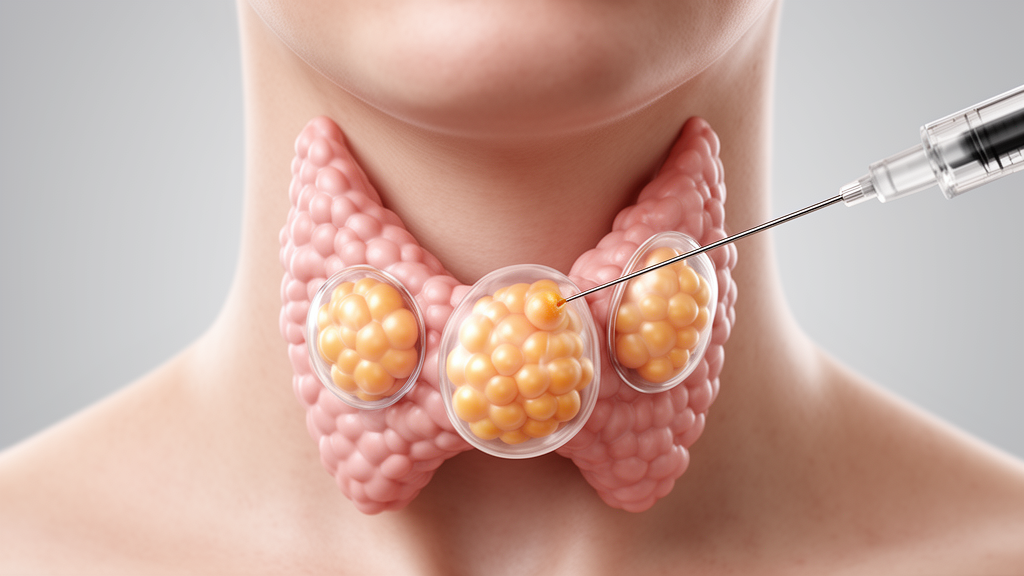
A focused review with two illustrative cases concludes that follicular-patterned thyroid tumors create a consequential diagnostic gap for radiofrequency ablation and remote-access surgery. Fine-needle aspiration can characterize cells and assign Bethesda risk categories, but it cannot determine whether a follicular tumor has invaded its capsule or blood vessels. That distinction defines follicular thyroid carcinoma and ordinarily requires examination of a surgical specimen. The authors argue that repeated reports of tumor deposits along needle tracts, ablation paths and surgical tunnels justify closer attention to diagnostic uncertainty before a minimally invasive procedure is selected. The evidence remains dominated by case reports, small series and mechanistic reasoning, so the review does not establish an incidence rate or prove that these procedures generally cause implantation.
The clinical problem begins with a fundamental mismatch between cytology and the disease it must exclude. Classical papillary thyroid carcinoma is often recognized through characteristic nuclear features that can be sampled by fine-needle aspiration. Follicular thyroid carcinoma, by contrast, is defined by capsular invasion, vascular invasion or both. These architectural findings depend on examining the tumor-capsule interface and associated vessels, not merely isolated cells. A macrofollicular lesion containing abundant colloid and bland nuclei can therefore receive a reassuring Bethesda II interpretation even though later examination of an intact specimen reveals capsular invasion. The limitation is not simply reduced sensitivity or specificity; it reflects the inability of cytology to assess the tissue relationships needed for definitive classification.
Bethesda reporting helps clinicians communicate malignancy risk, but the boundary remains visible in categories such as benign and indeterminate cytology. Indeterminate results can signal the need for histologic evaluation, whereas the most difficult scenario arises when a follicular-patterned lesion is not recognized as potentially neoplastic before treatment. This matters because radiofrequency ablation destroys or alters the target tissue and may complicate subsequent histologic interpretation. Endoscopic and robotic thyroidectomy have a different objective, but they create subcutaneous, intermuscular or alternative access corridors that are absent in conventional open surgery. A technically feasible and cosmetically attractive route is therefore not automatically oncologically equivalent. For a lesion whose invasive status remains uncertain, the very intervention intended to reduce morbidity can remove the opportunity for definitive examination or expose a potentially invasive tumor to extensive manipulation.
Procedure-related implantation is defined in the review as tumor deposition along a documented procedural pathway that is difficult to explain through ordinary lymphatic or hematogenous spread alone. Reported pathways include fine-needle aspiration or core-biopsy tracts, radiofrequency ablation trajectories, endoscopic surgical tunnels, robotic access corridors and chest-wall or axillary entry routes. Evidence is strongest when a deposit is anatomically aligned with the path of a needle or instrument, occurs in tissue where thyroid tissue or normal lymphoid architecture would not be expected, and is confirmed as thyroid-derived by pathology or immunophenotyping. Investigators must also consider alternatives such as residual disease in the thyroid bed, lymph-node metastasis, ordinary local recurrence or distant cutaneous metastasis. Not every subcutaneous lesion near a scar represents implantation, and incomplete procedural or imaging documentation can leave a case only strongly suggestive.
Proposed mechanisms involve displacement of viable tumor cells, their survival in newly disrupted tissue and subsequent growth. Needle passage may drag cells along a tract. Ablation introduces thermal injury, pressure changes, tissue disruption and post-procedure remodeling, while endoscopic and robotic operations repeatedly move instruments through broad working spaces that can differ substantially from those created during open thyroidectomy. Follicular architecture, encapsulation, capsular disruption, reduced cellular cohesion and vascular invasion have all been discussed as potentially relevant features. These remain reported associations or biologically plausible factors rather than validated predictors. The reviewed literature documents events arising from weeks to months after biopsy in some cases and years after endoscopic or robotic surgery in others, with deposits found in subcutaneous tissue, strap muscle, muscular planes, chest-wall access sites and the sternocleidomastoid region.
The first illustrative case involved a 35-year-old man whose right thyroid nodule appeared well defined and hypoechoic on ultrasonography, without microcalcifications or suspicious lymphadenopathy. Ultrasound-guided fine-needle aspiration was interpreted as Bethesda II, consistent with adenomatous goiter, and the lesion was treated with radiofrequency ablation as a presumed benign nodule. Less than two years later, imaging showed a new anterior cervical subcutaneous mass superficial to the strap muscles and spatially corresponding to the ablation needle trajectory. Enlarged central and right lateral neck nodes were also present. Fine-needle aspiration of a right level V node contained thyroid follicular epithelial cells, raising concern for metastatic follicular neoplasm. Surgery revealed multifocal follicular thyroid carcinoma in the right lobe, definite capsular invasion, central and pretracheal nodal metastases, and carcinoma in the anterior cervical subcutaneous tissue and strap muscle. The deposit lacked lymphoid architecture and aligned with the previous ablation route, supporting implantation.
Targeted sequencing in that case identified a DICER1 c.5428G>C, or p.D1810H, RNase IIIb hotspot mutation with a variant allele frequency of 33.88%. Rare KIT p.W359R and PIK3CA p.P104R variants were also detected and classified as variants of uncertain significance. DICER1 RNase IIIb hotspot variants have been reported in follicular-patterned thyroid tumors across pediatric, adolescent, young-adult and adult populations. Associated tumors may be macrofollicular, encapsulated, bland or infarction-prone, yet a subset has shown capsular invasion, vascular invasion, nodal disease, recurrence or progression. Many reported lesions remain low grade, making the evidence a spectrum of behavior rather than proof of a uniformly aggressive genotype. Crucially, the review states that no direct evidence links DICER1 alteration to procedure-related implantation; the mutation offers biological context, not a causal or predictive conclusion.
The second scenario involved a 31-year-old man who underwent endoscopic partial thyroidectomy for a right-lobe follicular-patterned nodule. Several years later, he developed recurrent disease in the thyroid bed, deposits along the endoscopic tunnel and additional anterior chest-wall nodules. Histopathology confirmed recurrent follicular-patterned thyroid carcinoma in the surgical cavity, soft tissue and tunnel pathway, with no distant metastasis identified at diagnosis. The distribution corresponded to the subcutaneous tunnel and extracervical entry route, supporting mechanical displacement during endoscopic manipulation. The two cases illustrate distinct pathways—ablation and surgical access—but a shared issue. In both, a follicular-patterned tumor with invasive potential was exposed to a procedure before its full biological significance was appreciated, and later disease appeared in tissue planes associated with the intervention.
The review proposes several domains for more rigorous preprocedural assessment: cytology, concordance between imaging and clinical behavior, the planned access route, molecular context and follow-up of the intervention pathway. These domains are descriptive rather than a validated management algorithm. Growth, size, sonographic pattern, cytology and molecular results may be discordant, and benign cytology is less definitive when follicular-lineage neoplasia remains possible. Documentation of needle paths, passes, ablation parameters, hydrodissection, capsule status, access routes, specimen handling and the location of subsequent lesions is needed to distinguish implantation from other recurrence patterns. Follow-up should also account for the fact that deposits have appeared months or years after the index procedure. Molecular findings may inform interpretation, but no genotype currently predicts implantation with sufficient validation to support genotype-based exclusion or selection rules.
Major uncertainties remain. The rarity of reported implantation events prevents reliable estimation of incidence or individual risk, while publication bias is likely because unusual complications attract more attention than uneventful procedures. The illustrative cases cannot establish causation, and the reviewed literature is heterogeneous, often lacking denominators and detailed procedural anatomy. Standardization is therefore essential: future reports should distinguish definite implantation, supported by spatial alignment and confirmation of thyroid origin, from probable or possible cases when documentation is incomplete. Prospective registries, procedure-specific datasets and molecularly annotated cohorts could test whether implantation reflects a reproducible mechanical pathway, how often it occurs and which patient or tumor features are associated with it. Until such evidence exists, the balanced conclusion is neither that radiofrequency ablation or remote-access surgery is broadly unsafe nor that rare implantation can be ignored. It is that follicular-lineage lesions require diagnostic scrutiny commensurate with the invasiveness of the proposed procedure, because definitive classification of capsular and vascular invasion may remain unavailable until tissue is examined directly.
Subject of Research: Diagnostic limits and procedure-related implantation in follicular-patterned thyroid tumors
Article Title: Diagnostic limitations and procedure-related implantation in follicular-patterned thyroid tumors: a focused review with two illustrative cases
Article References: Zhang, W., Chen, Y., Xiao, J., Liu, Y., Wang, P., Liu, H., Ren, J., & Wu, J. (2026). Diagnostic limitations and procedure-related implantation in follicular-patterned thyroid tumors: a focused review with two illustrative cases. Frontiers in Endocrinology, 17, Article 1927184. https://doi.org/10.3389/fendo.2026.1927184
Image Credits: AI Generated
DOI: 10.3389/fendo.2026.1927184
Keywords: follicular thyroid carcinoma, fine-needle aspiration, radiofrequency ablation, tumor implantation, endoscopic thyroid surgery, DICER1, thyroid nodules, Bethesda classification, Diagnostic, limitations, procedure-related, implantation
Cite Scienmag News
Ophelia Keating. (October 21, 2026). Follicular thyroid tumors expose a diagnostic gap in minimally invasive procedures. Scienmag. https://scienmag.com/follicular-thyroid-tumors-expose-a-diagnostic-gap-in-minimally-invasive-procedures/
Ophelia Keating. "Follicular thyroid tumors expose a diagnostic gap in minimally invasive procedures." Scienmag, 21 October 2026, https://scienmag.com/follicular-thyroid-tumors-expose-a-diagnostic-gap-in-minimally-invasive-procedures/. Accessed 21 October 2026.
Ophelia Keating. "Follicular thyroid tumors expose a diagnostic gap in minimally invasive procedures." Scienmag. October 21, 2026. https://scienmag.com/follicular-thyroid-tumors-expose-a-diagnostic-gap-in-minimally-invasive-procedures/


