

Sunday, June 28, 2026
Science
No Result
View All Result
  • Login
  • HOME
  • SCIENCE NEWS
  • CONTACT US
  • HOME
  • SCIENCE NEWS
  • CONTACT US
No Result
View All Result
Scienmag
No Result
View All Result
Home Science News Social Science

Majority of Patients Favor Their Primary Physicians, Willing to Wait Longer for Appointments

March 24, 2025
in Social Science
Reading Time: 1 min read
0
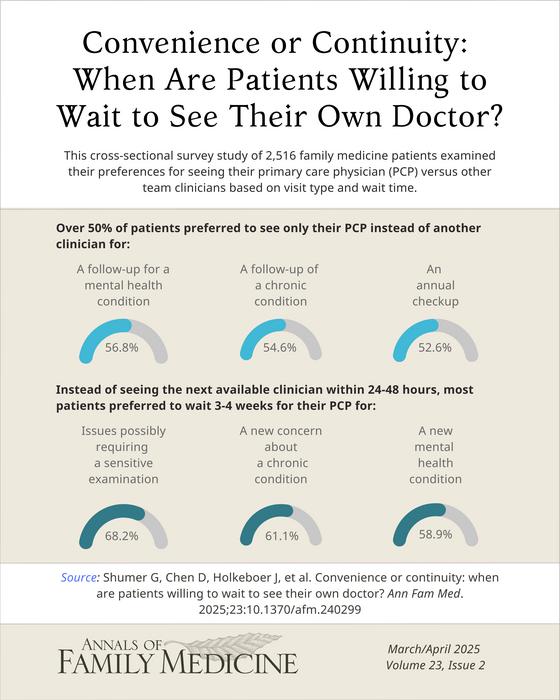
Convenience or Continuity: When Are Patients Willing to Wait to See Their Own Doctor?
66
SHARES
598
VIEWS
Share on FacebookShare on Twitter
ADVERTISEMENT

In an era where the healthcare landscape is rapidly evolving, a compelling study led by Gregory Shumer, MD, MHSA, and his team at the University of Michigan seeks to illuminate the preferences of primary care patients regarding wait times and continuity of care. As the healthcare environment increasingly prioritizes accessibility and rapid care services, the question arises: how does this shift align with patient needs and expectations? The research digs deep into the preferences of patients when faced with the choice between continuity with their own primary care physician (PCP) and the convenience of quicker access to care from other clinicians.

The background of this original research highlights a pivotal aspect of the patient experience—sparking a dialogue about the often-overlooked trade-offs users face in health systems. The study’s researchers embarked on a mission to understand whether patients hold a preference for waiting to see their familiar PCP, and the implications this has on healthcare delivery models. The results could significantly shape strategies for health systems that strive to innovate service delivery methods while still catering to what patients deem essential for their wellbeing.

To gather meaningful data, a cross-sectional online survey was conducted on adult primary care patients in Michigan. This comprehensive approach offered insights from a diverse array of primary care patients, drawing connections between their experiences and preferences across various healthcare scenarios. Each participant responded to different scenarios detailing visit types, such as annual checkups, chronic and mental health follow-ups, new symptoms, and urgent concerns. Survey questions were structured to elicit choices among three distinct options: strictly seeing their PCP, preferring to see their PCP but willing to see

Tags: accessibility in healthcare servicescontinuity of care in healthcarehealthcare delivery modelshealthcare innovation and patient needsimportance of primary care physicianspatient experience in primary carepatient satisfaction with primary physicianspatient willingness to wait for careprimary care patient preferencesprimary care research studiesUniversity of Michigan healthcare studywait times for doctor appointments
Share26Tweet17
Previous Post

Innovative Tool Enhances the Efficacy of Cancer Immunotherapy

Next Post

An Easy Strategy to Enhance Mathematical Advancement

Related Posts

Social Science

Direct questioning could exaggerate media criticism, study finds

June 25, 2026
Social Science

Limited Proof That Australia’s Under-16 Social Media Limits Reduce Adolescent Usage

June 24, 2026
Social Science

Study Reveals Connection Between Social Media Use and Declining Mental Health in Older Canadians

June 24, 2026
Social Science

Pop Song Lyrics Became Increasingly Self-Focused in the US and Germany Over the Past 50 Years, Study Finds

June 24, 2026
Neurobiomarker-Guided Neuromodulation Treats Youth Depression — Social Science
Social Science

Neurobiomarker-Guided Neuromodulation Treats Youth Depression

June 24, 2026
Finns’ Engagement in Voluntary National Defence Driven by Diverse Motivations, Study Finds — Social Science
Social Science

Finns’ Engagement in Voluntary National Defence Driven by Diverse Motivations, Study Finds

June 24, 2026
Next Post
An Easy Strategy to Enhance Mathematical Advancement

An Easy Strategy to Enhance Mathematical Advancement

  • Mothers who receive childcare support from maternal grandparents show more parental warmth, finds NTU Singapore study

    Mothers who receive childcare support from maternal grandparents show more parental warmth, finds NTU Singapore study

    27656 shares
    Share 11059 Tweet 6912
  • University of Seville Breaks 120-Year-Old Mystery, Revises a Key Einstein Concept

    1061 shares
    Share 424 Tweet 265
  • Bee body mass, pathogens and local climate influence heat tolerance

    682 shares
    Share 273 Tweet 171
  • Researchers record first-ever images and data of a shark experiencing a boat strike

    546 shares
    Share 218 Tweet 137
  • Groundbreaking Clinical Trial Reveals Lubiprostone Enhances Kidney Function

    531 shares
    Share 212 Tweet 133
Science

Embark on a thrilling journey of discovery with Scienmag.com—your ultimate source for cutting-edge breakthroughs. Immerse yourself in a world where curiosity knows no limits and tomorrow’s possibilities become today’s reality!

RECENT NEWS

  • Tracking Lanthanide-Labeled Microplastics in Plants
  • POSTECH Researchers Slash Cost of Reconstituted Cell-Free Systems by 95%
  • AI and Physics Collaborate to Design Advanced Hydrogen Storage Materials
  • ECMWF Integrates Cloud Radar Data into Global Forecasting System for the First Time Worldwide

Categories

  • Agriculture
  • Anthropology
  • Archaeology
  • Athmospheric
  • Biology
  • Biotechnology
  • Blog
  • Bussines
  • Cancer
  • Chemistry
  • Climate
  • Earth Science
  • Editorial Policy
  • Marine
  • Mathematics
  • Medicine
  • Pediatry
  • Policy
  • Psychology & Psychiatry
  • Science Education
  • Social Science
  • Space
  • Technology and Engineering

Subscribe to Blog via Email

Success! An email was just sent to confirm your subscription. Please find the email now and click 'Confirm Follow' to start subscribing.

Join 5,147 other subscribers

© 2025 Scienmag - Science Magazine

Welcome Back!

Login to your account below

Forgotten Password?

Retrieve your password

Please enter your username or email address to reset your password.

Log In
No Result
View All Result
  • HOME
  • SCIENCE NEWS
  • CONTACT US

© 2025 Scienmag - Science Magazine
