


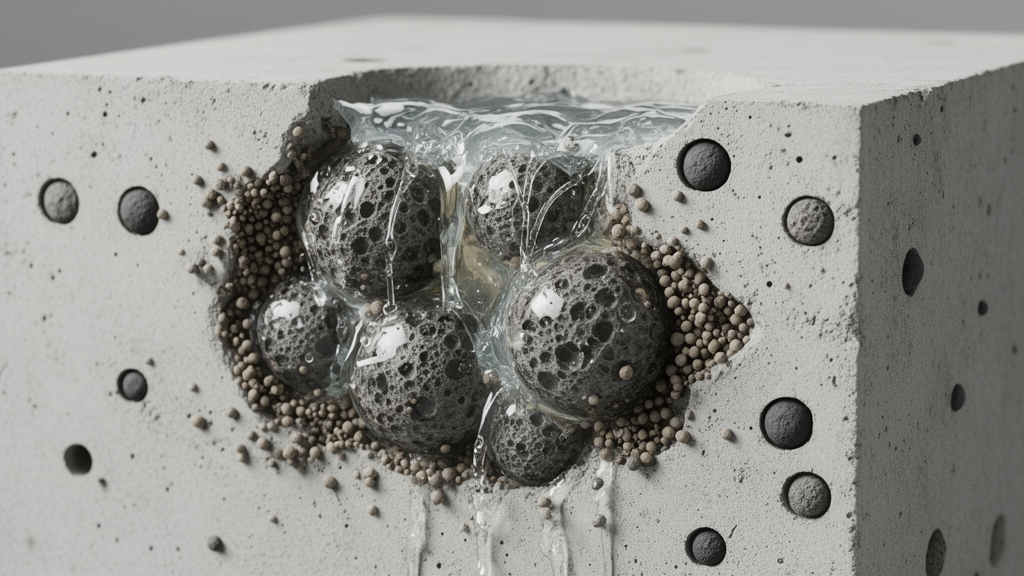
Concrete made with alkali-conditioned fly ash lightweight aggregate can retain the compressive strength required for demanding structural applications while reducing dead load and improving resistance to water penetration, according to a laboratory study of lightweight aggregate concrete. The researchers found that conditioning spherical fly ash aggregate in sodium hydroxide solution increased its 28-day compressive strength, strengthened the vulnerable zone where aggregate meets cement paste, and lowered the permeability of the resulting concrete. The work was conducted on laboratory mixtures rather than field-scale shaft structures, and the authors noted that fly ash varies among sources, leaving the broader applicability of the method to be tested.
The motivation for the study is the weight of underground mine shafts, whose large concrete walls can impose substantial loads on surrounding geology and support systems. Lightweight concrete can reduce those loads by replacing part or all of the natural sand-and-gravel fraction with less-dense aggregate. The researchers used spherical lightweight aggregates made primarily from Class F fly ash, with a small amount of Portland cement to create coherent pellets. In an equal-volume concrete comparison, the hardened density was 2,385 kilograms per cubic meter for concrete containing natural gravel and 1,940 kilograms per cubic meter for concrete containing untreated fly ash lightweight aggregate, a reduction of about 18.7 percent.
Before testing the alkali treatment, the team screened aggregates containing 10, 20, 30, or 40 percent cement by blend mass, while fixing the water-to-cement ratio at 0.2 and the admixture dosage at 1 percent. At 28 days, cylindrical aggregate strength rose steadily from 6.3 to 18.7 megapascals as cement content increased, while packing density rose from 840 to 1,023 kilograms per cubic meter. One-hour water absorption moved in the opposite direction, declining from 18.7 to 8.5 percent. The researchers selected the 10 percent cement formulation for subsequent tests on the basis of its adequate molding performance and basic strength while limiting the cement content, rather than selecting the strongest formulation obtained in the preliminary comparison.
Immersion tests then compared sodium hydroxide, sodium chloride, sodium sulfate, and paired salt solutions. The treatment concentrations and ages varied, but sodium hydroxide produced the clearest improvement among the individual solutions, while the sodium hydroxide plus sodium sulfate combination performed best among the binary treatments in the aggregate-strength comparison. Other salts produced modest gains or declines relative to the plastic-bag-cured reference. Follow-up tests therefore focused on sodium hydroxide at mass concentrations of 10, 20, 30, and 40 percent, with the solution-to-aggregate mass ratio set at 1:1 and immersion conducted at 20 plus or minus 2 degrees Celsius and relative humidity of at least 95 percent.
Strength did not rise indefinitely with alkalinity. The researchers measured a peak 28-day aggregate compressive strength of 9.62 megapascals after treatment with 30 percent sodium hydroxide, a 64 percent increase over the control reported in that test series. In a separate comparison, strength at 30 percent was reported as 182.1 percent above the control, while 40 percent sodium hydroxide produced strength 6.4 percent below the 30 percent treatment. Apparent density followed a similar rise-and-fall pattern, and one-hour water absorption changed in the opposite direction, reaching its most favorable value at 30 percent concentration. These observations identify a threshold beyond which the highly alkaline environment appears to impair rather than improve the hydration products that support aggregate strength.
X-ray diffraction and Fourier-transform infrared spectroscopy supported a reaction-based explanation for the concentration effect. The principal crystalline phases in the untreated and treated aggregates included mullite, quartz, calcite, and calcium silicate hydrate, and alkaline curing did not create a new mineral phase. At 30 percent sodium hydroxide, quartz diffraction peaks became relatively weaker while calcium silicate hydrate peaks became stronger, qualitatively indicating greater consumption of quartz and formation of hydration products. At 40 percent, the relative intensities of both quartz and calcium silicate hydrate peaks declined. The infrared spectra likewise indicated more calcium silicate hydrate and calcium aluminate hydrate formation after 30 percent treatment, but suggested reduced formation of those products at the highest concentration. These phase analyses support a mechanism in which moderate alkalinity accelerates fly-ash reaction but excessive alkalinity can inhibit the development or stability of hydration products.
The researchers proposed that sodium hydroxide initiates dissolution at the fly-ash particle surface by acting on silanol and siloxane bonds. As immersion continues, the solution penetrates the aggregate and disrupts the glassy structure of the ash. Calcium released from cement hydration products can then react with the activated silicate species to form calcium silicate hydrate. Although the high hydroxide concentration suppresses the aqueous concentration of dissolved calcium at first, calcium gradually diffuses from the aggregate interior into the bath, sustaining the pozzolanic reaction and densifying the aggregate. The resulting material has a smoother, more strongly interlocked microstructure. The authors also emphasized that this mechanism was inferred from the combined strength, phase, and microscopic evidence rather than demonstrated through a single direct measurement.
In concrete tests, the researchers compared three mixtures at a water-to-cement ratio of 0.5 while keeping the coarse-aggregate volume constant. These contained crushed stone, untreated fly ash lightweight aggregate, or alkali-conditioned fly ash lightweight aggregate. At 3, 7, and 28 days, crushed-stone concrete had the highest compressive strength, followed by concrete with conditioned lightweight aggregate and then concrete with untreated lightweight aggregate. At 28 days, their average strengths were 47.86, 46.41, and 43.62 megapascals, respectively, with standard deviations of 0.9, 1.1, and 2.3 megapascals. The conditioned lightweight aggregate therefore produced concrete 6.4 percent stronger than the otherwise comparable untreated aggregate mixture, while remaining close to the strength of the natural-stone concrete tested at the same water-to-cement ratio.
Permeability testing showed a clearer advantage for the treated aggregate. At 3 days, the mean permeability coefficients were 8.7 millimeters per hour for crushed-stone concrete, 7.9 for untreated lightweight aggregate concrete, and 5.1 for alkali-conditioned lightweight aggregate concrete. All three values declined as curing continued, reaching 4.3, 3.7, and 2.7 millimeters per hour, respectively, at 28 days. These results were averages from six replicate specimens for each mixture. The declining values with age were associated with continued cement hydration and the progressive filling of interconnected pores, while the lower coefficient of the conditioned mixture was consistent with its denser interfacial microstructure. Because the study used controlled laboratory mixtures and a particular aggregate formulation, the measurements do not by themselves establish long-term performance in a full-scale shaft wall or other field application.
Microscopy and microhardness measurements identified the aggregate–paste interface as a central reason for the improvement. In concrete with crushed stone or untreated fly ash aggregate, microhardness in the interfacial transition zone was below that of the bulk cement paste and decreased as the test position approached the aggregate surface. In concrete containing alkali-conditioned aggregate, interfacial hardness exceeded that of the bulk paste and increased toward the aggregate. Scanning electron micrographs showed a porous crushed-stone interface containing needle-like calcite, whereas untreated fly ash aggregate retained visible ash spheres and large voids. The treated aggregate presented a smoother cross-section without recognizable fly-ash particles in the observed area, with calcium silicate hydrate gel densely filling the interface and interlocking the aggregate with the paste. The study therefore links the observed strength and permeability gains to stronger interfacial bonding, denser reaction products, and the additional internal moisture supplied by the lightweight aggregate during curing, while identifying source-dependent fly ash behavior as an important limitation on generalization.
Subject of Research: Experimental enhancement of fly ash lightweight aggregate concrete through alkali conditioning
Article Title: Performance enhancement of concrete with alkali-conditioned fly ash lightweight aggregate
Article References: Zheng, X., Han, T., Wang, Z., Luo, T., Liu, G., Xue, B., Yu, P., & Ji, Y. (2026). Performance enhancement of concrete with alkali-conditioned fly ash lightweight aggregate. Frontiers in Materials, 13, Article 1978854. https://doi.org/10.3389/fmats.2026.1978854
Image Credits: AI Generated
DOI: 10.3389/fmats.2026.1978854
Keywords: fly ash, lightweight concrete, alkali conditioning, sodium hydroxide, compressive strength, water permeability, interfacial transition zone, underground mining, cement hydration, shaft structures, Performance, enhancement
Cite Scienmag News
Denise Maddox. (October 21, 2026). Alkali-Treated Fly Ash Aggregate Lightens and Strengthens Concrete. Scienmag. https://scienmag.com/alkali-treated-fly-ash-aggregate-lightens-and-strengthens-concrete/
Denise Maddox. "Alkali-Treated Fly Ash Aggregate Lightens and Strengthens Concrete." Scienmag, 21 October 2026, https://scienmag.com/alkali-treated-fly-ash-aggregate-lightens-and-strengthens-concrete/. Accessed 21 October 2026.
Denise Maddox. "Alkali-Treated Fly Ash Aggregate Lightens and Strengthens Concrete." Scienmag. October 21, 2026. https://scienmag.com/alkali-treated-fly-ash-aggregate-lightens-and-strengthens-concrete/


