


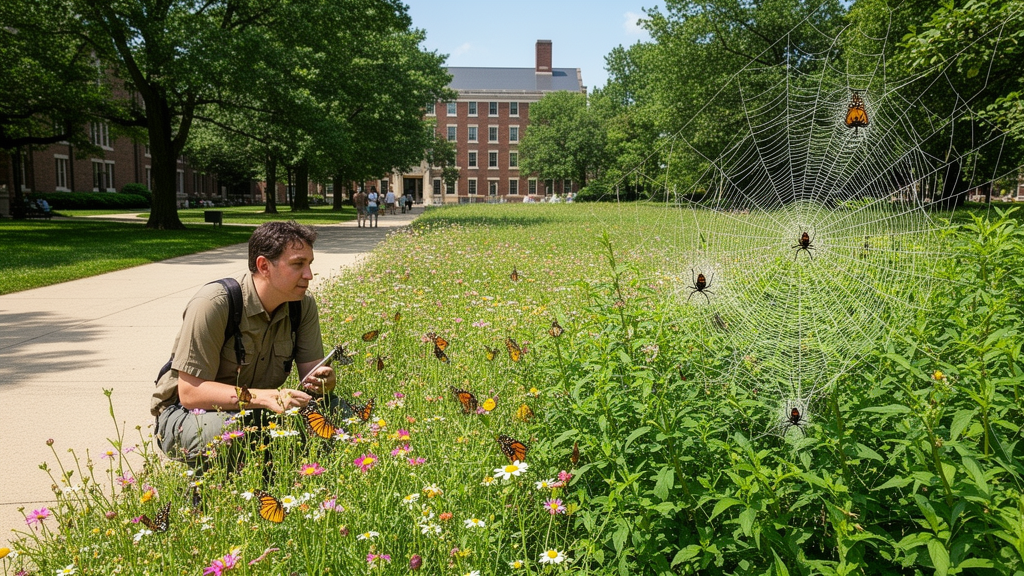
A six-month field study at the University of Kalyani in tropical Nadia, West Bengal, found no statistically significant habitat-related differences in the taxonomic or functional diversity of butterflies and spiders across roadside, managed and unmanaged parts of the 400-acre campus. The researchers recorded 88 arthropod species: 49 butterfly species and 39 spider species. Butterfly richness was numerically lower along roadsides, but the difference did not meet the study’s threshold for statistical significance, while functional diversity remained stable throughout the sampled campus. The authors interpret the pattern as evidence of ecological stability and high functional redundancy within this particular landscape, while emphasizing that the small and unevenly replicated sample limits broader conclusions.
The observational study compared two groups chosen for their contrasting positions in the food system and their distant evolutionary relationship. Butterflies are primary consumers that can also pollinate plants, while spiders are predators that may regulate herbivorous insects. Their environmental requirements are not identical: butterfly communities can depend strongly on larval host plants, whereas spiders are influenced by prey availability, the surfaces available for anchoring webs, vegetation layers and physical structure. By sampling both groups across the same disturbance gradient, the researchers tested whether markedly different campus habitats filtered communities or instead supported broadly overlapping assemblages.
Ten sampling plots were established across the campus, with at least 200 meters separating plots to preserve spatial independence. Six were classified as highly urbanized roadside environments, where visual estimates indicated less than 20% canopy cover, 40–60% impervious surface and fragmented or sparse vegetation. Two were managed green spaces characterized by 20–40% canopy, short or mowed grass, regular landscaping and little heavy infrastructure. The remaining two were unmanaged natural zones with 75–90% canopy cover, dense or overgrown understory, native trees and an undisturbed leaf-litter floor. The estimated spatial footprints were approximately 0.3 hectares for the roadside cluster, 10 hectares for the managed areas and 12 hectares for the unmanaged areas, giving the campus a clear structural gradient but an unbalanced number of replicate plots.
Butterflies were recorded through systematic point counts along transects approximately 200 meters long and 10 meters wide. Observers walked at 10 meters per minute and identified butterflies within five meters in front of or beside the route under warm, calm and largely dry conditions, generally between 8 a.m. and 4 p.m. Spiders were sampled through one- to two-hour visual searches of tree bark, foliage, twigs, building facades, leaf litter and fallen debris. Individuals were photographed to minimize collection, although some spiders that could not be identified immediately were preserved in ethanol for laboratory examination. Records that could not be assigned confidently to at least the genus were excluded. Surveys ran from January through June 2026, but weather restrictions limited successful visits to three or four per site rather than the initially planned monthly schedule.
The butterfly survey recorded 772 individuals belonging to 49 species, 41 genera and five families. Mean species richness was highest in the unmanaged plots, with 35.0 species, followed by 33.5 in managed plots and 20.0 in roadside plots. The roadside difference was not statistically significant for species richness in the one-way analysis of variance, which yielded F = 4.09 and p = 0.066. Shannon diversity and Simpson’s index also showed no significant differences among habitat categories. For spiders, the survey recorded 203 individuals representing 39 species, 24 genera and seven families. Mean richness was highest in managed plots at 16.5 species, compared with 13.5 in unmanaged and 11.5 in roadside plots, but neither richness nor either alpha-diversity measure differed significantly among the three habitat types.
Community-composition tests produced a similar result. The researchers calculated Bray–Curtis dissimilarities from pooled presence–absence records for each plot and visualized the assemblages with two-dimensional non-metric multidimensional scaling. The butterfly ordination had a stress value of 0.10 and the spider ordination 0.12, both within the threshold the authors considered acceptable for ecological interpretation. A permutational multivariate analysis of variance with 999 permutations found no significant association between habitat category and community composition. For butterflies, the result was F = 1.057, R² = 0.232 and p = 0.44; for spiders, it was F = 0.724, R² = 0.171 and p = 0.884. The authors linked the broad overlap partly to generalist species that were widely distributed across the campus and able to cross local habitat boundaries.
Trait-based analyses detected no significant functional separation among the habitats. For butterflies, the selected traits were wingspan, larval host-plant breadth and host-plant form, with host-plant breadth distinguishing specialist from generalist feeding categories. The spider traits comprised hunting mode, web type, preferred stratum, circadian activity and body size. Because the trait datasets combined continuous and categorical measurements, the researchers used Gower dissimilarity to calculate functional richness, functional evenness and functional divergence. None differed significantly among roadside, managed and unmanaged habitats for either arthropod group. Butterfly functional richness and functional divergence had p-values of 0.141 and 0.702, while functional evenness showed a nonsignificant trend at p = 0.078. For spiders, p-values for the three indices ranged from 0.710 to 0.882.
Relative functional redundancy was high across all sampled habitats. Using a generalized Hill-number framework with order two, the researchers estimated redundancy at 0.77–0.93 for butterfly assemblages and 0.67–0.87 for spider assemblages. In the study’s trait-based framework, these values indicate that multiple species occupied similar combinations of ecological characteristics within each habitat. That overlap may help explain why several diversity measures remained stable despite substantial differences in canopy, impervious surface and disturbance. The result does not mean that the communities were identical, nor does it establish that pollination, predation or pest suppression occurred at equal rates in every habitat: the study did not measure interaction networks, pollination success, prey consumption, predation rates or population trends.
Several limitations constrain the findings. The investigation covered one tropical suburban campus, just 10 plots and a single six-month sampling period, and it compared six roadside plots with only two managed and two unmanaged plots. This unequal replication gave the statistical tests limited power and left open the possibility that real spatial differences were masked by small samples and substantial variation among individual plots. The absence of statistical significance therefore should not be treated as proof that habitat had no effect or that every zone was ecologically equivalent. The broad distribution of generalist species also does not rule out biotic homogenization. Although the study detected no significant habitat-associated turnover, compositional uniformity itself may reflect the loss or absence of more specialized taxa, a question the data cannot resolve directly.
What the results support is a specific and measurable form of stability within the sampled landscape: at Kalyani University, butterflies and spiders retained statistically comparable richness, community composition and functional structure across a pronounced gradient of local management. The study therefore provides a case in which heterogeneous campus microhabitats supported both primary consumers and predators, including highly mobile hunting spiders and adaptable web-builders, without the measured declines expected by the researchers’ initial hypothesis. The authors also highlight high redundancy as a possible buffer against the loss of a particular ecological role when one species disappears. They do not establish that campuses generally resist urbanization, that specialized species were unaffected or that the observed assemblages will persist through seasons and years. The safest conclusion is that this campus retained a diverse, functionally overlapping arthropod community during the 2026 survey, while the uneven design leaves the broader scale of the result uncertain.
Subject of Research: Taxonomic and functional diversity of butterflies and spiders across a tropical university campus urbanization gradient
Article Title: High functional redundancy and stable diversity of phylogenetically distant arthropods across a tropical university campus urbanization gradient
Article References: Sarkar, I., & Sarkar, S. K. (2026). High functional redundancy and stable diversity of phylogenetically distant arthropods across a tropical university campus urbanization gradient. Frontiers in Ecology and Evolution, 14, 1941194. https://doi.org/10.3389/fevo.2026.1941194
Image Credits: AI Generated
DOI: 10.3389/fevo.2026.1941194
Keywords: urban ecology, arthropod diversity, butterflies, spiders, functional redundancy, tropical campus, community composition, urban green space, habitat gradient, biotic homogenization, High, functional
Cite Scienmag News
Gavin Prescott. (October 21, 2026). Campus butterflies and spiders show stable diversity across an urbanization gradient. Scienmag. https://scienmag.com/campus-butterflies-and-spiders-show-stable-diversity-across-an-urbanization-gradient/
Gavin Prescott. "Campus butterflies and spiders show stable diversity across an urbanization gradient." Scienmag, 21 October 2026, https://scienmag.com/campus-butterflies-and-spiders-show-stable-diversity-across-an-urbanization-gradient/. Accessed 21 October 2026.
Gavin Prescott. "Campus butterflies and spiders show stable diversity across an urbanization gradient." Scienmag. October 21, 2026. https://scienmag.com/campus-butterflies-and-spiders-show-stable-diversity-across-an-urbanization-gradient/


