

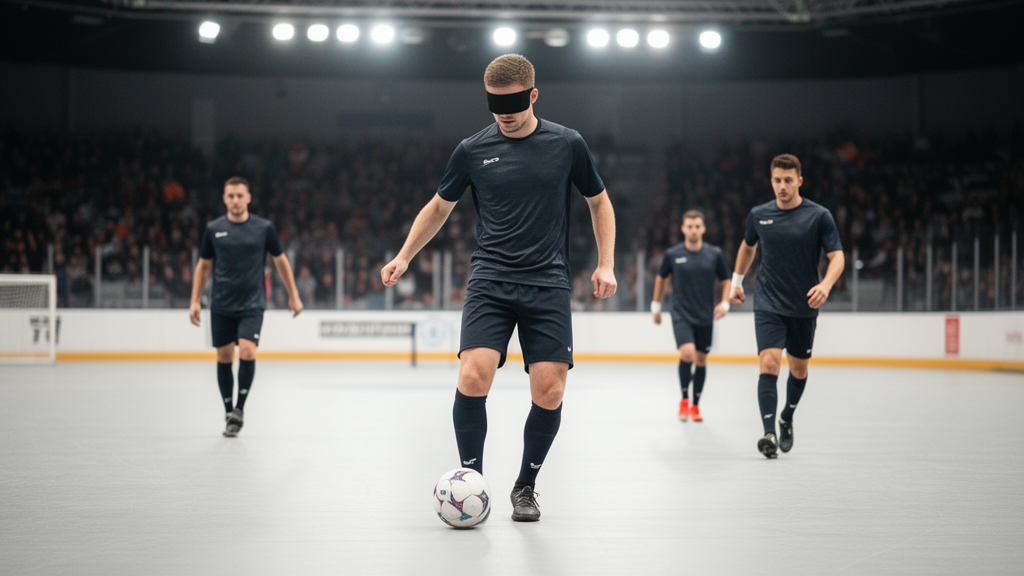
Argentina’s elite blind football team showed pronounced right-foot predominance during the 2022 IBSA Copa América, but the apparent scoring advantage of its rarer left-foot actions was not statistically established, according to a retrospective notational analysis. Across six matches, the team used the right foot for 107 of 141 analysed shooting actions, compared with 34 left-foot actions, producing a lateral asymmetry index of 51.8% and a right-to-left ratio of 3.1 to 1. Individual specialisation was even more pronounced: five of eight players used only one foot throughout the tournament. The findings describe a small sample and do not demonstrate that either foot is inherently more effective.
The analysis examined a publicly available event log generated from official broadcasts of the Argentine men’s national five-a-side football team, a sport for players with visual impairment played on a 40 by 20 metre court with kickboards. The original log contained 148 open-play or restart shooting actions, two penalty kicks and 14 duplicated goal records. After the researchers removed the duplicate goals, excluded eight actions without a recorded executing foot and omitted one action struck with the body, the dataset contained 141 shots by eight players against Peru, Mexico, Chile, Colombia and Brazil. The team scored 14 goals from these actions, including two penalties. Because the penalties had no court coordinates, spatial and multivariable analyses used 139 non-penalty actions containing 12 goals.
Players with the IBSA B1 classification are totally blind outfield players who wear eyeshades, while each team also fields a sighted goalkeeper. In conventional football, players can visually identify an opportunity and alter which leg they use within fractions of a second. In blind football, by contrast, the executing foot is closely connected to the player’s physical orientation relative to an audible ball and verbal cues from guides. The researchers therefore cautioned that the right-left comparison should not be treated as a simple comparison of dominant and non-dominant limbs: limb dominance was not independently measured, and each player’s preferred foot was defined only as the foot used most often in the recorded competition actions.
The team-level imbalance was accompanied by substantial variation among athletes. Four players used exclusively the right foot, while one used exclusively the left. Another was nearly one-sided, using the right foot for 23 of 24 actions. Only two players used both feet regularly, with asymmetry indices of 54.3% and 40.0%. The exclusively left-footed player, identified as P03, recorded 22 shots and four goals, making that athlete responsible for four of the six goals scored with the left foot. Among players with at least five actions, individual asymmetry did not have a statistically significant association with goal rate: Pearson’s correlation was 0.30 and Spearman’s correlation was 0.29, based on seven players. With so few athletes and goals, these estimates cannot establish or exclude a relationship between bilateral foot use and scoring performance.
Left-foot actions had a higher observed goal rate than right-foot actions, 17.6% compared with 7.5%, equivalent to six goals from 34 actions versus eight from 107. The crude odds ratio was 2.65, but its 95% confidence interval ranged from 0.85 to 8.28, and Fisher’s exact test produced a p value of 0.102. The absolute difference was 10.1 percentage points, with a 95% confidence interval from minus 1.2 to 26.4 percentage points. Left-foot shots were also more often on target, at 47.1% versus 36.4%, although that comparison was also imprecise and non-significant, with an odds ratio of 1.55 and a 95% confidence interval of 0.71 to 3.38. The intervals were compatible both with no difference and with a substantial advantage.
Adjusting for the context of the attacks produced a similar point estimate without making the result conclusive. A Firth-penalised logistic regression based on the 139 non-penalty actions included executing foot, origin of play, lateral lane, distance from goal and match minute. Its left-foot odds ratio was 3.25, with a 95% confidence interval of 0.96 to 11.35 and p = 0.057. A reduced model controlling for foot and distance gave an odds ratio of 3.21. None of the other included variables was associated with goal scoring: distance, lateral lane, play origin and match minute all had confidence intervals spanning no association. At a reference scenario, the model predicted a 4.9% goal probability for a right-footed action and 14.4% for an otherwise identical left-footed action, but the authors said the sparse data and roughly 1.7 goal events per parameter limit the precision of this contrast.
Sensitivity analyses showed how strongly the apparent effect depended on a small number of players and actions. A model allowing actions to cluster within players widened the left-foot odds ratio’s confidence interval to 0.67–34.31. Leave-one-player-out estimates varied from 2.49 to 7.22, and statistical significance appeared only when particular right-footed scorers were omitted. Excluding the exclusively left-footed player reduced the adjusted odds ratio to 2.80, with a 95% confidence interval of 0.43–14.19 and p = 0.256. When the analysis instead compared each player’s preferred and non-preferred foot, the non-preferred foot produced two goals from 12 actions, a rate of 16.7%, compared with 12 goals from 129 preferred-foot actions, or 9.3%. That odds ratio was only 2.24, with a 95% confidence interval of 0.40–8.96 and p = 0.322.
Most attacks were generated close to the goal. Overall, 94.2% of the non-penalty actions were taken within 10 metres of the goal line, and every goal came from that area. Left-foot attempts were taken from a median distance of 6.5 metres, compared with 7.2 metres for right-foot attempts, but the difference was not statistically significant, with p = 0.060. Median absolute shot angle was similar at 33.2 degrees for the left foot and 34.1 degrees for the right, with p = 0.450. The proportion of attempts from the central lane did not differ significantly between feet, 47.1% for left-foot actions and 35.2% for right-foot actions. Zone-specific conversion estimates were unstable because each contained only six to 12 left-foot actions and one or two goals, so the analysis could not isolate a distinct spatial pathway for either foot.
The authors identified several limits that constrain how the results can be interpreted. The dataset included only eight players, six matches, 141 actions and 14 goals, and actions were nested within both players and matches. Player identity was strongly confounded with foot because five athletes used only one foot. The events and coordinates had been coded by the creator of the public database rather than by the study authors, and no intra- or inter-observer reliability information was available. The template’s left-right orientation could not be verified, so lateral analysis distinguished only central from wide positions. Start-of-play coordinates were unavailable, preventing analysis of how attacks progressed or of ball trajectories. Defensive pressure, goalkeeper positioning, player biomechanics and training loads were also absent, meaning the study could not test whether the less-used foot was selected in favourable or deceptive situations or whether one-sided patterns carried an injury-related load.
For coaches and scientists, the clearest implication is methodological rather than clinical: a visible imbalance in foot use may reflect the sensory demands and motor patterns of blind football, the composition of a particular squad and each player’s learned technique. Individual foot-use profiles may assist technical-tactical scouting and the planning of bilateral training, but the study does not support claims of a non-dominant-limb scoring advantage. Larger samples spanning multiple teams and tournaments, independent assessments of limb dominance, reliability-tested coding and linked biomechanical, training-load and injury data will be needed to determine whether selective use of the non-preferred foot represents a repeatable tactical advantage and whether persistent unilateral patterns carry measurable physiological costs.
Subject of Research: Foot-use asymmetry and shooting effectiveness in elite blind football
Article Title: Lateral foot-use asymmetry and offensive effectiveness in elite 5-a-side soccer for the blind: an exploratory notational analysis
Article References: Becerra-Patiño, B. A., Pino-Ortega, J., Yáñez-Sepúlveda, R., & López-Gil, J. F. (2026). Lateral foot-use asymmetry and offensive effectiveness in elite 5-a-side soccer for the blind: an exploratory notational analysis. Frontiers in Sports and Active Living, 8, Article 1887871. https://doi.org/10.3389/fspor.2026.1887871
Image Credits: AI Generated
DOI: 10.3389/fspor.2026.1887871
Keywords: blind football, F5 football, foot preference, lateral asymmetry, shooting effectiveness, notational analysis, Paralympic sport, Argentine national team, acoustic orientation, adaptive sport, Lateral, foot-use
Cite Scienmag News
Scienmag. (October 21, 2026). Blind football team shows striking foot-use asymmetry, study finds. https://scienmag.com/blind-football-team-shows-striking-foot-use-asymmetry-study-finds/
Scienmag. "Blind football team shows striking foot-use asymmetry, study finds." Scienmag, 21 October 2026, https://scienmag.com/blind-football-team-shows-striking-foot-use-asymmetry-study-finds/. Accessed 21 October 2026.
Scienmag. "Blind football team shows striking foot-use asymmetry, study finds." Scienmag. October 21, 2026. https://scienmag.com/blind-football-team-shows-striking-foot-use-asymmetry-study-finds/


