


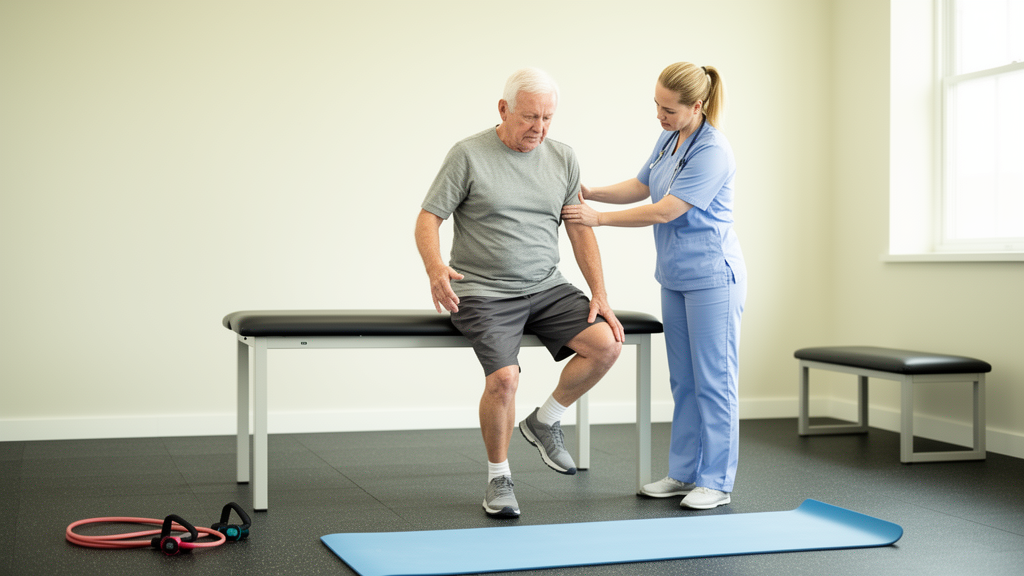
A systematic review and meta-analysis of 14 randomized controlled trials involving 1,029 people with knee osteoarthritis found that neuromuscular training produced modest improvements in knee symptoms, activities of daily living and knee-related quality of life compared with control interventions. The analysis did not find statistically significant benefits for pain, sport and recreation, most objective functional tests or muscle-strength measures, and it could not establish that neuromuscular training and the control approaches carried equivalent safety risks.
The review, published in Frontiers in Physiology, searched PubMed, Embase, Web of Science and the Cochrane Library from database inception through August 30, 2025. Seventeen reports describing 14 independent randomized trials were eligible, after duplicate publications and linked reports from the same trial were combined. The participants had a mean age of approximately 59 years; 516 were assigned to neuromuscular training and 513 to control interventions. These controls included rehabilitation exercise, quadriceps or progressive strength training, proprioceptive exercises, medication, education, usual care or no exercise. Training lasted from four weeks to 12 weeks and generally involved two or three sessions per week.
Neuromuscular training is an exercise-based approach that combines principles of motor control, joint biomechanics, coordination and dynamic stability rather than concentrating only on increasing muscle strength. In the meta-analysis, it produced a mean improvement of 4.44 points on the Knee injury and Osteoarthritis Outcome Score Symptoms scale, with a 95% confidence interval of 1.62 to 7.26 and P = 0.002. The difference was consistent with the direction favoring training, and statistical heterogeneity was low at I² = 23%. The Symptoms domain includes stiffness, swelling, activity limitation and mechanical discomfort, with higher scores indicating better symptom control.
Benefits also appeared in the activities-of-daily-living and quality-of-life domains, but the evidence was less uniform. Neuromuscular training was associated with a 3.94-point advantage in KOOS activities of daily living, covering activities such as standing, walking, turning, stair climbing and squatting (95% confidence interval 0.09 to 7.79; P = 0.04). This analysis had moderate heterogeneity, with I² = 54%, and its confidence interval was close to the null value. Excluding one report in sensitivity analysis strengthened the estimate to 5.44 points and reduced heterogeneity to I² = 5%, although the original result remained the primary finding.
For knee-related quality of life, the pooled mean difference was 5.59 points, with a 95% confidence interval of 0.97 to 10.21 and P = 0.02. This domain captures patients’ concerns about their knee, expectations for future function and the burden of osteoarthritis on daily life. Heterogeneity was high at I² = 71%, and a sensitivity analysis that included a trial with neuromuscular exercise in both randomized groups produced a similar estimate of 5.31 points. Broader general-health measures, including EQ-5D-3L outcomes, did not differ significantly between groups, so the finding was specific to knee-related quality of life rather than a demonstrated improvement in overall health status.
Neuromuscular training did not significantly outperform control interventions for pain. The primary KOOS Pain analysis yielded a mean difference of 1.95 points, but the 95% confidence interval ranged from −0.27 to 4.17 and P was 0.08, with no statistical heterogeneity at I² = 0%. A sensitivity analysis that included a trial comparing two neuromuscular-exercise strategies also remained nonsignificant. Additional pooled analyses of visual analogue pain scores after walking and overall pain likewise found no statistically significant differences. The pattern therefore suggests that any observed benefit is not adequately explained by a direct or consistent pain-relieving effect.
No statistically significant advantage was found in KOOS Sport and Recreation, where the mean difference was 1.64 points (95% confidence interval −2.24 to 5.53; P = 0.41; I² = 0%). Most objective performance measures also failed to show consistent between-group differences, including the 30-second chair-stand test, maximum knee bends, one-leg rises, one-leg hop, stair climbing, Timed Up and Go and walking velocity. A 20-meter walk test showed a statistically significant difference of −0.56 seconds in favor of neuromuscular training, but the clinical relevance of that small change was uncertain. Measures of knee-flexion and knee-extension peak torque, extensor and flexor strength and other biomechanical indicators likewise did not show consistent benefits.
Ten randomized trials contributed adverse-event data. The pooled relative risk was 0.83, with a 95% confidence interval of 0.50 to 1.37 and P = 0.46, indicating no statistically significant difference in reported adverse events between neuromuscular training and control groups. This result must not be read as proof that the interventions were equally safe, because studies differed in how they defined, monitored and reported adverse events. The funnel plot appeared broadly symmetrical, but Egger’s test for the adverse-event analysis gave P = 0.01, suggesting possible publication bias or small-study effects. The review’s GRADE assessment was used to evaluate certainty for primary outcomes and adverse events, recognizing factors such as risk of bias, inconsistency, indirectness, imprecision and publication bias.
Most prespecified subgroup analyses did not identify reliable effect modifiers. The reviewers examined control type, intervention duration, mean age, mean body-mass index and geographic region, and used formal interaction tests rather than treating a significant result in one subgroup as sufficient. Only mean age significantly interacted with the quality-of-life result, with P for interaction = 0.02. Although quality of life improved in groups whose mean age was at least 60 years and in those with a mean BMI of at least 28 kilograms per square metre, the limited number of studies and reliance on study-level rather than individual-participant age data make the age signal exploratory. No definitive regional, BMI, duration or control-type effect was established.
Clinical importance remains another central limitation. The pooled differences of 4.44 points for symptoms, 3.94 for activities of daily living and 5.59 for quality of life were all below a commonly cited 8–10-point threshold for a clinically important change on KOOS, although the relevance of that threshold depends on the population and estimation method. Overall, the evidence suggests that neuromuscular training may partially ease perceived knee symptoms and support daily activity and knee-related quality of life in some people with knee osteoarthritis, but it does not establish a broad effect on pain, strength or physical performance. The investigators called for larger, adequately powered trials with standardized protocols, objective tracking of adherence and training dose, and longer follow-up to clarify the magnitude, mechanisms and long-term clinical value of these modest benefits.
Subject of Research: Effects of neuromuscular training on symptoms, function, quality of life and safety in people with knee osteoarthritis
Article Title: Rehabilitation efficacy of neuromuscular training for individuals suffering from knee osteoarthritis: a systematic review and meta-analysis based on randomized controlled trials
Article References: Bai, B., Gu, Y., Dingpeng, L., Xie, X., & Yao, F. (2026). Rehabilitation efficacy of neuromuscular training for individuals suffering from knee osteoarthritis: a systematic review and meta-analysis based on randomized controlled trials. Frontiers in Physiology, 17, Article 1892963. https://doi.org/10.3389/fphys.2026.1892963
Image Credits: AI Generated
DOI: 10.3389/fphys.2026.1892963
Keywords: knee osteoarthritis, neuromuscular training, rehabilitation, systematic review, meta-analysis, randomized controlled trials, quality of life, exercise therapy, adverse events, efficacy, neuromuscular, training
Cite Scienmag News
Courtney Benton. (October 21, 2026). Neuromuscular training shows modest knee osteoarthritis benefits. Scienmag. https://scienmag.com/neuromuscular-training-shows-modest-knee-osteoarthritis-benefits/
Courtney Benton. "Neuromuscular training shows modest knee osteoarthritis benefits." Scienmag, 21 October 2026, https://scienmag.com/neuromuscular-training-shows-modest-knee-osteoarthritis-benefits/. Accessed 21 October 2026.
Courtney Benton. "Neuromuscular training shows modest knee osteoarthritis benefits." Scienmag. October 21, 2026. https://scienmag.com/neuromuscular-training-shows-modest-knee-osteoarthritis-benefits/


