


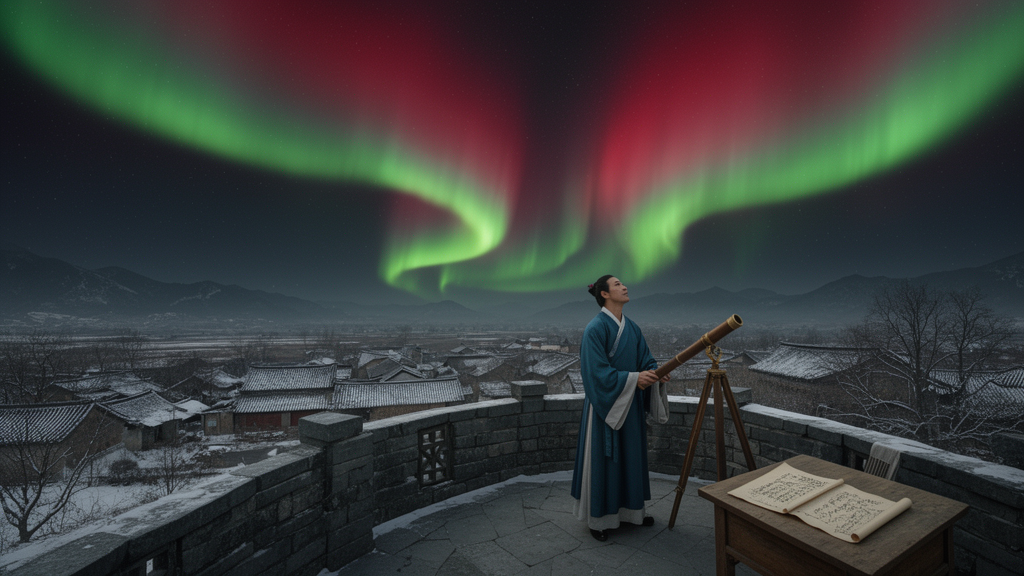
A September 1770 geomagnetic storm reconstructed from Chinese historical auroral records may have been more intense than the celebrated 1859 Carrington event, according to a quantitative study of the Qianlong XXXV event. The researchers estimated a best Disturbance Storm Time index, or Dst, of −1,319 nT, with a 95% confidence interval from −1,832 to −1,066 nT. Under the same method, the Carrington storm received a reconstructed value of −1,025 nT, with a 95% confidence interval from −1,367 to −853 nT. The central estimate for Qianlong XXXV was therefore about 30% more negative, although the intervals overlap. The authors describe the event as a potential benchmark for the upper limits of geomagnetic activity rather than a definitively measured rival to Carrington.
The reconstruction rests on 23 auroral records within China for 11–19 September 1770, drawn from regional chronicles, official Qing historical compendia, and modern collections of ancient Chinese astronomical records. The survey covered longitudes from 73° to 135° E and latitudes from 18° to 54° N, with particular attention to southern provinces. European and American reports were added from the NASA Space Physics Data Facility historical aurora database, while Japanese and Korean observations came from an existing compilation. The southernmost Chinese account came from Dongtinghu in Hunan Province, at 29.14° N and 113.12° E. It described red vapor, hundreds of emerald-white rays, and a fiery display that illuminated the sky before fading at dawn.
Because the auroral oval is organized by magnetic rather than geographic coordinates, the investigators converted each location using the GUFM1 historical geomagnetic field model to locate the 1770 magnetic north pole, then transformed the coordinates with the AACGM-v2 algorithm, which includes non-dipolar field contributions. The historical account at Dongtinghu indicated a display extending to high elevation, but did not supply a numerical viewing angle. The researchers therefore selected a conservative elevation of 60° rather than the zenith value of 90°. This choice places the inferred equatorward auroral boundary farther poleward and yields a less intense storm estimate. Based on the viewing geometry, the boundary was placed at 20.40° N magnetic latitude at ionospheric altitude.
A nearly conjugate Southern Hemisphere observation provides a second spatial constraint. Captain Cook’s crew aboard HMS Endeavour reported an aurora near the Malacca Strait Narrows, at 10.45° S and 112.82° E, corresponding to a ground magnetic latitude of 20.39° S. Its viewing geometry implied an auroral boundary at 28.23° S. The less-than-40-degree separation between the northern and southern signatures was interpreted as evidence that the magnetosphere was severely compressed and eroded. This does not by itself establish storm intensity, but it is consistent with the extraordinary low-latitude visibility documented in East Asia. European reports for 1770 were comparatively sparse and concentrated in Germany and France, while Japan recorded the aurora as a major spectacle.
To translate auroral extent into an index of geomagnetic severity, the authors used a nonlinear least-squares relationship between the magnetic latitude of the auroral boundary and Dst. Their calibration contained 37 extreme storms from space-age and historical periods. Inverting that relationship produced the Qianlong XXXV estimate of −1,319 nT. Applying the identical procedure to auroral reports from the 1859 Carrington event yielded −1,025 nT, broadly consistent with earlier retrospective estimates of roughly −855 to −1,087 nT. The reconstructed Qianlong boundary was also farther equatorward than the Carrington boundary, which the method placed at 28.30° N. The study’s central comparison therefore favors a stronger 1770 disturbance, while the overlapping confidence intervals require a cautious interpretation.
The authors checked their framework against the May 2024 storm, for which direct measurements are available. Solar active region AR3664 produced several X-class flares and coronal mass ejections, followed by a G5-class geomagnetic storm with a peak Dst of −412 nT. The researchers considered unaided visual sightings while excluding observations detected only by sensitive cameras, thereby approximating the visibility conditions of the 18th century. A red aurora imaged at Hanle in Ladakh was classified as a stable auroral red arc, a phenomenon associated with ring-current energy dissipation rather than the active auroral oval. The southernmost accepted naked-eye report was from Alxa Youqi in Inner Mongolia, whose corresponding auroral boundary was estimated at 40.99° N magnetic latitude.
Historical reports present a major source of uncertainty because observers could not distinguish an active auroral oval from a stable auroral red arc. Such a misclassification could move a reconstructed Dst toward more negative values, especially because both phenomena can expand equatorward during extreme storms. The southernmost Qianlong XXXV report offers a partial safeguard: its emerald-green and white coloration is consistent with atomic oxygen emissions associated with the active auroral oval, whereas stable auroral red arcs are characteristically red. The authors consequently interpret the Qianlong estimate as a conservative lower bound on disturbance intensity. Other stated limitations include the selected viewing-angle assumption and the inability to retrieve the southward interplanetary magnetic field that controlled how efficiently the solar eruption coupled to Earth’s magnetosphere.
Applying a Gumbel extreme-value model to the reconstructed intensities, the researchers estimated a central recurrence interval of approximately 14,000 years for a storm matching Qianlong XXXV. The corresponding central estimate for Carrington-class storms was approximately 1,400 years. These are statistical return periods derived from a small set of historical extremes and a selected probability model, not observed waiting times or precise forecasts. The model’s assumptions limit how confidently it can describe the frequency of events beyond the instrumental era. Even so, the calculation illustrates how historical archives can extend the observational baseline for rare space weather and help constrain the tail of a storm-intensity distribution.
Sunspot evidence offers a possible explanation for the event’s exceptional scale. Historical records indicate a corrected area of about 6,000 millionths of the solar disk, roughly twice the size of the Carrington sunspot group, implying a large reservoir of magnetic energy. The active region was first observed near the eastern limb on 12 September and rotated toward, but not beyond, the central meridian during the storm’s peak, a geometry that could have directed coronal mass ejections toward Earth. The source also raises the possibility of investigating the event with annually resolved tree-ring carbon-14 records, whose continuous coverage now extends about 3,000 years. Such a multi-proxy approach could test whether a solar energetic-particle event accompanied the geomagnetic storm and tighten estimates derived from auroral observations.
The historical comparison also raises the role of Earth’s changing magnetic field. The dipole moment has weakened by approximately 14% since 1770 and by 7.4% since 1859, meaning that the 1770 magnetosphere began the storm under a stronger background field than the one present during Carrington. Under the study’s interpretation, reaching the same low magnetic-latitude auroral boundary in 1770 may have required a more powerful solar eruption than one capable of producing the 1859 disturbance. The result does not demonstrate that Carrington was the absolute upper limit of geomagnetic activity, and the authors do not treat the Qianlong central estimate as a replacement for direct measurement. Instead, the study presents a quantitative, archive-based candidate for a more extreme benchmark, while emphasizing the need for a larger catalog of historical storms, independent cosmogenic evidence, and physical modeling before either recurrence estimate can be used with high confidence.
Subject of Research: Archive-based reconstruction of the September 1770 Qianlong XXXV extreme geomagnetic storm
Article Title: The Qianlong XXXV event: a potential benchmark for extreme geomagnetic storms based on historical Chinese auroral archives
Article References: Yuan, D., Yin, T., Xu, X., Wang, B., Srivastava, A. K., Poedts, S., Nakariakov, V. M., Feng, X., Chen, W., & Luo, D. (2026). The Qianlong XXXV event: a potential benchmark for extreme geomagnetic storms based on historical Chinese auroral archives. Frontiers in Astronomy and Space Sciences, 13, Article 1857812. https://doi.org/10.3389/fspas.2026.1857812
Image Credits: AI Generated
DOI: 10.3389/fspas.2026.1857812
Keywords: Qianlong XXXV storm, geomagnetic superstorm, Chinese chronicles, auroral oval, Dst index, Carrington event, historical aurora, extreme space weather, Gumbel model, magnetic latitude, Qianlong, XXXV
Cite Scienmag News
Cameron Wolfe. (October 21, 2026). Chinese aurora archives suggest a 1770 superstorm surpassed Carrington. Scienmag. https://scienmag.com/chinese-aurora-archives-suggest-a-1770-superstorm-surpassed-carrington/
Cameron Wolfe. "Chinese aurora archives suggest a 1770 superstorm surpassed Carrington." Scienmag, 21 October 2026, https://scienmag.com/chinese-aurora-archives-suggest-a-1770-superstorm-surpassed-carrington/. Accessed 21 October 2026.
Cameron Wolfe. "Chinese aurora archives suggest a 1770 superstorm surpassed Carrington." Scienmag. October 21, 2026. https://scienmag.com/chinese-aurora-archives-suggest-a-1770-superstorm-surpassed-carrington/


