


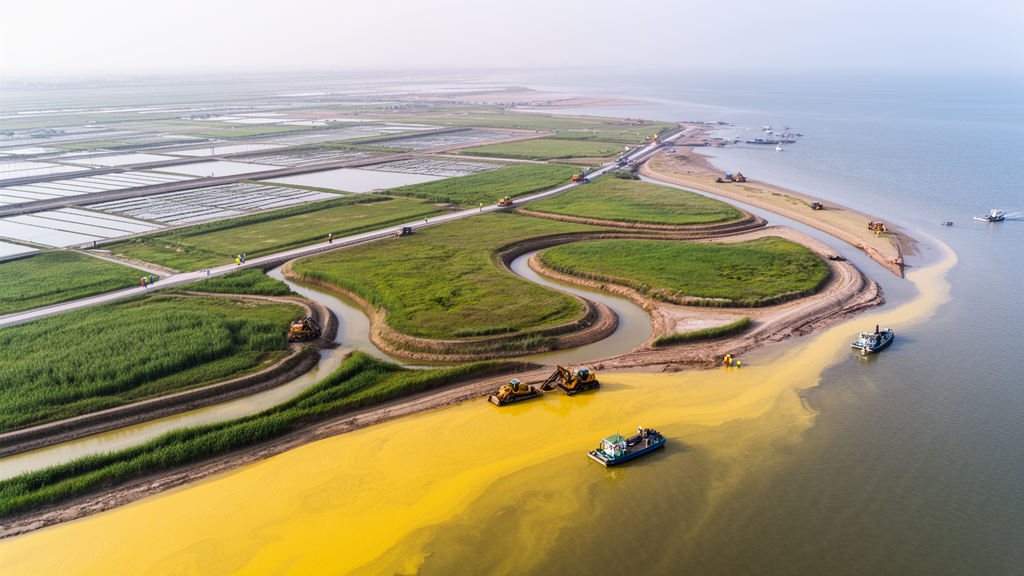
Restoring the Yellow River Delta will require coordination across water, sediment, landforms, biology and institutions, according to a systematic review of 339 studies published from 2009 through May 2026. The review finds that the Chinese coastal wetland is being degraded by interacting pressures rather than by a single environmental problem: reduced river flow and sediment delivery, shoreline erosion, saltwater intrusion, salinization, invasive plants, land reclamation and other human activities. Instead of treating these pressures separately, the authors propose a resilience-oriented framework combining nature-based solutions, digital monitoring and cross-scale adaptive management.
Their analysis supports the potential value of coordinated restoration, but the authors stress that direct quantitative comparisons between integrated and single-factor interventions remain limited. The bibliometric analysis used the Web of Science Core Collection as its main dataset and validated the publication trend with 69 articles retained from Scopus. About 87% of the retained Scopus records overlapped with the Web of Science corpus, and both databases showed a similar two-stage pattern: relatively slow growth before 2018 and faster expansion afterward, reaching 53 Web of Science articles in 2025.
The apparent fall to 18 publications in 2026 reflects the search cutoff of May 31 rather than a completed annual decline. Keyword analysis identified a shift from foundational work on water, sediment and wetland condition between 2009 and 2015, through studies of invasive species, soil carbon and ecological water replenishment from 2015 to 2020, toward connectivity, ecosystem services, nature-based approaches and multi-objective planning from 2020 onward. The authors describe this as an emerging trend, not evidence of a uniform replacement of component-specific research.
The ecological starting point is a highly interconnected land-river-sea system. Natural wetland area in the reviewed study area declined by approximately 55% between 1976 and 2018, while salt-marsh vegetation degradation reached 65.15% between 1990 and 2020. Reservoir regulation has sharply reduced the sediment reaching the estuary, leaving the modern delta generally in an eroding state in which sediment loss exceeds sediment gain.
Sea-level rise, stronger or more frequent storm surges and saltwater moving through tidal channels and groundwater compound the effects of lower freshwater supply. Remote-sensing evidence indicates that salinized land expanded inland from 2003 to 2021. These pressures interact: erosion exposes formerly terrestrial soils to seawater, intrusion pushes saline conditions inland, and salinization limits the establishment of salt-sensitive native vegetation.
That coupling explains why isolated interventions can disappoint. Ecological water replenishment can reduce salinity, improve organic carbon and support microbial communities, but its performance depends on the amount, frequency and extent of delivery as well as local water-salt exchange; inadequate replenishment may even create localized saline “dead zones.” Planting alone often produces poor survival when hydrology and salinity remain unfavorable. Concrete revetments may protect a shoreline in the short term while severing exchanges of sediment, water and energy, intensifying scour in front and depriving wetlands behind them of sediment.
Similarly, rapid wholesale removal of invasive cordgrass, Spartina alterniflora, can expose sediment that had been stabilized by its roots and stems, increasing erosion and leaving vacant habitat open to renewed invasion. The review’s central technical argument is therefore that restoration must treat water, terrain, plants, animals and microbes as interacting controls rather than independent components. The review organizes representative practices into three forms of coordination.
“Elemental synergy” combines measures aimed at different limiting factors. In degraded supratidal wetlands, constructed microtopography increased Salicornia europaea cover by 20% to 98% relative to bare control plots, demonstrating the effect of physical habitat modification alone rather than a proven supra-additive benefit from combining it with water replenishment. Combined plant-microbial remediation is consequently a plausible approach for saline bare ground, although its effectiveness depends on local environmental conditions and successful microbial establishment.
These practices are best understood as ways to target complementary constraints, not as interventions that have consistently produced more than the sum of their separate effects. “Spatial synergy” links restoration across the Yellow River basin, the delta landscape, the estuary and the nearshore zone. Basin-scale water and sediment regulation can deliver resources to downstream wetlands; the Xiaolangdi scheme supplied substantial sediment in the short term and helped local shoreline stabilization, although reservoir interception continues to leave total sediment input below historical levels.
Reusing historical channels has also been proposed as a way to guide deposition and reduce wetland loss. At landscape scale, graph and circuit theory can identify source patches, corridors and nodes, with priority given to reconnecting areas fragmented by reclamation, roads and oil infrastructure. Nearshore oyster reefs and seagrass beds are being investigated as wave-attenuating and sediment-stabilizing systems that may complement intertidal marshes and terrestrial buffers.
These approaches are presented as a developing three-dimensional protection system, not as proven replacements for every hard coastal structure. “Objective synergy” concerns invasive-species control and native reconstruction. Where cordgrass removal creates erosion risk, the reviewed literature points toward a sequence of stabilization, vegetation recovery and ecological enhancement.
Phragmites australis or Tamarix chinensis may be used where stronger soil stabilization is needed, while Salicornia europaea or Salsola sorbus are better suited to lower, more saline terrain. Native annual plants and burrowing crabs can reinforce one another: crab burrows create pits that retain seeds, while plant roots and litter provide food and shelter. A simple tillage operation intended to mimic this disturbance significantly improved pioneer-plant recovery in reported experiments.
Such results do not establish that every cleanup should use a universal recipe; timing, scale and intensity must be adjusted to hydrodynamic conditions, erosion risk, native establishment and the likelihood of cordgrass regrowth. This governance problem is continuous because rising salinity can favor the salt-tolerant invader while adequate freshwater may strengthen native plant communities. Reported benefits span vegetation recovery, soil desalination, tidal-flat stability, biodiversity, carbon sequestration and landscape connectivity, but they do not necessarily rise together.
Ecological replenishment has been associated with recovery of reeds and benthic invertebrates, improved habitat conditions for birds, and recovery of microbial communities; after 11 years of restoration, bacterial diversity and functions in reed wetlands approached those of natural wetlands. Carbon-source amendments such as reed straw and biochar have improved soil conditions and supported vegetation, with reed straw showing favorable carbon-reduction performance in life-cycle assessments. Yet gains in carbon storage or habitat quality can coexist with declining ecosystem-service connectivity.
The studies also vary substantially in intervention, setting, indicators and monitoring duration, so the evidence supports qualitative complementarity rather than a universal ranking of integrated restoration methods. The authors explicitly caution that the six outcome dimensions are not independent or uniformly improved by every intervention. Major constraints remain.
Competition from agriculture, industry and urban growth limits water available for ecological replenishment, while short-term sediment diversions do not resolve the basin’s long-term sediment deficit. Sea-level rise can offset desalination, and extreme events can destroy habitats such as seagrass beds faster than natural recovery can follow. Restoration can span decades, but most current projects have short monitoring cycles, making it difficult to assess long-term sustainability and resilience.
Large ecological networks also demand substantial money, personnel and technical capacity, while the long-term cost-effectiveness of coordinated restoration remains insufficiently assessed. Fragmented responsibilities across water, agriculture, natural-resource, marine and environmental agencies further impede land-sea integration, often leaving projects to treat symptoms rather than their upstream causes. The authors propose a phased roadmap through 2030, 2030–2050 and beyond 2050.
The near-term phase emphasizes watershed-scale ecological base-flow allocation, combined water replenishment and microtopographic modification in critical patches, coordinated cordgrass removal and native substitution, and baseline monitoring. The middle phase shifts toward reconnecting tidal creeks and marsh habitats, identifying source patches, corridors and key nodes, and coordinating upstream water and sediment regulation with nearshore oyster-reef and intertidal recovery. The long-term phase envisions resilient land-river-sea networks, ecological compensation and cross-departmental governance.
The roadmap is a proposed strategy rather than a tested intervention program, and its success will depend on sustained political coordination, financial support, site-specific assessment and monitoring capable of revealing delayed or unintended ecological effects. The roadmap also envisages a “Digital Twin Delta,” explicitly described as a conceptual future framework rather than an operating system. Satellite and drone imagery, ground sensors for variables such as water level and salinity, and environmental DNA could feed quality-controlled models of hydrology, landform evolution, ecology and land-use change.
Coupled models could assimilate monitoring data and compare scenarios involving alternative water-sediment strategies, sea-level rise and vegetation measures, while sensitivity analysis and uncertainty ranges expose the limits of predicted outcomes. This framework would support a monitoring-assessment-revision cycle, not automatically select an optimal plan. Its implementation still requires development and validation of data integration, model coupling, uncertainty assessment and decision-support procedures.
Whether the proposed combination of nature-based processes, digital tools and adaptive institutions can outperform fragmented restoration remains the central empirical question, and resolving it will require longer monitoring, direct comparisons of integrated and single-factor treatments, and validation across changing environmental conditions.
Subject of Research: Systematic review of coupled land-river-sea restoration strategies in China’s Yellow River Delta
Article Title: Ecological restoration of the land-sea interface: practices, challenges, and prospects in the Yellow River Delta
Article References: Peng, Y., Chen, X., Gao, X., Zhao, M., Yu, R., Liu, Y., & Jiang, C. (2026). Ecological restoration of the land-sea interface: practices, challenges, and prospects in the Yellow River Delta. Frontiers in Marine Science, 13, Article 1983485. https://doi.org/10.3389/fmars.2026.1983485
Image Credits: AI Generated
DOI: 10.3389/fmars.2026.1983485
Keywords: Yellow River Delta, coastal wetland restoration, land-sea coordination, salinity, ecological water replenishment, nature-based solutions, adaptive management, Digital Twin Delta, invasive species, bibliometric analysis, Ecological, restoration
Cite Scienmag News
Violet Maxwell. (October 21, 2026). Yellow River Delta restoration shifts toward coordinated land-sea management. Scienmag. https://scienmag.com/yellow-river-delta-restoration-shifts-toward-coordinated-land-sea-management/
Violet Maxwell. "Yellow River Delta restoration shifts toward coordinated land-sea management." Scienmag, 21 October 2026, https://scienmag.com/yellow-river-delta-restoration-shifts-toward-coordinated-land-sea-management/. Accessed 21 October 2026.
Violet Maxwell. "Yellow River Delta restoration shifts toward coordinated land-sea management." Scienmag. October 21, 2026. https://scienmag.com/yellow-river-delta-restoration-shifts-toward-coordinated-land-sea-management/


