


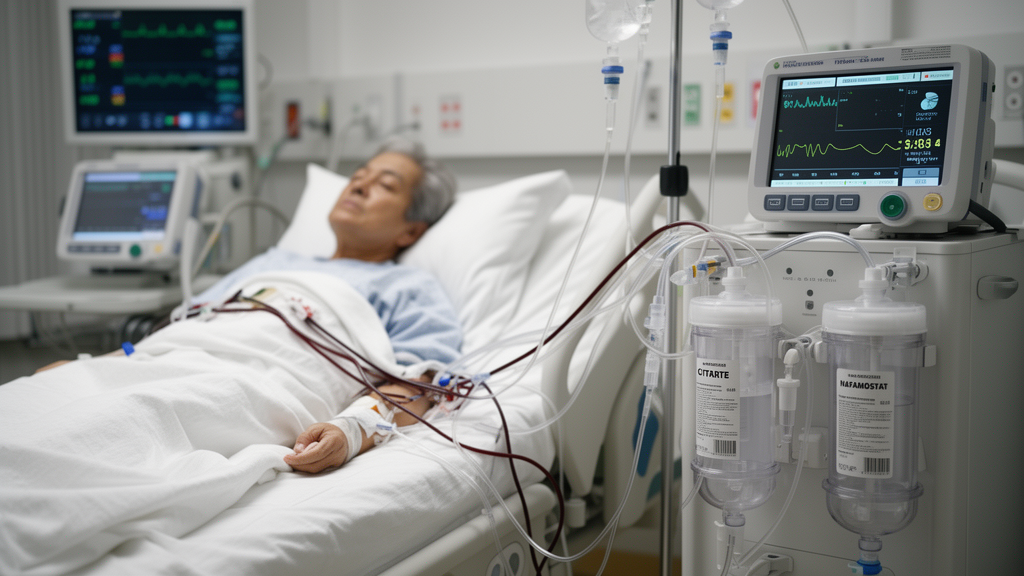
In a retrospective case series of 11 critically ill adults with liver failure, pairing low-dose regional citrate with low-dose nafamostat during continuous renal replacement therapy (CRRT) was operationally feasible and was not accompanied by severe anticoagulation-related complications. All patients received the same anticoagulation strategy in continuous veno-venous hemodiafiltration (CVVHDF) mode. Median filter life was 48 hours, one patient experienced mild oral mucosal bleeding, and no patient developed severe bleeding, citrate accumulation, severe hypocalcemia or major acid-base or electrolyte disturbances.
Because the study included no comparison group, the results show feasibility only and do not establish that the combination is safer or more effective than other anticoagulation strategies. The cohort comprised seven men and four women with a median age of 58 years. Eight patients had acute-on-chronic liver failure, one had acute liver failure following gastrointestinal bleeding, and two had subacute liver failure.
Sepsis or septic shock was the precipitating factor in five patients with acute-on-chronic liver failure, while two had cardiogenic or ischemic injury and one had malignant disease. The group was severely ill: seven of the 11 patients had grade 3 acute kidney injury, seven required vasoactive drugs, and the median Acute Physiology and Chronic Health Evaluation II (APACHE II) score was 23.5. Median platelet count was 44 × 10 9 /L, and liver-related coagulopathy was common.
The small, selected group came from the Department of Critical Care Medicine at Zhongnan Hospital of Wuhan University, where the investigators reviewed patients treated in 2025. The clinical problem addressed by the study is the narrow balance required for CRRT anticoagulation in liver failure. Reduced hepatic synthesis and coagulation dysfunction make systemic anticoagulation more hazardous, while impaired citrate metabolism can make conventional-dose regional citrate anticoagulation prone to accumulation, hypocalcemia and metabolic alkalosis.
Nafamostat can provide anticoagulation without citrate, but a dose sufficient to maintain filter patency may produce excessive systemic coagulation inhibition and increase bleeding concerns. The investigators therefore used a reduced citrate dose together with nafamostat, with the stated aim of limiting citrate exposure while maintaining anticoagulation of the extracorporeal circuit. Whether that combination improves the balance between filter patency and systemic safety cannot be determined from an uncontrolled series.
All patients were treated with Fresenius CRRT machines equipped with a citrate-calcium module and large-area filters. Blood was drawn at 80 mL/min and circulated at 120 mL/min, with post-dilution used and replacement-fluid and dialysate flow each set to 1,000 mL/h. The anticoagulant regimen consisted of 4% sodium citrate infused pre-filter at 150 mL/h, nafamostat mesylate at 20 mg/h before the filter, 5% sodium bicarbonate at 100 mL/h before the filter, and calcium gluconate at the blood-return line.
Post-dilution was selected to protect the venous drip chamber, while the calcium-containing replacement fluid made pre-dilution unnecessary. The investigators described the setup as a standardized bedside approach intended to be reproducible, although the protocol was not prospectively validated against another anticoagulation strategy. Calcium replacement was stratified according to peripheral ionized calcium.
The initial 10% calcium gluconate infusion was 6 mL/h when blood calcium exceeded 1.1 mmol/L, 8 mL/h at 1.0–1.1 mmol/L, 10 mL/h at 0.9–1.0 mmol/L, and 12 mL/h below 0.9 mmol/L. Additional intravenous calcium could be added after physician evaluation. Post-filter ionized calcium was used to assess regional anticoagulation, with a target above 0.4 mmol/L, while the peripheral activated partial thromboplastin time (APTT) was maintained at 1.2–1.5 times its baseline value.
Peripheral blood gases and APTT were checked every two hours for the first six hours and every four hours thereafter, with infusion rates adjusted as needed. The protocol also included inspection of the filter and pipeline and monitoring for bleeding, hypocalcemia, acid-base imbalance, electrolyte abnormalities and drug allergy. Safety monitoring included systemic coagulation tests and surveillance for bleeding and metabolic complications.
Citrate accumulation was defined as a sustained total-to-ionized calcium ratio of at least 2.5 accompanied by metabolic alkalosis or hypocalcemia. Hypocalcemia was defined as peripheral ionized calcium below 0.90 mmol/L. Metabolic alkalosis required arterial pH above 7.45 and bicarbonate above 26 mmol/L, while metabolic acidosis required pH below 7.35 and bicarbonate below 22 mmol/L, excluding respiratory influences.
Coagulation measurements and platelet counts were obtained before CRRT and immediately after the circuit was disconnected, before anticoagulation or other therapy was changed. Filter life ranged from 23 to 72 hours, with a median of 48 hours and an interquartile range of 38 to 68.75 hours. No severe pipeline or filter coagulation was recorded.
PT, INR, APTT, fibrinogen, D-dimer and platelet count did not differ significantly between baseline and the first measurement after CRRT ended; thrombin time was lower at the end of treatment, with a reported P value of 0.05. One patient, representing 9.1% of the cohort, had mild oral mucosal bleeding, but no severe or massive bleeding occurred. Six patients met the study’s hypocalcemia threshold, and five had metabolic alkalosis at baseline, although no severe hypocalcemia or serious acid-base and electrolyte disorder was observed during treatment.
These findings describe what happened in this selected cohort; they do not establish comparative event rates for the regimen. Several clinical measurements changed over the course of intensive treatment. Median procalcitonin fell from 4.78 to 1.92 ng/mL, with P = 0.005, and the median APACHE II score decreased from 23.5 to 17, with P = 0.011.
The median SOFA score fell from 6.67 to 5, but that change was not statistically significant at P = 0.463. Interleukin-6, white blood cell count and neutrophil percentage did not change significantly, while ALT, AST, total bilirubin, creatinine and urea nitrogen also showed no significant before-and-after differences. The study also recorded that liver and kidney function showed no obvious deterioration, but that observation cannot be interpreted as evidence of organ protection.
The before-and-after design, the small sample and the simultaneous use of other critical-care therapies make causal attribution particularly limited. All 11 patients simultaneously received other intensive-care interventions, including antibiotics, vasopressors, source control and broader organ support. The lower procalcitonin and APACHE II score therefore cannot be attributed to the mixed anticoagulation regimen.
The investigators also noted that the pre-filter bicarbonate strategy was based on institutional experience rather than prospective validation; it was intended to support acid-base stability when endogenous citrate metabolism and bicarbonate generation were impaired, but its adequacy in this population remains unevaluated. Median intensive-care unit stay was 12 days, median hospital stay was 21 days, and eight patients restarted CRRT within seven days after it was stopped because of clinical need. One patient died from severe irreversible disease.
These outcomes reflect the illness course and concurrent care, not a measured effect of anticoagulation. The findings are chiefly an operational description of how the regimen was delivered. They show that low-dose citrate combined with standardized nafamostat, calcium stratification, blood-gas monitoring and APTT adjustment could be implemented in selected patients with liver failure receiving CRRT.
The small, selected, single-center sample, absence of subgroup analysis and short follow-up further limit interpretation. The authors characterize the results as preliminary and hypothesis-generating and call for validation in adequately powered, multicenter, prospective controlled trials.
Subject of Research: Feasibility of low-dose citrate-nafamostat anticoagulation during CRRT in patients with liver failure
Article Title: Successful application of low-dose regional citrate combined with nafamostat mixed anticoagulation in CRRT for patients with liver failure: a retrospective case series study of 11 patients
Article References: Zhang, Y., Ma, J., Xiao, L., Ye, J., Li, H., Li, Z., Xiao, M., Ding, X., & Zhang, P. (2026). Successful application of low-dose regional citrate combined with nafamostat mixed anticoagulation in CRRT for patients with liver failure: a retrospective case series study of 11 patients. Frontiers in Pharmacology, 17, 1896125. https://doi.org/10.3389/fphar.2026.1896125
Image Credits: AI Generated
DOI: 10.3389/fphar.2026.1896125
Keywords: liver failure, continuous renal replacement therapy, regional citrate anticoagulation, nafamostat, mixed anticoagulation, filter patency, citrate accumulation, critical care, bleeding, hypocalcemia, Successful, application
Cite Scienmag News
Ophelia Keating. (October 21, 2026). Low-Dose Citrate-Nafamostat Strategy Feasible in Liver-Failure CRRT Series. Scienmag. https://scienmag.com/low-dose-citrate-nafamostat-strategy-feasible-in-liver-failure-crrt-series/
Ophelia Keating. "Low-Dose Citrate-Nafamostat Strategy Feasible in Liver-Failure CRRT Series." Scienmag, 21 October 2026, https://scienmag.com/low-dose-citrate-nafamostat-strategy-feasible-in-liver-failure-crrt-series/. Accessed 21 October 2026.
Ophelia Keating. "Low-Dose Citrate-Nafamostat Strategy Feasible in Liver-Failure CRRT Series." Scienmag. October 21, 2026. https://scienmag.com/low-dose-citrate-nafamostat-strategy-feasible-in-liver-failure-crrt-series/


