


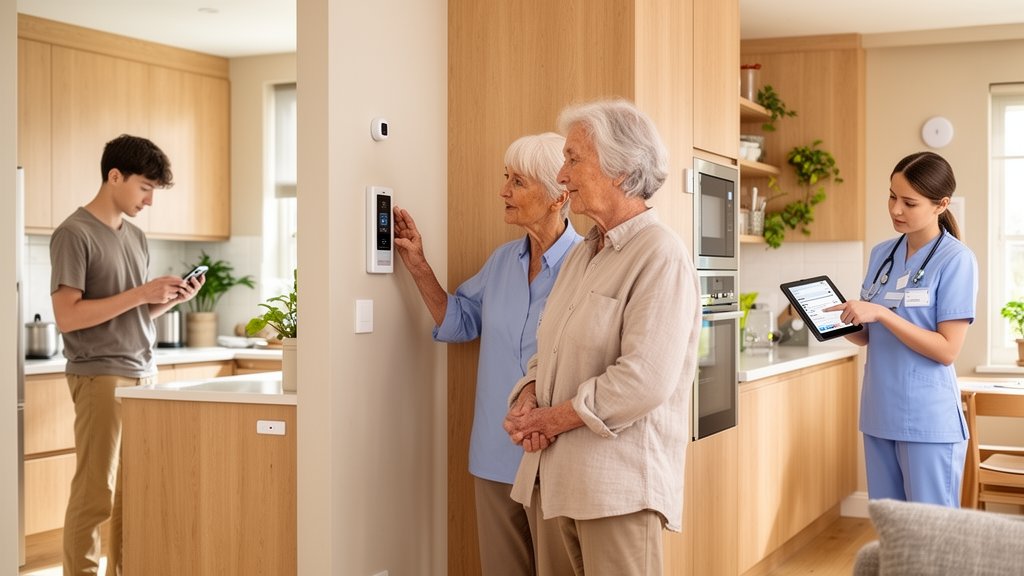
An exploratory mixed-methods study of 506 community-dwelling older adults in China found that smart home care platforms need graded, user-group-oriented requirements rather than a single feature list. Efficient service and health management had the highest overall demand-sensitivity scores, while emergency calling, environmental alerts, adaptive interfaces, security and privacy, and service-status transparency formed important baseline requirements. The analysis also identified differences associated with age, living arrangement, education and the perspectives of family caregivers and frontline service providers, although it did not test whether a tailored platform improved care outcomes.
Researchers began with semi-structured interviews involving five adult-child family caregivers and three frontline older-adult care personnel. Inter-coder agreement for thematic coding was κ = 0.81. Caregivers emphasized emergency response, remote access to service information, and records such as blood-pressure and medication-taking data, as well as concern about excessive operational complexity.
Service personnel focused on efficient task dispatch, access to complete user profiles, and visibility into service processes. These interviews supplied the initial item pool for the quantitative phase. The study then distributed Kano questionnaires to community-dwelling adults aged 65 or older who had basic smartphone operating capacity and could independently understand and complete the questions.
Of 562 questionnaires distributed through urban community activity centers and online QR codes shared by community administrators, 518 were returned and 506 were retained as valid. The sample included 272 respondents aged 65 to 70, 207 aged 71 to 80 and 27 aged 80 or older. Primary-school education was reported by 38 participants, while 182 held college or bachelor’s-level qualifications.
Separate simplified Kano questionnaires were completed by 58 family caregivers and 41 frontline service providers. The analysis used the Kano model, which classifies quality attributes as Must-be, One-dimensional, Attractive, Indifferent or Reverse according to how the presence and performance of a feature affect satisfaction. The researchers added Berger’s Better-Worse coefficients to provide a quantitative measure of sensitivity.
Better estimates the satisfaction increase when a function is fully delivered, while Worse estimates dissatisfaction when it is absent. A demand-sensitivity value, S, was calculated as the average of the absolute Better and Worse values. Values of at least 0.75 were classified as high sensitivity, values from 0.65 to below 0.75 as medium sensitivity, and values below 0.65 as low sensitivity.
The analysis used stratified Pearson chi-square tests, with a significance level of α = 0.05, and bootstrap 95% confidence intervals based on 1,000 resamples. Age-stratified comparisons showed several measurable differences in requirements. Emergency calling was classified as Must-be by 52.3% of participants aged 80 or older who lived alone, compared with 31.4% of those aged 65 to 69 who lived with caregivers; the reported subgroup comparison gave χ² = 11.27 and p < 0.01.
Social entertainment showed a different age distribution: 40.75% of respondents in the main analysis selected the Attractive category, but the proportion fell to 18.2% among participants aged 80 or older, whose Indifferent response rate reached 34.5%. That difference had χ² = 8.94 and p < 0.05. Security and privacy also shifted toward Must-be classification in the oldest group, with χ² = 10.85 and p < 0.01.
These are observed differences in questionnaire classifications, not evidence that age itself caused the preferences. Living arrangement and education were also associated with evaluation patterns. Older adults living alone assigned greater Must-be importance to emergency calls and environmental-risk alerts, while those living with family caregivers placed more Attractive weight on social entertainment and personalized services.
Participants with primary-school education produced higher proportions of Indifferent judgments for complex digital-oriented requirements. The researchers also reported greater prior exposure to computers and mobile digital devices among participants aged 65 to 70 than among those older than 70. The results nevertheless show why broad labels such as “older adult” can conceal differences within the sampled population.
Responses from family caregivers and service providers revealed a further distinction between end-user preferences and operational requirements. Caregivers wanted timely risk alerts, remote access to blood-pressure and medication records, and transparent information about whether services had been delivered. Frontline staff emphasized dispatch efficiency, complete user profiles and visibility into service workflows.
When family caregivers evaluated Service Status Awareness in their own questionnaires, it shifted from a One-dimensional requirement among older users to a Must-be requirement among caregivers, with Better = 0.61 and Worse = −0.58. The contrast indicates that service-status information carries particular importance for relatives who coordinate care, although the caregiver sample was smaller than the main sample. Better-Worse sensitivity grading identified Efficient Service and Health Management as the leading optimization targets, with S values of 0.878 and 0.876, respectively.
Both were categorized as One-dimensional demands, meaning that their quality was positively associated with satisfaction. Proactive Service followed at S = 0.841. Other high-sensitivity requirements included Daily Care at 0.788, Adaptive User Interface at 0.779, and Security and Privacy at 0.777.
Respect and Understanding reached the high threshold at 0.750. Emergency Call and Personalization were classified as Must-be and Attractive qualities, respectively, but had medium sensitivity scores of 0.662 and 0.666. The Usage Tutorial received a low sensitivity score of 0.574 despite being categorized as Indifferent.
From these results, the authors constructed a three-stage “Creation–Analysis–Application” contextual design model. Creation combines requirements from older users, caregivers and service personnel with household and care-delivery constraints. Analysis maps each demand to functional, physical and interaction domains and uses Kano classifications, sensitivity scores and subgroup comparisons to determine priorities.
Application converts the results into prototype specifications and service-system arrangements. Within that structure, the model places emergency response, environmental awareness, service-status transparency, adaptive interfaces, simple hierarchies, security and privacy in a baseline. Health management and dispatch efficiency are treated as continuously improvable core services, while entertainment, personalization and multisensory interaction can be offered as modules whose relevance varies among user groups.
The framework was retrospectively checked against four deployed platforms: the Wuchang District Smart Older Adult Care Service Network, Shijingshan’s Guoyuantong inclusive-care platform, the Shichahai Xidao system and Ziyang’s Smart Health and Care platform. Seventeen of the 19 demand items, corresponding to 89.5%, aligned with features represented in the cases, and all four systems included emergency calling, health management and adaptive interfaces. Two differences prompted revisions of the model.
Usage tutorials had been realized through family-proxy assistance, so the model redefined guidance as implicit, on-demand support; this was relevant because people with no smartphone operating ability had been excluded from the main sample. Environmental alerts were also folded into broader environmental-perception modules in the Xidao case. The back-testing was a retrospective comparison rather than a prospective deployment trial, so it did not establish whether the refined framework would improve usability, safety, adherence or clinical outcomes.
The findings are constrained by an urban, community-dwelling sample and relatively modest caregiver and provider groups. Rural residents, bedridden people, individuals with severe cognitive impairment or dementia who could not complete the survey, and older adults with no smartphone operating ability were excluded, limiting generalizability to people with substantial care or accessibility needs. The questionnaire also did not measure affordability or willingness to pay, preventing quantitative analysis of cost-benefit trade-offs for the proposed graded packages.
The authors call for multi-city studies, randomized A-B interface testing, continuous technical support and feedback mechanisms, and surveys that directly assess affordability. Within these limits, the evidence supports using the study’s classifications to formulate adaptable smart home care requirements: safety, privacy and transparency provide a baseline for some groups, health and dispatch services carry broad sensitivity, and entertainment and personalization have more group-dependent value.
Subject of Research: User-centered requirements for smart home care platforms serving older adults
Article Title: Research on requirements for smart home-based older adult(s) care service platforms based on the Kano model
Article References: Xianheng, Z., Ling, W., & Tao, Z. (2026). Research on requirements for smart home-based older adult(s) care service platforms based on the Kano model. Frontiers in Public Health, 14, Article 1962040. https://doi.org/10.3389/fpubh.2026.1962040
Image Credits: AI Generated
DOI: 10.3389/fpubh.2026.1962040
Keywords: smart home care, older adults, Kano model, caregiver perspectives, age stratification, health technology, service platforms, digital support, user-centered design, environmental alerts, Research, requirements
Cite Scienmag News
Ophelia Keating. (October 21, 2026). Age and stakeholder differences shape smart home care requirements. Scienmag. https://scienmag.com/age-and-stakeholder-differences-shape-smart-home-care-requirements/
Ophelia Keating. "Age and stakeholder differences shape smart home care requirements." Scienmag, 21 October 2026, https://scienmag.com/age-and-stakeholder-differences-shape-smart-home-care-requirements/. Accessed 21 October 2026.
Ophelia Keating. "Age and stakeholder differences shape smart home care requirements." Scienmag. October 21, 2026. https://scienmag.com/age-and-stakeholder-differences-shape-smart-home-care-requirements/


