


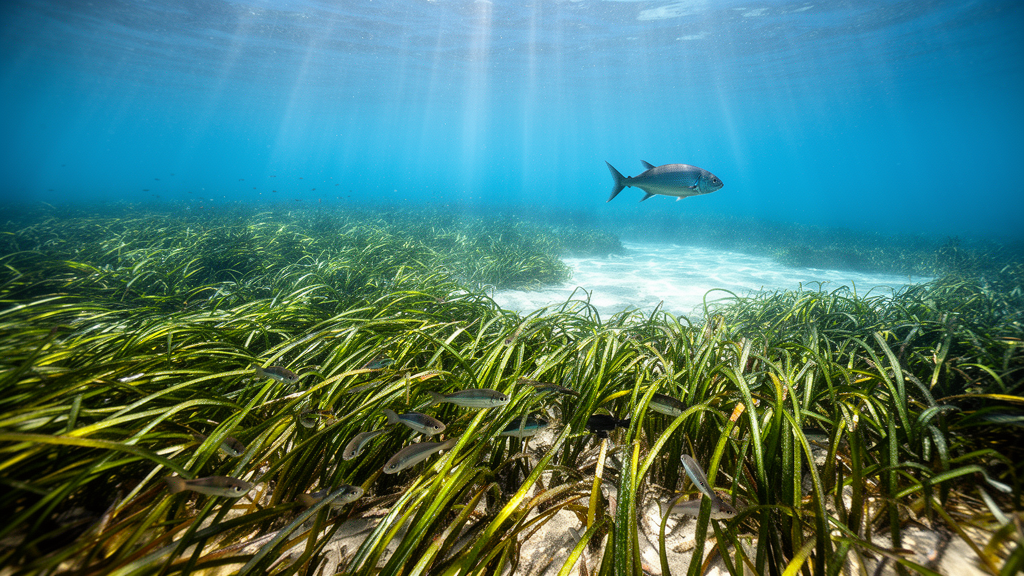
A field study conducted from September 2009 to November 2010 found that fish assemblages in eelgrass meadows at Myeongsa and Daepo on southern Geoje Island, South Korea, differed between sites and across seasons. The survey covered 14 sampled months at Myeongsa and 13 at Daepo; one Daepo survey was omitted because of coastal road-reclamation construction, and both sites were missed in August 2010 because of high tourist activity.
Researchers collected fish with 5 mm mesh beach seines and push nets during daytime low tides in the neap-tide period, generally about 20 m offshore. Each sampling session included five hauls. Environmental measurements included surface water temperature, salinity and eelgrass dry biomass. The analyses covered species composition, abundance, biomass and diversity, using a Bray–Curtis similarity matrix, permutational multivariate analysis of variance and non-metric multidimensional scaling.
The samples contained 51 fish species from 31 families, with a combined density of 3,019 individuals per square metre. Myeongsa contained 42 species and Daepo 36. Myeongsa had greater fish abundance and species richness overall, whereas Daepo had higher total fish biomass: 8,145.67 g compared with 6,414.18 g. Most species collected were small specimens or juveniles.
Species composition differed markedly between the locations. At Myeongsa, Takifugu niphobles accounted for 34.3% of relative abundance, Aulichthys japonicus for 31.9% and Neoditrema ransonnetii for 7.1%. At Daepo, Rudarius ercodes represented 38.4%, Paracentropogon rubripinnis 13.1% and Hexagrammos agrammus 9.1%. R. ercodes occurred in every Daepo sample.
The multivariate analysis found significant associations between fish assemblage structure and both site and season. The site effect had a pseudo-F value of 7.991, while the seasonal effect had a pseudo-F value of 2.019; both P values were below 0.05. The site-by-season interaction was not significant, with a pseudo-F value of 1.301 and P above 0.05. The ordination separated Myeongsa and Daepo samples and showed a broad warm-season versus cold-season pattern.
Water temperature ranged from 5.8 to 28°C at Myeongsa and 5.9 to 27.9°C at Daepo, with the highest readings in July and the lowest in December and January. Salinity ranged from 25.9‰ to 26.8‰ at both sites, with no significant monthly or spatial variation reported. Eelgrass biomass averaged 212.4 versus 152.5 gDW·m−2 at Daepo and Myeongsa, respectively. The range was 108.6–378.0 gDW·m−2 at Daepo and 52.8–282.1 gDW·m−2 at Myeongsa. Biomass peaked in April at Daepo and May at Myeongsa, declined after July and remained low from November through December.
Daepo had denser vegetation and a mixed gravel-and-sand substrate, while Myeongsa had sparse vegetation, mainly sandy substrate and freshwater input from the north. Fish abundance and richness generally increased with warmer water, and dominant species showed distinct seasonal patterns. T. niphobles was most abundant at Myeongsa from September 2009 through March 2010, whereas H. agrammus, A. japonicus and Ditrema temminckii led during other sampled months. At Daepo, R. ercodes and P. rubripinnis were abundant in warmer months, while H. agrammus and Syngnathus schlegeli tended to occur more in colder months.
The two-site comparison provides observational evidence that assemblage composition was associated with local habitat conditions, including vegetation structure, substrate and freshwater influence, but it cannot isolate which factor caused the differences. Sampling covered only two nearby meadows, missed two scheduled sessions and used small-mesh coastal gear, limiting broader generalization about Korean eelgrass meadows.
Subject of Research: Spatial and seasonal variation in fish assemblages within eelgrass meadows
Article Title: Influence of seasonal and spatial seagrass vegetation ( Plantae , Zosteraceae ) on fish assemblages in southern Geoje Island, Korea
Article References: Lani, N., Baeck, G. W., Jeong, J. M., Ye, S. J., Kang, D. Y., & Park, J. M. (2026). Influence of seasonal and spatial seagrass vegetation (Plantae, Zosteraceae) on fish assemblages in southern Geoje Island, Korea. Acta Ichthyologica et Piscatoria, 56, 133-143. https://doi.org/10.3897/aiep.56.182678
Image Credits: AI Generated
Keywords: fish assemblages, eelgrass meadows, Geoje Island, South Korea, seasonal variation, habitat structure, field study, coastal ecology, Influence, seasonal, spatial, seagrass
Cite Scienmag News
Gavin Prescott. (October 21, 2026). Field study finds site and seasonal differences in fish assemblages at two Korean eelgrass meadows. Scienmag. https://scienmag.com/field-study-finds-site-and-seasonal-differences-in-fish-assemblages-at-two-korean-eelgrass-meadows/
Gavin Prescott. "Field study finds site and seasonal differences in fish assemblages at two Korean eelgrass meadows." Scienmag, 21 October 2026, https://scienmag.com/field-study-finds-site-and-seasonal-differences-in-fish-assemblages-at-two-korean-eelgrass-meadows/. Accessed 21 October 2026.
Gavin Prescott. "Field study finds site and seasonal differences in fish assemblages at two Korean eelgrass meadows." Scienmag. October 21, 2026. https://scienmag.com/field-study-finds-site-and-seasonal-differences-in-fish-assemblages-at-two-korean-eelgrass-meadows/


