


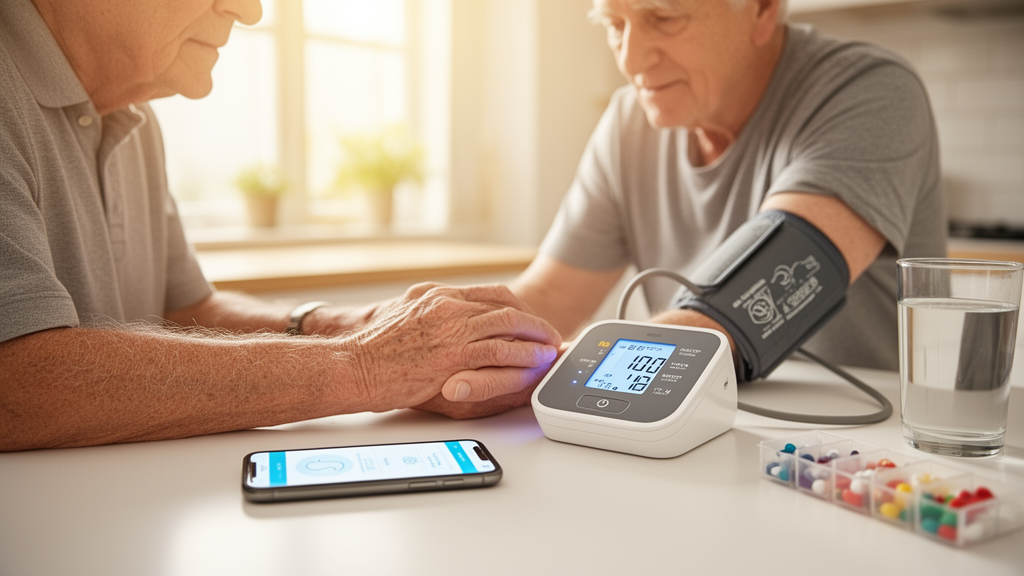
A prospective, single-arm pre–post study in Shenzhen, China, found that 12 months of a mobile health–enabled hierarchical care model was associated with improved blood pressure and health-related quality of life among 210 adults aged 60–70 with hypertension. The findings are preliminary because the study had no concurrent control group and did not systematically track changes in antihypertensive medication use.
Researchers recruited 225 participants from community health service centers affiliated with regional medical consortia between January and December 2025. All received the mobile health–enabled hierarchical diagnosis and treatment education program, delivered through the Shekangtong WeChat mini program. The program combined home blood pressure self-monitoring, personalized education, family doctor follow-up and specialist consultation pathways within the existing regional care network.
Participants were encouraged to record daily home blood pressure measurements, while tailored education on hypertension prevention, diet, physical activity and lifestyle modification was offered two to three times per week. Participants could consult family doctors through platform functions, with responses to health-related inquiries expected within 24 hours. Family doctors could also seek additional assessment or specialist support through the regional medical consortium pathway. Monthly online education and experience-sharing sessions were part of the program.
Among the 210 participants who completed both baseline and 12-month assessments, mean systolic blood pressure decreased from 145.35 ± 4.18 mmHg to 130.64 ± 5.62 mmHg. The mean difference was 14.71 mmHg, with a 95% confidence interval of 13.68 to 15.74 mmHg and p<0.001. Mean diastolic blood pressure decreased from 68.93 ± 4.85 mmHg to 60.73 ± 4.31 mmHg, a mean difference of 8.20 mmHg with a 95% confidence interval of 7.28 to 9.12 mmHg and p<0.001. Endpoint measurements were taken by trained research personnel using calibrated electronic sphygmomanometers, rather than derived from home readings.
The primary outcome, health-related quality of life measured with the EQ-5D-5L, also improved. Its mean utility value rose from 0.82 ± 0.13 at baseline to 0.94 ± 0.06 at follow-up, a mean difference of 0.12 (95% CI, 0.10 to 0.14; p<0.001). The mean EQ-VAS score increased from 74.16 ± 11.07 to 80.93 ± 8.03, a mean difference of 6.77 points (95% CI, 6.18 to 7.36; p<0.001).
The largest change among the five EQ-5D-5L dimensions was in anxiety/depression: the proportion reporting no problems increased from 68 of 210 participants, or 32.4%, to 178, or 84.8%, after false-discovery-rate correction (adjusted p<0.001). The authors emphasized that this item measures perceived health-related distress rather than diagnosing or treating clinical anxiety or major depression. Changes in mobility were also significant after correction, while changes in pain/discomfort, self-care and usual activities did not meet the corrected significance threshold.
Greater blood pressure reductions were associated with larger quality-of-life improvements. Systolic reductions correlated with changes in the EQ-5D-5L utility value (r=0.32; 95% CI, 0.21 to 0.43) and EQ-VAS score (r=0.25; 95% CI, 0.14 to 0.36). Diastolic reductions correlated with utility-value changes (r=0.28; 95% CI, 0.17 to 0.39) and EQ-VAS changes (r=0.22; 95% CI, 0.11 to 0.33); all reported p-values were below 0.001. These correlations represent associations, not evidence that blood pressure reduction caused the quality-of-life gains.
Implementation data were broadly consistent with feasibility over 12 months. The retention rate was 93.3%, as 210 of 225 enrolled participants completed follow-up, and participants uploaded home blood pressure measurements an average of 3.2 ± 1.4 times per week. No intervention-related adverse events were reported. However, standardized measures of adherence across all program components and formal intervention-fidelity assessment were not used, so engagement with blood pressure uploads could not establish the degree of exposure to the complete model.
The absence of a control group prevents causal attribution. Potential contributors to the observed changes include regression to the mean, the natural course of hypertension, concurrent lifestyle changes, participation-related behavior and broader changes in care. Medication use is another important limitation: baseline regimens were documented, but medication initiation, dose adjustment, discontinuation and adherence changes were not systematically tracked during follow-up. The study also excluded adults older than 70 and did not establish whether the improvements were sustainable, cost-effective or transferable to other healthcare settings. The authors therefore characterized the results as preliminary evidence of pre–post associations and called for controlled studies with concurrent comparison groups and more comprehensive measurement.
Subject of Research: Prospective evaluation of mobile health–enabled hierarchical hypertension care in Chinese adults aged 60–70
Article Title: Evaluation of a mobile health–enabled hierarchical care model for hypertension management and health-related quality of life among older adults: a prospective pre–post intervention study
Article References: Ma, X., Li, K., Zheng, D., Song, Y., Lin, J., & Chen, L. (2026). Evaluation of a mobile health–enabled hierarchical care model for hypertension management and health-related quality of life among older adults: a prospective pre–post intervention study. Frontiers in Public Health, 14, Article 1964536. https://doi.org/10.3389/fpubh.2026.1964536
Image Credits: AI Generated
DOI: 10.3389/fpubh.2026.1964536
Keywords: mobile health, hypertension, blood pressure, quality of life, older adults, hierarchical care, pre–post study, digital health, WeChat, Shenzhen, Evaluation, mobile
Cite Scienmag News
Ophelia Keating. (October 21, 2026). Single-arm pre-post study links 12-month mobile hypertension care with improved blood pressure and quality of life in adults aged 60–70. Scienmag. https://scienmag.com/single-arm-pre-post-study-links-12-month-mobile-hypertension-care-with-improved-blood-pressure-and-quality-of-life-in-adults-aged-60-70/
Ophelia Keating. "Single-arm pre-post study links 12-month mobile hypertension care with improved blood pressure and quality of life in adults aged 60–70." Scienmag, 21 October 2026, https://scienmag.com/single-arm-pre-post-study-links-12-month-mobile-hypertension-care-with-improved-blood-pressure-and-quality-of-life-in-adults-aged-60-70/. Accessed 21 October 2026.
Ophelia Keating. "Single-arm pre-post study links 12-month mobile hypertension care with improved blood pressure and quality of life in adults aged 60–70." Scienmag. October 21, 2026. https://scienmag.com/single-arm-pre-post-study-links-12-month-mobile-hypertension-care-with-improved-blood-pressure-and-quality-of-life-in-adults-aged-60-70/


