


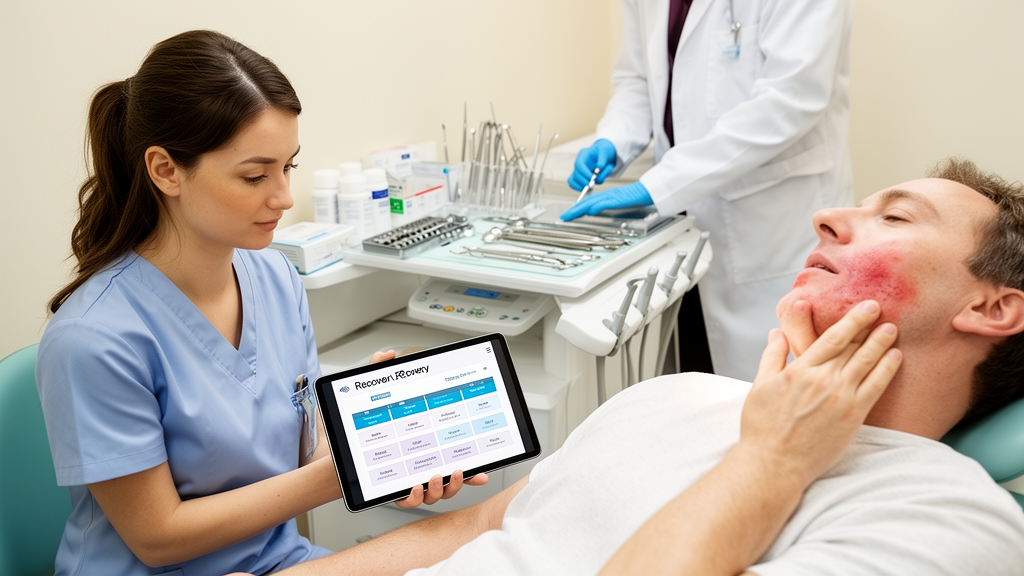
A structured bedside oral-care pathway was feasible after oral cancer resection and free-flap reconstruction in a prospective, single-center observational cohort of 36 adults, and patients showed improvement across multiple oral-health domains during their first two postoperative weeks. The study, conducted at a regional teaching hospital in central Taiwan, observed care delivered from the day of surgery through postoperative day 13. All 36 participants completed paired oral assessments, while 32 of 36 were recorded as completing all scheduled daily oral-care sessions. The results describe recovery over time rather than demonstrating that the pathway caused the improvement, because oral care had already begun before the first formal assessment and the study included no untreated or usual-care comparison group.
Major oral cancer resection and free-flap reconstruction can create an immediate recovery environment in which independent oral hygiene is difficult or temporarily impossible. Newly reconstructed intraoral tissue, surgical sutures, edema, blood and secretion accumulation, pain, restricted mouth opening, airway-related devices and nasogastric-tube feeding can interfere with brushing, rinsing, expectorating and inspection of the mouth. The supportive-care pathway examined in the cohort was therefore organized as a defined clinical process rather than a single product. It specified when care started, how frequently it was delivered, how irrigation, suction and mechanical cleansing were performed, how family caregivers were trained, and how oral recovery was assessed across mucosal, functional and wound-related domains.
Oral supportive care began as soon as postoperative bedside care commenced on the day of surgery, whether a participant returned to the ward or was transferred to the intensive-care unit. It continued through the early postoperative period and was scheduled six times daily in relation to nasogastric-tube feeding. During each session, 30 millilitres of the routinely used oral-care formulation was applied with a 20-millilitre syringe positioned approximately 2.5 to 5 centimetres from the intraoral wound, followed by suction drainage and cleansing with sponge swabs. In the intensive-care unit, unit nurses performed the care; on the ward, trained family caregivers performed it when available, with ward nurses providing care when a caregiver was unavailable. During the first three postoperative days, the same head nurse instructed the primary family caregiver in the cleaning procedure and assessed the caregiver’s technique before the caregiver independently continued the work.
Two formulations were used during routine clinical care: a clindamycin-based solution and a chlorhexidine-based gargle. Treating physicians selected between them according to ordinary prescribing practice, and the research team neither assigned nor modified the choice. The clindamycin formulation was prepared with three 150-milligram capsules in 500 millilitres of normal saline, yielding a concentration of 0.9 milligrams per millilitre. The commercial chlorhexidine product contained 0.2 percent chlorhexidine gluconate and 4.1 percent alcohol by volume; mixing 15 millilitres with 15 millilitres of normal saline produced a final chlorhexidine concentration of 0.1 percent and an approximate alcohol concentration of 2.05 percent by volume. Although a coin toss determined which formulation-defined category would contribute the next participant, the procedure governed observational sampling rather than treatment allocation. Each category was intended to contain 18 participants, and formulation comparisons were designated secondary and exploratory.
Oral status was evaluated with the Oral Assessment Scale for Post-Operational Patients with Oral Cancer, known as OASPOCa. Its 10 domains cover the lips, tongue, gingiva, buccal mucosa, hard palate, floor of the mouth, swallowing, saliva, mouth opening and surgical-wound condition. Each domain is scored from 1, representing the most favorable state, to 3, representing the most impaired state, producing a total score from 10 to 30 in which lower values indicate better oral status. For patients receiving nasogastric feeding, the swallowing domain was assessed according to their ability to manage and swallow saliva or oral secretions rather than requiring oral food intake. The reconstructed flap and suture line were evaluated using postoperative criteria that included flap appearance, warmth, capillary refill, wound approximation and the presence of blood, clots, secretions or other concerning findings.
The same experienced head nurse conducted all formal OASPOCa assessments on postoperative days 3 and 13, during the day shift and one hour after oral care. She was not blinded to the oral-care formulation and did not undergo a separate study-specific calibration exercise, so published psychometric properties of the scale should not be interpreted as study-specific calibration. Mean total OASPOCa score decreased from 14.97 with a standard deviation of 2.79 on day 3 to 11.44 with a standard deviation of 1.65 on day 13. The mean within-participant improvement was 3.53 points, with a standard deviation of 3.15, a 95 percent confidence interval from 2.46 to 4.59 and a paired P value below 0.001. The median improvement was 3 points, with an interquartile range of 1.75 to 6. These measurements characterize temporal change during a period in which supportive care was already underway, not the effect of care relative to an untreated baseline.
Recovery was not uniform across the 10 oral-health domains. At least some participants improved in every domain between days 3 and 13, while others remained unchanged or worsened. Improvement occurred in 8 of 36 participants for the swallowing domain, or 22.2 percent, and in 20 of 36, or 55.6 percent, for saliva. No participant’s lip score worsened, although worsening occurred in some participants in the tongue, gingiva, buccal mucosa, hard palate, floor of the mouth, mouth opening and surgical-wound domains. The percentage improving in each domain is influenced by how much room participants had for improvement at the first assessment. For example, only 3 of 18 participants in the clindamycin-defined group were already in the most favorable saliva category on day 3, compared with 10 of 18 in the chlorhexidine-defined group. No established minimally clinically important difference is available for OASPOCa, so the 3.53-point average change cannot be judged against a validated clinical-response threshold. The day-13 average of 11.44 also approached the scale’s theoretical minimum of 10, creating a potential floor effect that could limit detection of further improvement.
The exploratory comparison did not show a clear overall advantage for either formulation. Mean score improvement was 3.72 points with a standard deviation of 3.54 among the 18 participants who received the clindamycin-based formulation and 3.33 points with a standard deviation of 2.79 among the 18 who received the chlorhexidine-based formulation. The estimated between-formulation difference was 0.39 points, with a 95 percent confidence interval of minus 1.78 to 2.55 and a Welch P value of 0.717. Reanalysis with a bias-corrected and accelerated bootstrap produced a similar interval of minus 1.83 to 2.22, while an exact two-sided permutation test gave P = 0.757. These calculations indicate that the data do not distinguish a formulation-specific advantage; they do not establish equivalence. Resampling can assess statistical robustness but cannot remove confounding arising from the absence of research-directed treatment assignment, and the domain-level analyses involved sparse data and multiple exploratory comparisons.
Implementation findings were encouraging but incomplete. All 36 participants completed both scheduled assessments, and the archived adherence record indicated that 32 participants, or 88.9 percent, completed all daily oral-care sessions. Four participants had one missed-session record, two in each formulation-defined group, but the archive did not retain the reasons for those omissions or distinguish medically withheld sessions from other missed care. It also did not establish whether individual sessions were verified by direct nursing observation or caregiver report. No participant was recorded as using an additional oral-cleaning product. No clinically significant formulation-related intolerance or discontinuation was recorded, but adverse-event surveillance relied on routine clinical monitoring rather than a dedicated graded safety framework. The findings therefore provide preliminary information about short-term tolerability, not definitive safety evidence. The study also did not quantify caregiver-training duration, staffing time or validated caregiver competency, and temporary clinical modifications to the pathway were not recorded as separate research variables.
Several design features limit how far the results can be generalized. This was a single-center study with a predominantly male cohort: 35 of 36 participants were men, and 15 had recurrent rather than initial oral cancer. The protocol excluded patients unable to cooperate, those with certain psychiatric diagnoses or abnormal liver function, and those receiving pedicled or local rotational flaps. Detailed tumor subsite, TNM stage, resection extent, flap subtype, prior radiotherapy or chemoradiotherapy, tracheostomy status, comorbidity burden, nutritional status and baseline dentition were not collected as standardized variables. Categorical hospital stay also differed markedly between the formulation-defined groups, potentially reflecting unmeasured differences in case complexity, postoperative course, discharge readiness or clinical practice. The cohort offers a detailed account of a structured bedside process that appeared practicable in one hospital setting, but it does not establish pathway efficacy, comparative safety or superiority of either oral-care formulation. Larger controlled studies with a pretreatment baseline, research-directed formulation assignment, formal safety monitoring and outcomes such as infection, wound complications, function, microbiology and patient-reported recovery would be needed to determine whether the pathway itself produces clinical benefits.
Subject of Research: Prospective observational study of early oral supportive care and oral-health recovery after oral cancer resection and free-flap reconstruction
Article Title: Implementation of a structured early oral supportive-care pathway and early oral health recovery after oral cancer resection and free-flap reconstruction: a prospective observational cohort study
Article References: Huang, T.-M., Chen, Y. C., Cheng, Y.-C., Yeh, C.-Y., Chang, Y.-K., Nian, M.-W., Chiang, T.-I., & Tsai, S. C.-S. (2026). Implementation of a structured early oral supportive-care pathway and early oral health recovery after oral cancer resection and free-flap reconstruction: a prospective observational cohort study. Frontiers in Oncology, 16, Article 1981326. https://doi.org/10.3389/fonc.2026.1981326
Image Credits: AI Generated
DOI: 10.3389/fonc.2026.1981326
Keywords: oral cancer, free-flap reconstruction, postoperative care, oral hygiene, nursing care, caregiver support, oral-health recovery, clindamycin, chlorhexidine, prospective cohort, Implementation, structured
Cite Scienmag News
Ophelia Keating. (October 21, 2026). Structured oral-care pathway tracks recovery after oral cancer surgery. Scienmag. https://scienmag.com/structured-oral-care-pathway-tracks-recovery-after-oral-cancer-surgery/
Ophelia Keating. "Structured oral-care pathway tracks recovery after oral cancer surgery." Scienmag, 21 October 2026, https://scienmag.com/structured-oral-care-pathway-tracks-recovery-after-oral-cancer-surgery/. Accessed 21 October 2026.
Ophelia Keating. "Structured oral-care pathway tracks recovery after oral cancer surgery." Scienmag. October 21, 2026. https://scienmag.com/structured-oral-care-pathway-tracks-recovery-after-oral-cancer-surgery/


