


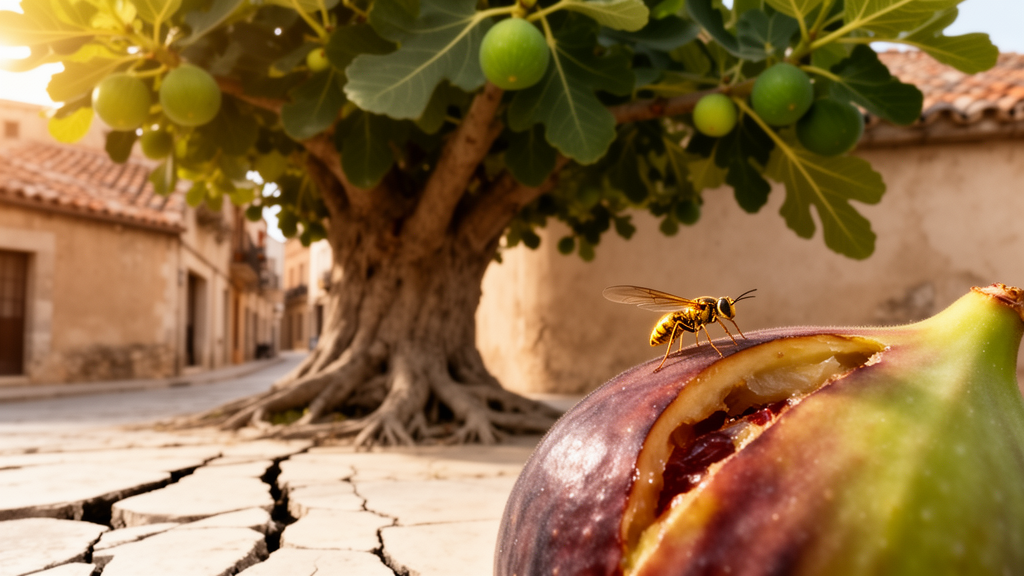
An observational field survey in southern Spain found two pollinating fig-wasp species and four non-pollinating chalcidoidean associates in ornamental figs, together with seedlings and saplings indicating spontaneous reproduction of three Ficus species outside their native ranges. The 2019–2024 study documented the regeneration in Cádiz, Seville and Alicante and described it as a potential biological-invasion pathway, although it did not quantify the scale of the phenomenon.
The researchers sampled syconia, the fig-like inflorescences, from commonly cultivated Ficus microcarpa, F. macrophylla and F. rubiginosa in urban parks and gardens in the three cities. Infrutescences were taken to a laboratory and examined with a 20–60× stereomicroscope. Observed Hymenoptera were sorted and stored in 70% alcohol, identified using established taxonomic keys, and photographed with a Leica DMS1000 digital microscope. Some specimens were deposited at the Museo Nacional de Ciencias Naturales in Madrid, while others were retained in the author’s personal collection.
Fig trees generally depend on an obligate mutualism with pollinating wasps in the superfamily Chalcidoidea. Female agaonids enter a fig through the ostiole, pollinate its flowers and lay eggs in the ovules. Their larvae feed on gall tissue while seeds and stamens mature. Wingless males emerge first, mate with females inside the galls and open an exit through the receptacle wall. Females then leave, either collecting pollen in their pollen pockets or carrying pollen dusted onto them. The literature cited in the study notes that the traditional one-pollinator-per-fig relationship often breaks down through species complexes or the presence of several pollinator species within one host fig; it does not establish host shifts as the basis for those exceptions.
Among the pollinators detected, Eupristina aff. verticillata was associated with F. microcarpa, while Pleistodontes imperialis was identified as the pollinator of F. rubiginosa. Two female P. imperialis were also found in syconia of F. macrophylla. The authors treated both pollinators as first confirmed records for the Iberian Peninsula because earlier Spanish reports did not include locality information that could verify the records. E. verticillata, as presently understood, is a species complex of at least three species, and P. imperialis also comprises morphologically related species. Nevertheless, the European P. imperialis examined in the study shared the diagnostic characters of the nominal entity.
Four non-pollinating wasp species completed the inventory. Eufroggattisca okinavensis produced large galls in F. microcarpa syconia, and Josephiella microcarpae formed leaf galls marked by spherical or warty blisters. Walkerella microcarpae was recorded as a gall-former in F. microcarpa figs. Philotrypesis okinavensis, a parasitoid associated with E. verticillata and W. microcarpae, represented the first record from Spain and the Iberian Peninsula. The broader fig-wasp community also includes gall-makers, seed predators, parasitoids and inquilines, which can reduce pollinator numbers and viable seed production. The authors noted that a possible biological-control role for some non-pollinators cannot be excluded, but their effects appeared smaller than previously thought.
The survey also documented spontaneous regeneration of ornamental Ficus trees in all three study areas. Seedlings and saplings occurred near cultivated adults along the Guadalquivir River and in central Seville, as well as in Jerez de la Frontera. They emerged from cracks or gaps in pavements, walls, balconies, sewer systems, stairways, sidewalks and other vertical urban surfaces. Some seedlings appeared to be less than one or two years old, while larger plants suggested older recruitment, often at sites where urban management was limited. The authors interpreted these observations as evidence of sexual reproduction rather than propagation from cuttings.
Root growth was associated with visible damage. The researchers observed cracking of walls and pavement, lifting of balcony slabs and harm to historic architecture. Ficus plants were recorded in the moat of the Rectorate in Seville, on a watchtower of the Cádiz city wall and from a drainage outlet on the roof of the Tempul water reservoir in Jerez de la Frontera. In Alicante, seedlings were also observed on ornamental palm trees and were described as capable eventually of covering and crowding their hosts. Fig plants can develop root systems that enter cracks in buildings, walls and other trees, potentially widening gaps and aggravating structural damage.
Animal feeding may provide an additional route for dispersal. Common wood pigeons, house sparrows and the invasive rose-ringed parakeet were observed feeding on mature syconia in María Luisa park in Seville and at the ZooBotánico Jerez. Animal-assisted dispersal by birds, ants and other vertebrates can transport seeds from urban plantings into nearby seminatural and natural habitats. The authors therefore described the combination of pollinating wasps and potential seed dispersers as a mechanism that could facilitate invasion, rather than as an effect quantified by the survey.
Overall, the study provides confirmed Iberian records for several fig-associated wasps and documents spontaneous regeneration of exotic Ficus in several parts of mainland Spain. The observations identify a potential invasion pathway affecting urban infrastructure, historic sites, other city trees and nearby ecosystems, but its scale remains uncertain. Wasp sampling was concentrated in three southern Spanish cities, the searches for seedlings and saplings were fortuitous rather than systematic and were intended only to detect their presence, and damage was assessed subjectively and descriptively rather than through standardized measurements.
Subject of Research: Field documentation of fig wasps and spontaneous reproduction of ornamental Ficus trees in southern Spain
Article Title: Unveiling an intricate relationship: Ficus trees, their associated wasps ( Hymenoptera , Chalcidoidea ) and another story of invasion in the Iberian Peninsula and Europe
Article References: Pérez-Gómez, Á., Sánchez-García, Í., Royo, J. M., Rasplus, J.-Y., & Robla, J. (2025). Unveiling an intricate relationship: Ficus trees, their associated wasps (Hymenoptera, Chalcidoidea) and another story of invasion in the Iberian Peninsula and Europe. Journal of Hymenoptera Research, 98, 667-687. https://doi.org/10.3897/jhr.98.156087
Image Credits: AI Generated
Keywords: Ficus, fig wasps, Chalcidoidea, Agaonidae, plant regeneration, biological invasion, Iberian Peninsula, urban trees, pollination, Unveiling, intricate, relationship
Cite Scienmag News
Patricia Pace. (October 21, 2026). Southern Spain survey links fig wasps with spontaneous regeneration of ornamental Ficus. Scienmag. https://scienmag.com/southern-spain-survey-links-fig-wasps-with-spontaneous-regeneration-of-ornamental-ficus/
Patricia Pace. "Southern Spain survey links fig wasps with spontaneous regeneration of ornamental Ficus." Scienmag, 21 October 2026, https://scienmag.com/southern-spain-survey-links-fig-wasps-with-spontaneous-regeneration-of-ornamental-ficus/. Accessed 21 October 2026.
Patricia Pace. "Southern Spain survey links fig wasps with spontaneous regeneration of ornamental Ficus." Scienmag. October 21, 2026. https://scienmag.com/southern-spain-survey-links-fig-wasps-with-spontaneous-regeneration-of-ornamental-ficus/


