


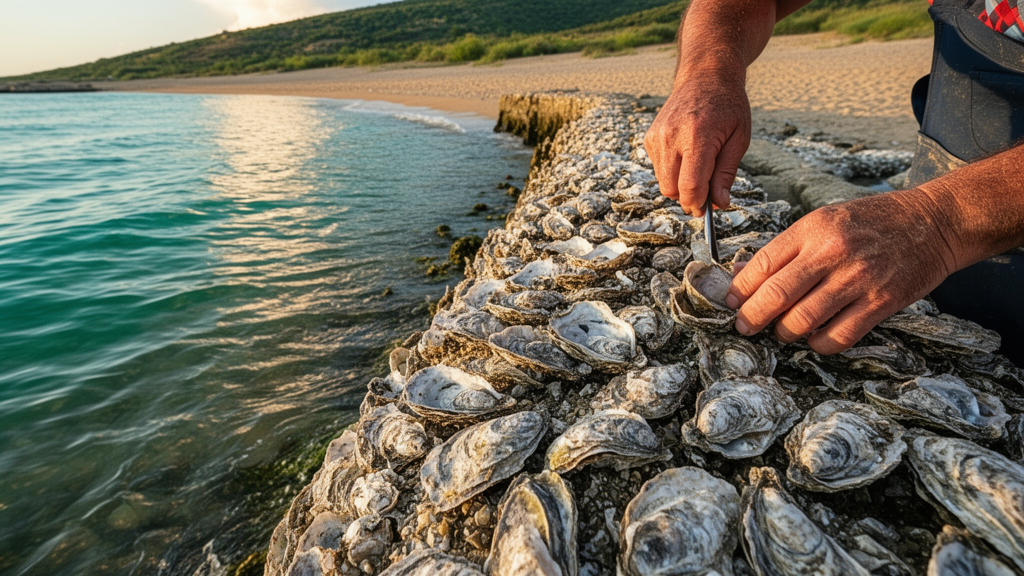
A field study with laboratory biochemical analysis found that Pacific oysters collected from seven sites along the Bulgarian Black Sea coast exhibited site- and season-specific oxidative-stress responses, with the measurements indicating substantial physiological resilience at several locations. The study assessed 70 Magallana gigas, including animals gathered from a mussel farm, and compared its stress markers with those of 46 native black mussels, Mytilus galloprovincialis, collected from some of the same habitats.
The Pacific oyster, also known as Crassostrea gigas, originates from the north-eastern Pacific coast of Asia and has been introduced elsewhere for aquaculture. It was first introduced into the Black Sea along the Crimean coast in the 1980s. On the Bulgarian coast, feral specimens were first reported in 2010 from the coast of Sts. Constantine and Helena Resort, and two relatively small wild colonies had subsequently been registered near Burgas and Kiten.
Researchers collected oysters from Kavarna, Varna Lake, Burgas, Sozopol Bay, Primorsko, Kiten and Tsarevo. Feral animals were removed manually from their attachment sites by SCUBA diving, while some specimens at Kavarna had settled on collectors at a black mussel farm. The oysters were transported in thermocontainers with dry ice and stored at −80 °C for analysis. For comparison, native black mussels measuring 4.9–6.0 cm in length were sampled at Kavarna, Varna Lake, Sozopol and Primorsko.
The investigators measured lipid peroxidation and protein oxidation as indicators of cellular oxidative changes, together with glutathione and the antioxidant enzymes superoxide dismutase, catalase, glutathione peroxidase, glutathione reductase and glutathione-S-transferase. They combined these measurements into a Specific Oxidative Stress index, calculated as the standardized pro-oxidant score minus the antioxidant score. Values near zero represented the site average, while positive and negative values indicated departures from that average. A four-quadrant framework characterized the combinations as underload, optimum stress, overload and burnout.
Pacific oysters varied substantially in size among locations. Mean upper shell length was highest at Sozopol Bay, at 94.3 ± 16.4 mm, followed by Kiten at 76.1 ± 11.5 mm and Varna Lake at 76.60 ± 14.00 mm. Mean wet weight ranged from 17.7 ± 8.9 g at Burgas to 133.2 ± 16.8 g at Kiten. Researchers used shell size only as an approximate guide to age, estimating that the sampled animals were mainly one to three years old and that the largest oysters at Sozopol Bay and Kiten were approximately three to four years old. They cautioned that growth can differ among habitats and regions, making these age estimates uncertain.
Biomarker values also differed by locality and season. In summer, the highest lipid-peroxidation values among oysters occurred at Tsarevo, at 10.12 ± 1.78 nmoles MDA/mg protein, and Burgas, at 9.05 ± 2.14 nmoles MDA/mg protein; the highest protein oxidation was measured at Varna Lake, at 19.21 ± 3.90 nmol PC/mg protein. Oysters from Varna Lake also had the highest autumn protein oxidation, at 18.20 ± 4.86 nmol PC/mg protein. Antioxidant responses differed among locations: Tsarevo and Burgas had exceptionally high superoxide dismutase activity in summer, Varna Lake had high catalase activity in both seasons, and Burgas had high glutathione peroxidase, glutathione reductase and glutathione-S-transferase activity in summer.
The integrated index placed Pacific oysters from all studied localities in either the low-stress Q1 category or Q3, where pro-oxidant and antioxidant processes were both above average and antioxidant capacity was being exceeded. None fell in the Q4 burnout category. Oysters from Kavarna, Sozopol Bay, Primorsko and Kiten generally showed low stress, whereas those from Burgas, Varna Lake and Tsarevo had higher index values. The comparison with mussels also showed different responses under the same site conditions. At Primorsko in summer, the authors classified the mussels as showing an initial antioxidant response, while the oysters were classified as underloaded. At Kavarna, oysters showed very little stress in both seasons, while the mussels were placed in the overload category in summer. The authors also classified the native mussels from Varna Lake near the burnout stage in both seasons and interpreted the oysters there as having lower stress and greater cellular resilience.
At Sozopol Bay, both species were placed in the low-stress category, with black mussels showing still lower values. The authors noted that this bay contains varied marine habitats, including rocky substrates favorable to Pacific oyster development, and forms part of the European Natura 2000 network. They suggested that niche separation may be possible, although the study did not directly test that explanation. They also placed the oyster index values into two stages of a theoretical adaptive-cycle model and interpreted them as corresponding to a growth or resource-exploitation stage. This was a model-based interpretation rather than a direct measurement of population growth, reproduction or colonization.
The findings provide initial evidence that the sampled Pacific oysters can persist under varied Bulgarian coastal conditions, but they do not demonstrate that the population will expand into a mass invasion or establish its ecological effects. The study did not measure reproduction, dispersal, systematic population trends or the native Black Sea oyster, Ostrea edulis, and site-specific sample sizes were small and uneven. The authors stated that further studies of dispersal and reproduction, together with proper monitoring, are needed to estimate whether expansion will occur and to assess possible consequences for native biodiversity, food webs and coastal habitats.
Subject of Research: Oxidative-stress indicators of Pacific oyster adaptability in seven Bulgarian Black Sea coastal sites
Article Title: Adaptability of the alien Pacific oyster to the coastal marine environment of the Bulgarian Black Sea and potential implications for ecosystem conservation
Article References: Alexandrova, A., Mitov, P., Kenderov, L., Tsvetanova, E., Georgieva, A., Andreeva, M., Petrov, G., Pramatarov, G., & Chipev, N. (2026). Adaptability of the alien Pacific oyster to the coastal marine environment of the Bulgarian Black Sea and potential implications for ecosystem conservation. Nature Conservation, 61, 159-176. https://doi.org/10.3897/natureconservation.61.169051
Image Credits: AI Generated
DOI: 10.3897/natureconservation.61.169051
Keywords: Pacific oyster, Bulgarian Black Sea, oxidative stress, physiological resilience, invasive species, field study, black mussel, coastal ecosystems, ecophysiology, Adaptability, alien, Pacific
Cite Scienmag News
Patricia Pace. (October 20, 2026). Oxidative-stress study finds Pacific oysters resilient across seven Bulgarian Black Sea sites. Scienmag. https://scienmag.com/oxidative-stress-study-finds-pacific-oysters-resilient-across-seven-bulgarian-black-sea-sites/
Patricia Pace. "Oxidative-stress study finds Pacific oysters resilient across seven Bulgarian Black Sea sites." Scienmag, 20 October 2026, https://scienmag.com/oxidative-stress-study-finds-pacific-oysters-resilient-across-seven-bulgarian-black-sea-sites/. Accessed 20 October 2026.
Patricia Pace. "Oxidative-stress study finds Pacific oysters resilient across seven Bulgarian Black Sea sites." Scienmag. October 20, 2026. https://scienmag.com/oxidative-stress-study-finds-pacific-oysters-resilient-across-seven-bulgarian-black-sea-sites/


