


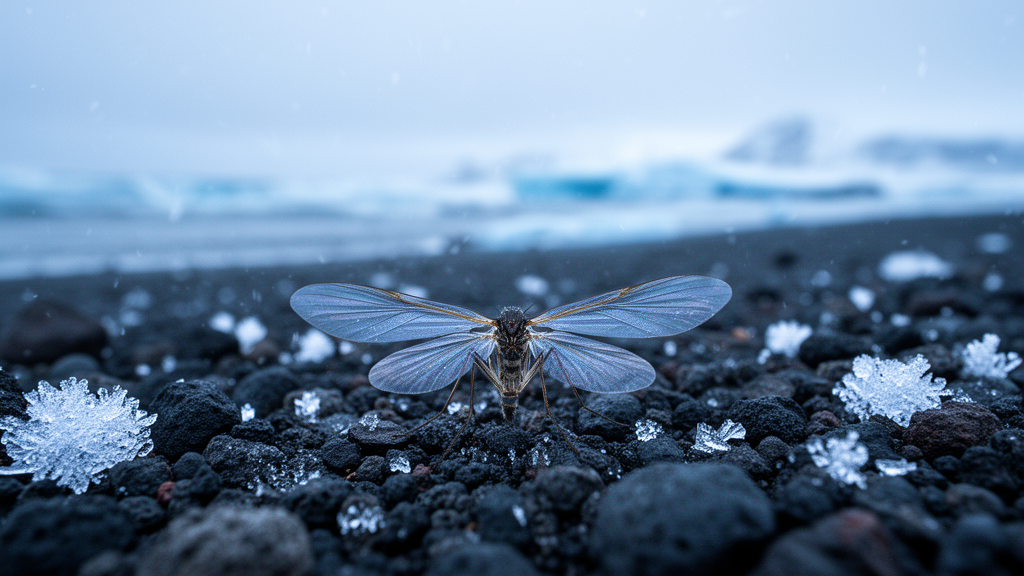
A geometric morphometric study found measurable differences in the wing shape and size of the non-native moth fly Psychoda albipennis among three localities in the Maritime Antarctic and Magellanic sub-Antarctic regions. The observational comparison linked these differences to locality, meteorological conditions and sampling year, but it did not establish that environmental conditions caused genetic adaptation or measured flight performance, dispersal capacity or ecological impacts.
Researchers collected 429 adult flies in 2024 and 2025 from two stations on King George Island in the South Shetland Islands—Chile’s Professor Julio Escudero Station and Uruguay’s Artigas Station—and from Puerto Williams on Navarino Island in the Cape Horn Biosphere Reserve. Light traps, Malaise traps and manual sampling were used. After damaged or incomplete wings were excluded, 241 individuals were retained for morphometric analysis, yielding 482 left and right wings.
The specimens were identified using morphological and molecular approaches and sexed by examining the abdominal apex. Wing images were obtained with an Axiocam 208 camera coupled to a Zeiss Stemi 305 stereomicroscope, and 14 homologous landmarks were digitised on each wing using TPSdig2. Generalised Procrustes Analysis removed variation attributable to scale, rotation and orientation, allowing the researchers to analyse wing shape separately from centroid size. Analyses were performed with MorphoJ and the R package geomorph.
Exploratory comparisons showed high correspondence between left and right wings, including near-complete overlap in principal-component morphospace, with no meaningful directional asymmetry. The two wings were therefore pooled. A Procrustes analysis of variance supported the reliability of landmark placement: the mean square for individuals, 3.20073 × 10⁻⁵, was greater than the mean square associated with measurement error, 3.8493 × 10⁻⁶.
Principal component analysis separated the Puerto Williams population from both King George Island populations, while Escudero and Artigas also differed from one another. The first three components accounted for 66.5% of wing-shape variation: 40.2% for PC1, 17.5% for PC2 and 8.8% for PC3. Mean-shape comparisons showed that flies from the two Antarctic stations had narrower, more elongated wings, whereas Puerto Williams flies had more compact, flattened wings. Escudero wings were slightly broader than Artigas wings. These are observed geographic differences, not direct measures of altered flight performance.
Wing centroid size differed by sex, locality and their interaction. Females generally had larger wings than males, except at Escudero, where only a small number of males was sampled. Puerto Williams had significantly smaller centroid sizes than Artigas (p = 0.0008) and Escudero (p = 0.0009), while no significant difference was detected between the two Antarctic stations (p = 0.933). A multivariate regression attributed 12.39% of shape variation to an allometric relationship with size. Within the Antarctic samples, size-related effects accounted for 3.27% of shape variation at Escudero and 12.32% at Artigas.
Samples collected in 2024 had larger wings than those collected in 2025 at both Antarctic stations. Separate Procrustes analyses found highly significant year effects at Escudero (F = 2112.10, p < 0.0001) and Artigas (F = 1434.51, p < 0.0001). Because sampling covered two years and no experimental manipulation of temperature or wind was conducted, the analysis cannot distinguish inherited differentiation from phenotypic plasticity, short-term environmental effects or other temporal influences.
Meteorological records measured at 2.5 metres above ground covered the austral summers from November 2023 to March 2024 and November 2024 to March 2025. Antarctica had lower minimum temperatures, Puerto Williams had higher maximum temperatures, and Puerto Williams also recorded stronger maximum winds. In partial least-squares models, maximum wind speed explained 46% of the variation in wing shape and minimum temperature explained 2.74%; both associations were significant at p = 0.001. Alternative models paired maximum wind speed with maximum temperature and produced the same respective explanatory values. These locality-level associations do not by themselves demonstrate that wind or temperature produced the differences.
The authors considered several bounded explanations for the patterns, including phenotypic accommodation, genetic assimilation, cryptic genetic structure or a combination of these processes. Morphological identification and mitochondrial COI sequences were insufficient to rule out cryptic population differentiation, and higher-resolution genomic analyses would be required to distinguish the alternatives. The study also identified an apparent contrast between measured wind speed and effective exposure: Puerto Williams had a higher average maximum wind speed, 18.13 km/h compared with 11.92 km/h in Antarctica, but its vegetation may reduce direct wind exposure, whereas Antarctic habitats are comparatively open. Habitat-specific microclimate measurements were not available to test that explanation directly.
Overall, the study documents spatial and interannual variation in the wing morphology of a non-native fly and finds associations between that variation and locality, size, temperature and wind measurements. It presents wing morphology as a potential indicator that may help monitor invasion-related phenotypic change, but the authors also emphasize the need for genomic and physiological evidence before drawing stronger conclusions about adaptation, invasion routes or population structure. The findings raise concern because P. albipennis occupies habitats associated with decaying organic matter and could expand its distribution in low-biodiversity Maritime Antarctic ecosystems; however, the study did not measure ecosystem effects caused by the fly.
Subject of Research: Geometric morphometrics of non-native Psychoda albipennis wing variation in Maritime Antarctica and the Magellanic sub-Antarctic
Article Title: Wing shape changes as a proxy for invasion success in Antarctica: case study of Psychoda albipennis ( Psychodidae ) using geometric morphometrics
Article References: Hernandez-Martelo, J., Contador, T., Gañan, M., Chávez-Vásquez, K., Guitierrez, J. P., Convey, P., Kvifte, G. M., Cruz-Jofré, F., & Benítez, H. A. (2026). Wing shape changes as a proxy for invasion success in Antarctica: case study of Psychoda albipennis (Psychodidae) using geometric morphometrics. NeoBiota, 105, 275-296. https://doi.org/10.3897/neobiota.105.167989
Image Credits: AI Generated
DOI: 10.3897/neobiota.105.167989
Keywords: Psychoda albipennis, geometric morphometrics, wing morphology, Maritime Antarctica, King George Island, Navarino Island, invasive insects, environmental association, Wing, shape, changes, proxy
Cite Scienmag News
Gavin Prescott. (October 20, 2026). Geometric morphometric study links wing differences in non-native moth fly to location, weather and sampling year. Scienmag. https://scienmag.com/geometric-morphometric-study-links-wing-differences-in-non-native-moth-fly-to-location-weather-and-sampling-year/
Gavin Prescott. "Geometric morphometric study links wing differences in non-native moth fly to location, weather and sampling year." Scienmag, 20 October 2026, https://scienmag.com/geometric-morphometric-study-links-wing-differences-in-non-native-moth-fly-to-location-weather-and-sampling-year/. Accessed 20 October 2026.
Gavin Prescott. "Geometric morphometric study links wing differences in non-native moth fly to location, weather and sampling year." Scienmag. October 20, 2026. https://scienmag.com/geometric-morphometric-study-links-wing-differences-in-non-native-moth-fly-to-location-weather-and-sampling-year/


