


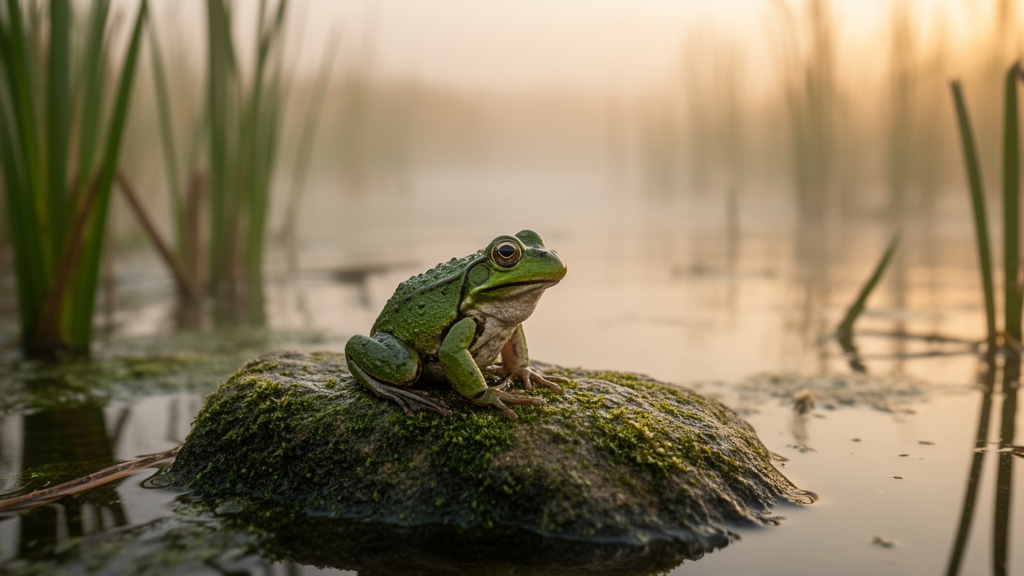
A field study documented more than 30 metamorphosed juvenile Greek frogs in Borački Creek in September 2024 and a subadult on the southwestern slope of Borački Krš the following month. Together with two AmphibiaWeb records from Bukulja Mountain, the observations suggest that the northern boundary of the Greek frog’s known distribution in central Serbia may be farther north than previously mapped.
The study was based on incidental observations during four visits to Borački Krš between June and October 2024. The researchers were compiling a list of protected reptile species at the natural monument rather than conducting a dedicated amphibian survey. On each visit, two researchers performed two or three visual encounter surveys along predefined routes, generally from 9:00 a.m. to 3:00 p.m. because of logistical constraints. Amphibians were recorded when encountered, without specialized equipment.
The September observation involved more than 30 metamorphosed juveniles along Borački Creek, in UTM square DP66 at 43.9643°N, 20.5962°E and 370 metres above sea level. The relevant section of the stream runs along the edge of deciduous forest beneath a dense canopy. During a mid-October visit, the team recorded a subadult on the southwestern slope of the protected area at 43.9632°N, 20.5992°E and 400 metres above sea level. Borački Creek and the Boračka River were both about 200–300 metres from that second site.
Borački Krš is a tertiary geological formation between the Rudnik and Kotlenik mountains, with elevations ranging from 313 to 515 metres. Oak forests predominate in the foothills, while thermophilic meadows and rocky or chasmophytic vegetation occur farther up the formation. It is designated as a first-category natural monument in Serbia. Before these observations, four amphibian species had been recorded there: the fire salamander, alpine newt, yellow-bellied toad and marsh frog. No data were available for brown frogs of the genus Rana or the common toad, despite the wider occurrence of these early-breeding amphibians in the Balkan Peninsula.
The findings revise the geographic picture previously presented for Šumadija, the large central Serbian region bounded by the Sava and Danube rivers to the north, the Velika Morava and Zapadna Morava to the east and south, and the Dičina, Ljig and Kolubara to the west. The northernmost previously published locality in Šumadija was the Crna Grača River gorge at the foothills of Juhor Mountain, south of Jagodina, in UTM square EP15. That location was farther south than known range limits in neighboring Bosnia and Herzegovina and western Serbia.
Two records submitted to the AmphibiaWeb database provide additional evidence from farther north. Dated from late October 2019 and early October 2020, both refer to Bukulja Mountain in UTM square DQ60, approximately 50 kilometres north of Borački Krš in a straight line. Their coordinates are 44.2828°N, 20.5088°E and 44.2863°N, 20.5186°E. Combined with the new field observations, these records suggest that the northern boundary of the Greek frog’s range in central Serbia could extend from 10 to 50 kilometres farther north than indicated by the distribution map published by Urošević and colleagues in 2018.
The records do not establish how widely the species occurs in the area. The field effort was brief, seasonal and designed primarily to document reptiles rather than amphibians. Greek frogs are usually detectable in aquatic habitats only briefly during the early-spring breeding and spawning season, and the authors note that egg clutches in small lotic habitats from late February through March may indicate their presence. Monitoring brown-frog tadpoles in fast-flowing rivers and streams from early April through late June may also help establish distribution. Such observations require caution because agile frogs and common frogs sometimes spawn in flowing water as well.
Earlier work described permanent, fast-flowing and clear mountain waters as an obligatory feature of Greek-frog habitats in Bosnia and Herzegovina and Serbia. Yet the species had not been recorded from some apparently suitable areas, including habitats east of the Velika Morava River, where its mapped northern boundary bends southeastward through Serbia. In Bulgaria, the northernmost localities also lie farther southeast, and a report from 1972 noted the species’ absence from a number of suitable habitats. These patterns and the new observations indicate that mapped limits may not fully represent where the species occurs.
Climate-driven expansion remains an untested possibility, not a conclusion from these records. Previous modelling found that temperature- and rainfall-related variables contributed most strongly to distribution modelling and indicated slight population growth from the Last Glacial Maximum without significant range expansion. The authors state that long-term monitoring of demographic variables would be required before drawing conclusions about a climate-related expansion. The current evidence instead supports targeted surveys of the Gledićke, Kotlenik, Rudnik, Venčac and Bukulja mountains and other habitats north of the mapped boundary to clarify the Greek frog’s distribution in central Serbia.
Subject of Research: Field and database records of the Greek frog at the northern edge of its known range in central Serbia
Article Title: A new record of the Greek frog at the northern border of the species area
Article References: Crnobrnja-Isailović, J., Mihailović, M., Ilić, M., Ćorović, J., & Jovanović, B. (2025). A new record of the Greek frog at the northern border of the species area. Herpetozoa, 38, 87-91. https://doi.org/10.3897/herpetozoa.38.e150553
Image Credits: AI Generated
DOI: 10.3897/herpetozoa.38.e150553
Keywords: Greek frog, Rana graeca, distribution range, central Serbia, Borački Krš, Borački Creek, Bukulja Mountain, AmphibiaWeb, field observations, amphibian monitoring, record, Greek
Cite Scienmag News
Margaret Porter. (October 20, 2026). Field observations extend Greek frog records northward in central Serbia. Scienmag. https://scienmag.com/field-observations-extend-greek-frog-records-northward-in-central-serbia/
Margaret Porter. "Field observations extend Greek frog records northward in central Serbia." Scienmag, 20 October 2026, https://scienmag.com/field-observations-extend-greek-frog-records-northward-in-central-serbia/. Accessed 20 October 2026.
Margaret Porter. "Field observations extend Greek frog records northward in central Serbia." Scienmag. October 20, 2026. https://scienmag.com/field-observations-extend-greek-frog-records-northward-in-central-serbia/


