


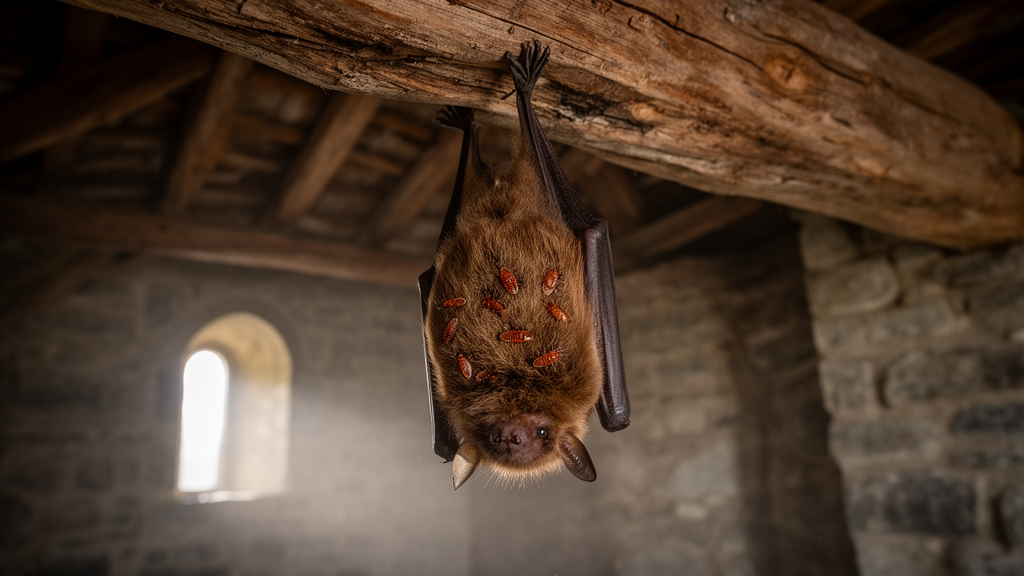
A field survey conducted in May and June 2022 documented the first known records of the common bed bug, Cimex lectularius, associated with bats in Armenia and Georgia. Researchers found the insect at three of 14 sites surveyed: Gremi Church and a church near Pichkhovani Village in Georgia, and Arakelots Monastery in Armenia.
The field work was conducted under the Caucasus Barcode of Life project. Investigators visited six sites in Georgia from May 30 to June 2 and eight sites in Armenia from May 20 to 23. The 14 locations comprised seven caves or tunnels and seven churches or other human-made buildings. At each roost, one to three people searched for cimicid bugs for at least 30 minutes and usually up to 60 minutes. The search began with spider webs, where dead cimicids and exuviae might occur, before examining walls and the ground, with particular attention to areas close to bats and their roosting places.
Specimens were collected by hand, fixed in 96% ethanol and stored at minus 22°C for further analysis at the University Museum in Bergen, Norway. Researchers identified all specimens morphologically as C. lectularius. Diagnostic characters excluded species in the Cimex pipistrelli group and Cimex emarginatus. The identification of one specimen from the church near Pichkhovani Village was also confirmed through DNA barcoding of the mitochondrial cytochrome c oxidase subunit I gene. Its GenBank accession number is OP897494.
At Gremi Church, the collection comprised two males, one female and the remains of a fourth- or fifth-stage nymph. None of the Georgian specimens showed evidence of a recent blood meal, although one male had dark spots in its gut that indicated a possible blood meal in 2022. One collected female contained several eggs, providing evidence of a reproductive population at that location. At the church near Pichkhovani Village, researchers collected three males and two females, one of which was dead.
The Armenian collection at Arakelots Monastery consisted of two dead, partly damaged females, one heavily damaged individual of unknown sex and one dead fifth-stage nymph. Small remnants of blood meals in these specimens indicated feeding in 2022 or shortly before the insects died. Together with the immature specimen, these observations show that multiple life stages were present, but the survey did not directly document eggs at the Armenian site.
Possible hosts were inferred from bats observed at the positive locations rather than confirmed by observing feeding. The church near Pichkhovani Village housed a maternity colony of Myotis blythii, or lesser mouse-eared bat, while Arakelots Monastery contained maternity colonies of M. blythii and Miniopterus pallidus, the pale bent-wing bat. Myotis blythii is a known host of C. lectularius. At Gremi Church, a maternity colony of Rhinolophus ferrumequinum, the greater horseshoe bat, was estimated at up to 400 individuals in 2021, with single individuals of Myotis emarginatus also present. The authors identified R. ferrumequinum as a potential host but did not establish it as the insect’s host at the church.
Previous records of C. lectularius in colonies of R. ferrumequinum had involved mixed bat colonies. The host association at Gremi therefore remains unresolved, and the presence of M. emarginatus did not provide sufficient evidence to identify that species as a host. The authors proposed that the earlier absence of published bat-associated records in the Caucasus could reflect low search effort rather than a true distributional gap. They also noted that documented records elsewhere in the Palearctic are unevenly distributed and that sampling differences can affect apparent geographic patterns.
All three positive sites were old churches rather than caves, although several caves were included in the survey. The limited number of locations examined did not establish a general habitat preference or the prevalence of bat-associated populations across the region. The authors discussed possible explanations for the rarity of these insects in bat caves, including host specificity, climatic requirements and the availability of stable, large Myotis colonies. Caves may be too humid and cold for some populations, while warmer and drier human structures can provide alternative summer roosts for bats and their associated insects. These hypotheses were not tested in the 2022 survey.
The study establishes occurrence at the three positive sites and documents eggs at one Georgian location, but it does not identify the insects’ dispersal routes, confirm specific host relationships at every location or determine how widespread bat-associated populations are beyond the sites examined. The authors said additional fieldwork would likely reveal further locations and that entomological training combined with short field experience could improve detection rates among researchers surveying bat colonies.
Subject of Research: Field documentation of bat-associated common bed bugs in Armenia and Georgia
Article Title: First records of bat-associated Cimex lectularius ( Cimicidae , Heteroptera ) for Armenia and Georgia
Article References: Ghazarayan, A., Hayrpetyan, T., Natradze, I., & Roth, S. (2023). First records of bat-associated Cimex lectularius (Cimicidae, Heteroptera) for Armenia and Georgia. Caucasiana, 2, 137-142. https://doi.org/10.3897/caucasiana.2.e104244
Image Credits: AI Generated
DOI: 10.3897/caucasiana.2.e104244
Keywords: Cimex lectularius, common bed bug, bat ectoparasites, Armenia, Georgia, Caucasus, field survey, bat roosts, DNA barcoding, entomology, First, records
Cite Scienmag News
Gavin Prescott. (October 20, 2026). 2022 field survey documents first bat-associated common bed bug records in Armenia and Georgia. Scienmag. https://scienmag.com/2022-field-survey-documents-first-bat-associated-common-bed-bug-records-in-armenia-and-georgia/
Gavin Prescott. "2022 field survey documents first bat-associated common bed bug records in Armenia and Georgia." Scienmag, 20 October 2026, https://scienmag.com/2022-field-survey-documents-first-bat-associated-common-bed-bug-records-in-armenia-and-georgia/. Accessed 20 October 2026.
Gavin Prescott. "2022 field survey documents first bat-associated common bed bug records in Armenia and Georgia." Scienmag. October 20, 2026. https://scienmag.com/2022-field-survey-documents-first-bat-associated-common-bed-bug-records-in-armenia-and-georgia/


