


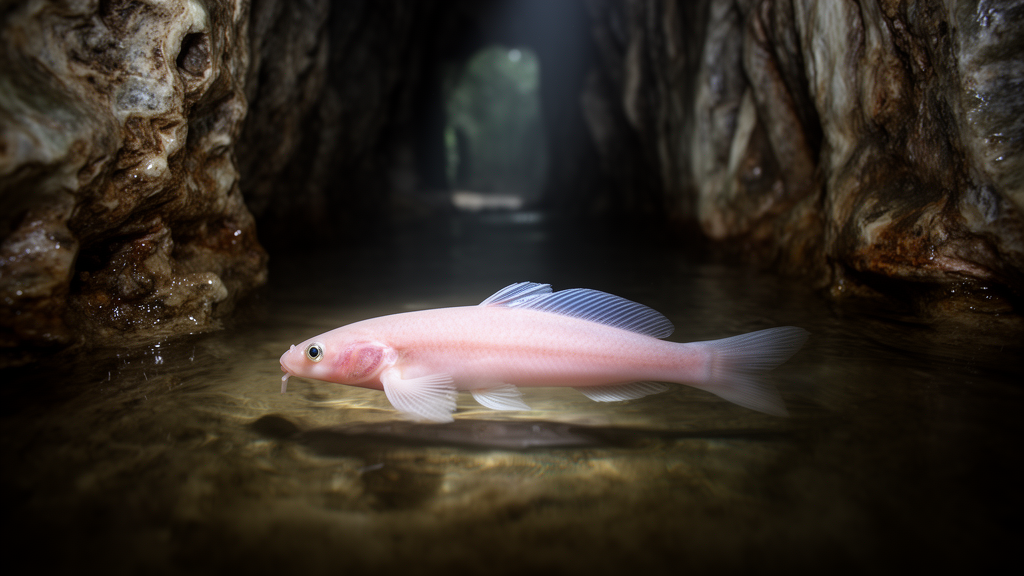
A taxonomic study combining measurements of 14 specimens with mitochondrial DNA analysis has identified the Dafang population of the mountain-loach genus Claea as a new species, Claea dafangensis, from Dafang County in Guizhou Province, China. The authors based the description on differences from all four recognized congeners and its placement as an independent lineage in a cytochrome b phylogeny.
The genus Claea was established by Kottelat in 2011 with Oreias dabryi as its type species. Before that, these loaches had been classified in Oreias, a name already used in bird taxonomy, leading to a prolonged nomenclatural dispute. Four valid Claea species had previously been recognized in the Yangtze River and its tributaries: C. dabryi, C. minibarba, C. scet and C. wulongensis.
The research question arose from the uncertain identity of Guizhou populations historically assigned to C. dabryi. That species had been reported from western Guizhou, but its type locality in Baoxing County, Sichuan, is about 500 km away in a straight line, with the Wumeng Mountains and the Jingshajiang River separating the areas. Given the low dispersal capacity of loaches, the authors considered geographic and hydrological isolation a possible setting for divergence. They also noted that populations in southern Chongqing and western Hubei had recently been described as separate species, suggesting that the broad range assigned to C. dabryi might conceal additional diversity.
During aquatic-vertebrate surveys conducted from 2018 through 2024, the researchers collected 14 Claea specimens from the Yuchong River, a tributary of the Wujiang River, and three C. dabryi specimens from Wenchuan County, Sichuan. Preserved fish were deposited at Guizhou Normal University in Guiyang. The researchers took 20 morphometric measurements from 17 well-preserved specimens and compared the new population with data for its congeners, using principal component analysis, bivariate plots, multivariate analysis of variance and canonical discriminant analysis. For the molecular analysis, they sequenced the mitochondrial cytochrome b gene from three newly collected samples and combined those sequences with 44 GenBank sequences, using Barbatula labia, B. barbatula and Homatula berezowskii as outgroups.
The new species differed significantly from every recognized congener, with 69% of characters differing significantly from C. dabryi and reported P values of 0.00–0.03. The first two principal components separated the new species from C. scet and C. minibarba, although it overlapped slightly with C. dabryi and C. wulongensis in those plots. Canonical discriminant analysis instead placed C. dafangensis in a distinct, non-overlapping cluster. The analysis also identified differences from C. wulongensis in standard length, predorsal length, preanal length, caudal-peduncle length and interorbital distance.
Both maximum-likelihood and Bayesian analyses placed the Dafang specimens in an independent mitochondrial lineage sister to C. wulongensis, although the support for that relationship was moderate, with a Bayesian posterior probability of 0.84 and an ultrafast bootstrap value of 67%. Uncorrected cytochrome b distances from C. dafangensis ranged from 2.6% to C. wulongensis to 5.7% to C. scet. The analysis also divided C. dabryi into two divergent lineages, with 2.8% genetic differentiation between populations from different tributaries of the Minjiang River basin. These observations led the authors to hypothesize that the widely distributed C. dabryi may contain multiple cryptic species, although that broader taxonomic question was not resolved by the study.
Diagnostic features of C. dafangensis include a body with pigmentation, a prominent processus dentiformis that covers the lower jaw when the mouth is closed, normal-sized eyes, eight or nine branched pectoral-fin rays and 16 branched caudal-fin rays. The maxillary barbel reaches the posterior margin of the eye, while the outer rostral barbel extends behind the anterior nostril. Caudal-peduncle depth is 6.1–8.7% of standard length, and the anal-fin base measures 4.0–5.5% of standard length. These combinations distinguish the new species from the four known members of Claea. Its coloration is yellowish in life with irregular dark-black patches on the head and body; after fixation in 10% formalin, the body becomes pale grey and the patches appear dark brown.
The description is based on 14 specimens from a single area: a cave-fed surface pool at Longtan Village, Yuchong Town, at an elevation of 1,376 m. The pool is more than 21 m long and 20 m wide, has slowly flowing water and lies at the cave entrance. The authors found only this locality for the species. The holotype, an 88.08 mm total-length fish, was collected there on 4 December 2024, and 13 paratypes came from the same locality. The English name proposed for the species is the Dafang mountain loach.
The analysis supports recognizing the Dafang population as distinct, but its evidence remains bounded by the small sample from one locality and the use of one mitochondrial marker for the presented phylogeny. Unpublished population-genomic data reportedly found no detectable gene flow between the new species and other congeners, but those data were not detailed in the article. The study also placed Claea within Triplophysa sensu lato as a sister to the cave-associated hypogean group, supporting a proposal to elevate that group to generic status; the authors cautioned that this broader classification requires further comprehensive study.
Subject of Research: Taxonomic description of the Dafang mountain loach using morphology and mitochondrial DNA
Article Title: Claea dafangensis ( Cypriniformes , Nemacheilidae ), a new cave-dwelling fish from the upper Wujiang River, Guizhou Province, China
Article References: Wang, J.-J., Luo, T., Xiao, M.-Y., Xie, X., Wang, Y.-L., Deng, H.-Q., Xiao, N., & Zhou, J. (2026). Claea dafangensis (Cypriniformes, Nemacheilidae), a new cave-dwelling fish from the upper Wujiang River, Guizhou Province, China. Zoosystematics and Evolution, 102(2), 519-531. https://doi.org/10.3897/zse.102.172325
Image Credits: AI Generated
Keywords: Claea dafangensis, new species, mountain loach, Nemacheilidae, Dafang County, Guizhou Province, Wujiang River, mitochondrial phylogeny, morphometrics, cave fauna, Claea, dafangensis
Cite Scienmag News
Juliet Wilcox. (October 20, 2026). Morphological and genetic study identifies new cave-associated loach species in Guizhou. Scienmag. https://scienmag.com/morphological-and-genetic-study-identifies-new-cave-associated-loach-species-in-guizhou/
Juliet Wilcox. "Morphological and genetic study identifies new cave-associated loach species in Guizhou." Scienmag, 20 October 2026, https://scienmag.com/morphological-and-genetic-study-identifies-new-cave-associated-loach-species-in-guizhou/. Accessed 20 October 2026.
Juliet Wilcox. "Morphological and genetic study identifies new cave-associated loach species in Guizhou." Scienmag. October 20, 2026. https://scienmag.com/morphological-and-genetic-study-identifies-new-cave-associated-loach-species-in-guizhou/


