


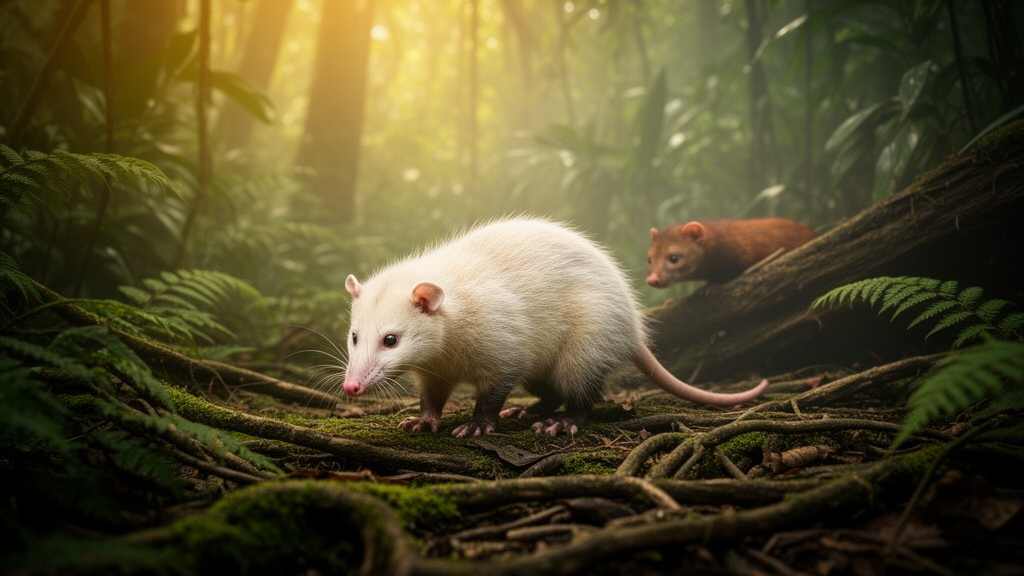
A Panamanian case report documented six mammals with atypical coloration across five species: an albino Derby’s woolly opossum, an albino lowland paca, an albino variegated squirrel, two erythristic northern tamanduas and a leucistic Central American agouti. The mixed museum, anecdotal-observation and camera-trap study expanded the published geographic and taxonomic record of these anomalies but did not estimate their prevalence in mammal populations.
Researchers combined records from the Eustorgio Méndez Zoological Collection and the Vertebrate Museum of the University of Panama with anecdotal observations, photographs and camera-trap monitoring. A separate PRISMA-based literature review examined coloration anomalies reported in American marsupials. Searches of Web of Science and Scopus used “albinism,” “leucism” and “xanthochromism,” refined with “marsupial,” “didelphis” or “caluromys.” Studies were selected when they reported a coloration anomaly in a marsupial from the Americas.
The museum review examined nine Derby’s woolly opossum specimens at the Eustorgio Méndez Zoological Collection: five males and four females. Eight had been collected in Panama between 1960 and 1970, while one came from Colombia in 1967. One Panamanian individual was albino and had been collected in 1970 near Aguacate in Panama Oeste Province. The collection also contained a grayish-brown individual collected in 1967 that resembled the pallidus subspecies. A separate review of 14 additional opossums at the University of Panama museum, collected in Panama from 1980 through 1993, found all displayed the species’ typical reddish-brown coloration.
The literature review summarized coloration anomalies previously reported in other American marsupials, all in the genus Didelphis. The authors described the Panamanian albino opossum as the first reported case of albinism in the genus Caluromys. Because the opossum specimen was collected decades ago, it documents an individual occurrence rather than the contemporary frequency of albinism in the species.
The lowland paca case involved a male weighing 10 kilograms and measuring 66.7 centimetres in length. It was killed during subsistence hunting by local residents in Alto de la Montaña, Veraguas Province. The authors identified it as the first reported case of albinism in Cuniculus paca in Panama. A separate albino variegated squirrel, Echinosciurus variegatoides, was observed by two biologists near the Pacora River on 6 June 2018. The paper described this as the first recorded case of albinism for that species.
Two northern tamanduas displayed erythrism, which the paper characterized as reddish or reddish-brown coloration of the hair. One was a juvenile rescued in Capira, Panamá Oeste Province, and the other was an adult observed in the protected forest on the campus of the Universidad Tecnológica de Panamá. The authors said the observations expanded the known geographic range of erythrism in the species. When combined with earlier reports, they considered erythrism the most frequently reported coloration anomaly for northern tamanduas in central Panama, although the conclusion rests on individual records rather than a population-level prevalence estimate.
A leucistic Central American agouti was documented on Cébaco Island through camera trapping conducted from 14 to 18 May 2023. Twenty cameras baited with corn kernels operated for five days, totaling 100 camera-trap days. The agouti was photographed repeatedly, sometimes alongside individuals with typical coloration. The authors described this as the first report of leucism in Dasyprocta punctata. A security guard also reported that leucistic agoutis were common in the area, but that statement was not supported by a systematic population count.
Together, the observations broaden the available records of albinism in Caluromys, Cuniculus paca and Echinosciurus variegatoides, as well as leucism in Dasyprocta punctata. The agouti record also adds a different anomaly to the species’ documented range, which already included a partial-albinism case from Honduras. The authors noted that the Cébaco observation is compatible with possible effects of isolation, inbreeding or low genetic variability, but the study did not test those explanations or directly measure the relevant genetic conditions.
Several limitations constrain what the report can establish. The opossum observation came from a museum specimen collected in 1970; the paca and squirrel cases were anecdotal observations; and the agouti record came from a short camera-trapping deployment. The report did not measure population-level prevalence, survival, reproduction, sensory function or the genetic causes of the observed phenotypes. Although a security guard’s account suggested that leucistic agoutis might survive well in a predator-free setting, the study did not test survival or pathology directly.
Accurate estimates of how often mammalian coloration anomalies occur would require reliable population-size data and improved monitoring of species that can be difficult to detect. The authors proposed assembling occurrence data across taxa and regions and conducting long-term studies of isolated populations to examine whether genetic or ecological conditions are associated with the anomalies. Until such evidence is available, the report’s principal contribution is six observational records from five mammal species, rather than a quantified assessment of how common these conditions are in Panamanian wildlife.
Subject of Research: Documented coloration anomalies in five Panamanian mammal species
Article Title: Report of coloration anomalies in mammals from Panama
Article References: Fuentes, R., Castillo, M., Moreno, R., Quintero-Arrieta, H., Pérez, E., Araúz, J., Añino, Y., Murcia-Moreno, D., Valdés, R., Bonilla, B., & Gálvez, D. (2024). Report of coloration anomalies in mammals from Panama. Neotropical Biology and Conservation, 19(3), 333-345. https://doi.org/10.3897/neotropical.19.e125890
Image Credits: AI Generated
DOI: 10.3897/neotropical.19.e125890
Keywords: mammal coloration, albinism, leucism, erythrism, Panama, case report, museum records, camera trapping, wildlife monitoring, Report, coloration, anomalies
Cite Scienmag News
Ophelia Keating. (October 20, 2026). Panama case report documents six coloration anomalies in five mammal species. Scienmag. https://scienmag.com/panama-case-report-documents-six-coloration-anomalies-in-five-mammal-species/
Ophelia Keating. "Panama case report documents six coloration anomalies in five mammal species." Scienmag, 20 October 2026, https://scienmag.com/panama-case-report-documents-six-coloration-anomalies-in-five-mammal-species/. Accessed 20 October 2026.
Ophelia Keating. "Panama case report documents six coloration anomalies in five mammal species." Scienmag. October 20, 2026. https://scienmag.com/panama-case-report-documents-six-coloration-anomalies-in-five-mammal-species/


