


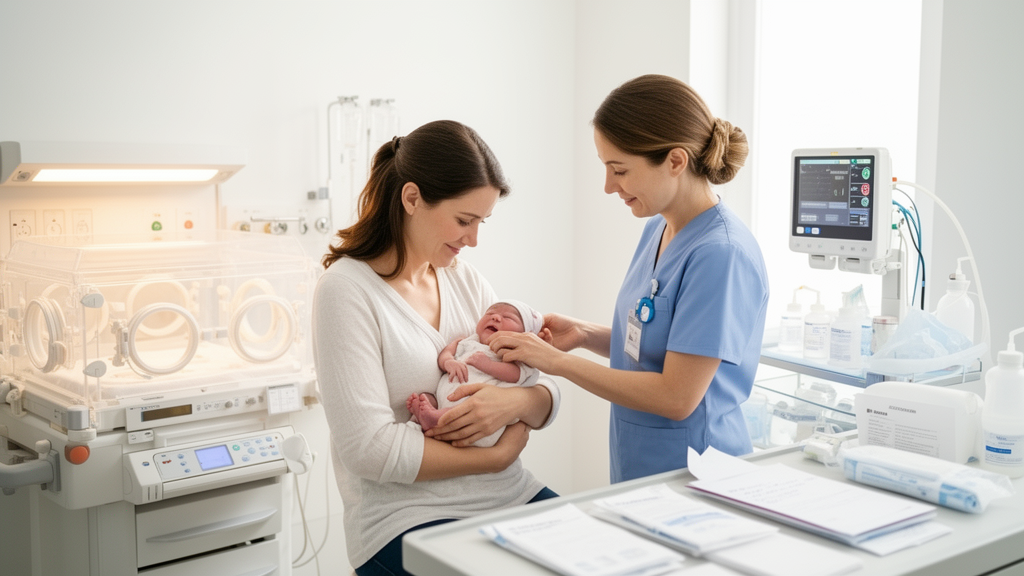
Mothers of preterm infants who received a theory-based nursing pathway had higher discharge-readiness scores, stronger caregiving confidence and fewer infant readmissions than mothers whose infants received routine care, according to a non-randomized controlled study using a historical control group. The study at Tongren Maternal and Child Health Care Hospital in Guizhou, China, included 115 mother–infant pairs: 57 received an Integrated Theory of Health Behavior Change, or ITHBC, pathway and 58 received usual discharge preparation and follow-up. The findings associate the multicomponent program with better outcomes, but the design cannot establish that the pathway itself caused the differences.
The pathway was implemented as a unit-wide practice change in May 2025. Mothers admitted between August 2024 and April 2025 formed the historical control group, while those admitted from May through September 2025 received the intervention. No individual randomization or matching was performed because a concurrent control group was not feasible after the practice change.
Initially, 78 mothers in the control period and 72 in the observation period met the inclusion criteria. After 12 control-group mothers and 10 observation-group mothers were excluded for incomplete baseline data, and eight controls and five intervention participants were lost to six-month follow-up, the final analysis included 58 and 57 mothers, respectively. The unequal enrollment windows—nine months for controls and five for the intervention—introduced potential seasonal variation.
Eligible infants were singletons born at a gestational age of at least 28 but less than 37 weeks, weighed more than 1,500 grams and had a stable clinical condition. Infants requiring neonatal surgery for severe congenital disease, mothers with major chronic illnesses, and families with incomplete records or loss to follow-up were excluded. At discharge, researchers assessed maternal readiness to care at home, the perceived quality of discharge instructions, caregiving ability, self-efficacy, resilience, anxiety and depression.
Six-month follow-up covered infant feeding, growth, thrush, diaper rash and readmission, along with maternal nursing satisfaction. Baseline characteristics of mothers and infants were generally comparable, although multivariable adjustment was used to account for potential differences in maternal age, gestational age, birth weight, delivery mode, payment method and residence. The intervention combined individualized education, practical training, psychological assessment, behavioral planning and social support rather than concentrating instruction on the day of discharge.
A multidisciplinary team included neonatal nurses, a neonatologist, an obstetrician, a rehabilitation physician and a psychologist. On admission, each mother received a one-to-one session lasting 30 to 45 minutes that included baseline psychological screening and an assessment of family-care needs, prognosis and other relevant information. During hospitalization, individualized education and skills training occurred at least twice each week.
Within 24 to 48 hours before discharge, the team performed a comprehensive readiness assessment and reinforced guidance on the mother’s knowledge, feeding skills, self-management, beliefs, psychological state, home environment and family support. Support continued after the family left the hospital. For six months, mothers received weekly educational material through WeChat, monthly telephone follow-ups lasting 10 to 20 minutes and a final outpatient review.
These contacts addressed feeding, growth, complications and maternal mood. The team also educated family members, organized exchange meetings for emotional and informational support, helped mothers identify barriers at different stages of behavior change, and revised personalized care plans as their knowledge, beliefs and self-efficacy developed. The pathway was developed with input from a multidisciplinary team, a review of research published from 2010 through July 2023 and two rounds of consultation with 18 experts.
The consultation yielded a 100% response rate in both rounds, and the final version received no proposed modifications. Discharge readiness was the primary outcome, measured with the Chinese Readiness for Hospital Discharge Scale–Parent Form. Its 23 items assess knowledge of the child’s condition, coping skills, expected support and the caregiver’s personal status, with total scores ranging from 0 to 230.
Mothers in the intervention group averaged 189.53 points, compared with 178.05 in the historical control group. The unadjusted difference corresponded to a Cohen’s d of 0.821, with a 95% confidence interval of 0.439 to 1.201, and was significant at P less than 0.001. After adjustment for the six specified maternal and infant covariates, the estimated intervention-minus-control difference was 10.81 points, with a 95% confidence interval of 5.29 to 16.32 and P less than 0.001.
Collinearity diagnostics showed no serious multicollinearity, with all variance inflation factors below 2. Intervention-group mothers also reported better discharge instructions and greater neonatal care ability. The adjusted difference in discharge-instruction quality was 17.07 points on the parent-rated scale, with a 95% confidence interval of 10.59 to 23.55.
The adjusted difference in caregiving ability was 22.01 points, with a 95% confidence interval of 14.29 to 29.73. Both differences were significant at P less than 0.001. The discharge-instruction measure contained 18 items covering content acquisition and guidance abilities, with scores from 0 to 180.
The neonatal care ability questionnaire contained 43 items addressing care knowledge, care behavior and care attitude, with scores from 0 to 172. Psychological outcomes also favored the intervention at discharge: self-efficacy and resilience scores were higher, while anxiety and depression scores were lower, with all reported between-group P values below 0.001. These measures did not differ significantly at admission, although both groups improved during hospitalization.
At six months, infants in the intervention group had higher adjusted estimates for daily milk intake, body length, head circumference and body weight. Adjusted differences were 5.33 for daily milk intake, 1.71 for body length, 1.58 for head circumference and 0.29 for body weight, with respective 95% confidence intervals of 3.46 to 7.20, 0.73 to 2.68, 1.11 to 2.04 and 0.01 to 0.57. Thrush occurred in 1 of 57 infants in the intervention group, compared with 8 of 58 historical controls; diaper rash affected 4 versus 13 infants, and readmission occurred in 2 versus 10.
Those complication and readmission comparisons were unadjusted and significant, with P values of 0.032, 0.020 and 0.016, respectively. Overall nursing satisfaction was 96.49%, representing 55 of 57 intervention mothers, and 77.59%, representing 45 of 58 controls; the between-group difference had a P value of 0.003. The results suggest that extending discharge support across admission, hospitalization and early home care may help mothers acquire practical skills, identify behavioral barriers and maintain recommended care practices.
The program also explicitly addressed emotional wellbeing and family support, components that conventional discharge education may overlook. Its reported associations were consistent with a theory in which knowledge, beliefs, self-efficacy, intention, behavior and maintenance develop through repeated support rather than a single instructional encounter. Nevertheless, the study cannot isolate which elements produced the observed differences or show that the ITHBC framework itself was responsible.
It was conducted at one center, used subjective measures that could be influenced by social expectations, and relied on a nursing-satisfaction questionnaire that had not been formally validated. Several further limitations constrain interpretation of the six-month findings. Because the intervention and historical-control groups were recruited during different periods, changes in referral patterns, case mix, disease spectrum, hospital policies, staffing, clinical protocols or discharge criteria could have influenced the results, even though the authors reported no major changes in staffing, protocols, discharge criteria or routine follow-up procedures.
Feeding type, breastfeeding rates, socioeconomic status, distance to follow-up care and other unmeasured factors may also have affected infant growth and readmission. The multicomponent pathway prevented separation of the effects of education, skills training, psychological support, WeChat contact, telephone follow-up and family involvement. Implementation measures such as nurse workload, maternal engagement with WeChat and delivery fidelity were not formally quantified, and binary outcomes and some psychological measures were not adjusted because of small event counts or baseline comparability.
Larger multicenter randomized studies with longer follow-up and blinded assessment of objective outcomes would be needed to test the pathway more rigorously.
Subject of Research: Evaluation of an ITHBC-based nursing pathway for discharge preparation and six-month follow-up among mothers of preterm infants
Article Title: Association between an ITHBC theory-based nursing pathway and discharge readiness among mothers of preterm infants: a non-randomized controlled study with a historical control group
Article References: Tang, F., Wu, Y., Dai, L., Yan, W., Yang, M., Shi, W., Tian, A., & Zhang, Y. (2026). Association between an ITHBC theory-based nursing pathway and discharge readiness among mothers of preterm infants: a non-randomized controlled study with a historical control group. Frontiers in Medicine, 13, Article 1938054. https://doi.org/10.3389/fmed.2026.1938054
Image Credits: AI Generated
DOI: 10.3389/fmed.2026.1938054
Keywords: preterm infants, discharge readiness, maternal health, nursing pathway, health behavior change, transitional care, infant growth, readmission, multidisciplinary care, Association, between, ITHBC
Cite Scienmag News
Harold Sullivan. (October 20, 2026). Research report: Association between an ITHBC theory-based nursing pathway and discharge readiness among mothers of preterm infants: a non-randomized controlled study with a historical control group. Scienmag. https://scienmag.com/research-report-association-between-an-ithbc-theory-based-nursing-pathway-and-discharge-readiness-among-mothers-of-preterm-infants-a-non-randomized-controlled-study-with-a-historical-control-group/
Harold Sullivan. "Research report: Association between an ITHBC theory-based nursing pathway and discharge readiness among mothers of preterm infants: a non-randomized controlled study with a historical control group." Scienmag, 20 October 2026, https://scienmag.com/research-report-association-between-an-ithbc-theory-based-nursing-pathway-and-discharge-readiness-among-mothers-of-preterm-infants-a-non-randomized-controlled-study-with-a-historical-control-group/. Accessed 20 October 2026.
Harold Sullivan. "Research report: Association between an ITHBC theory-based nursing pathway and discharge readiness among mothers of preterm infants: a non-randomized controlled study with a historical control group." Scienmag. October 20, 2026. https://scienmag.com/research-report-association-between-an-ithbc-theory-based-nursing-pathway-and-discharge-readiness-among-mothers-of-preterm-infants-a-non-randomized-controlled-study-with-a-historical-control-group/


