


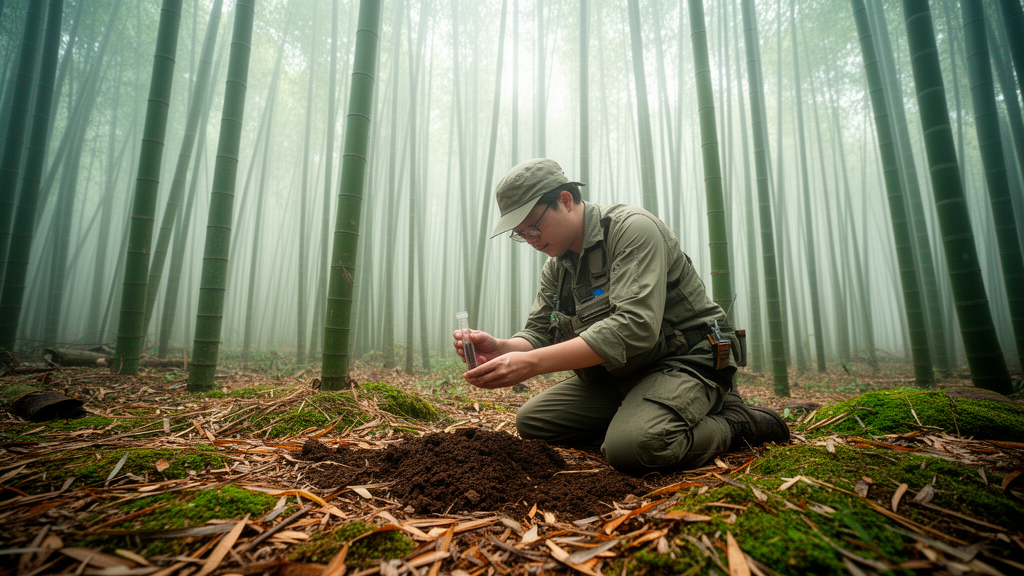
A soil-mycobiota study in a bamboo forest on Xiangyun Mountain, Wuyuan County, Jiangxi Province, China, identified two new species of Chaetosphaeriaceae: Chloridium jiangxiense and Paragongromeriza jiangxiensis. Both were recovered from soil collected in May 2024 and described using colony and microscopic morphology together with phylogenetic analyses of three gene regions.
Chaetosphaeriaceae is a family of micro-ascomycetes within Sordariomycetes that is widely distributed across diverse ecosystems. Members of the family are commonly found on decaying wood, leaf litter and in moist soil. The study focused on Chloridium and Paragongromeriza, two genera that had received comparatively limited taxonomic study. Systematic surveys of Chinese soil microhabitats remain scarce, while bamboo forest soils in southern China had been largely overlooked in fungal diversity surveys.
The authors collected 30 soil samples from three elevational gradients, establishing ten randomly selected sampling points within each gradient. At every point, they removed surface litter and collected a soil core 10 cm deep with a soil auger. Samples were sealed separately in sterile plastic bags, transported in an insulated box with ice packs and stored at 4 °C before processing. Fungi were isolated by dilution plating: 10 g of fresh soil was mixed with 90 mL of sterile water, shaken at 25 °C and 200 rpm for 30 minutes, and serially diluted. Aliquots of the 10−2, 10−3 and 10−4 dilutions were plated on potato dextrose agar and incubated in darkness at 25 °C. Mycelium from the margins of discrete colonies was transferred to fresh plates until pure cultures without bacterial contamination were obtained.
Colony characteristics were recorded on potato dextrose agar at 25 °C, and cultures were imaged after 14 days. Fungal structures were examined with stereomicroscopy and differential interference contrast microscopy, while randomly selected structures were measured and their mean sizes calculated. For molecular analysis, genomic DNA was extracted from 14-day cultures. The researchers amplified and sequenced the internal transcribed spacer region, the large subunit of ribosomal DNA and part of the translation elongation factor 1-alpha gene, using the primer pairs ITS5/ITS4, LR0R/LR5 and EF1-983F/EF1-2218R, respectively.
The concatenated ITS, LSU and tef1-α data comprised 381 sequences from 142 species and 2,638 characters, including gaps. Of these characters, 1,452 were variable and 1,087 were parsimony-informative. Maximum-likelihood and Bayesian inference analyses produced matching tree topologies. The maximum-likelihood analysis used 1,000 rapid bootstrap replicates, while the Bayesian analysis used four parallel runs with automatic stopping and a 0.25 burn-in fraction. Tracylla aristata strain CBS 141404 served as the outgroup.
Chloridium jiangxiense clustered within Chloridium and was closely related to C. novae-zelandiae. Pairwise comparisons between the two taxa showed 84.06% divergence in ITS, 89.80% in LSU and 91.81% in tef1-α. The new species also differed morphologically: its aseptate conidia measured 5.0–7.0 by 3.0–4.5 μm and had a truncate hilum and usually one or two guttules, while its conidiogenous cells had a swollen, constricted neck below the collarette. On potato dextrose agar at 25 °C in darkness, colonies reached 3–4 cm in diameter after two weeks and were dark grey to dark brown, often with concentric rings. The species was registered as Fungal Names FN 573913, with the holotype designated HSAUP II 26 2601.
Paragongromeriza jiangxiensis was placed within the Paragongromeriza lineage as a close relative of P. sinensis, with high bootstrap support. Both taxa produce macronematous, solitary, percurrently proliferating conidiophores with terminal collarettes and aseptate conidia. However, P. jiangxiensis lacks the lateral sessile or short-stalked chlamydospores reported for P. sinensis. Its slightly roughened, ellipsoidal to sub-globose conidia have truncate bases and measure 3.5–5.0 by 3.0–4.0 μm; the conidia of P. sinensis are smooth, cuneiform to obovate, broadly rounded at the base and smaller at 2.0–4.0 by 2.0–2.5 μm. Colonies of P. jiangxiensis grew slowly, reaching 3–4 cm in diameter after four weeks at 25 °C. The holotype is HSAUP II 26 2602, and the species is registered as Fungal Names FN 573914.
The authors considered the congruence between phylogenetic clustering and consistent morphological differences to support recognition of both taxa as distinct species. The discovery of P. jiangxiensis extends the documented Chinese range of Paragongromeriza, and the isolates show that bamboo forest soil can yield additional Chaetosphaeriaceae diversity. The study was nevertheless limited by its focus on one bamboo-forest site and by the absence of observed sexual morphs for either new species. The authors also noted that additional variable markers, such as RPB2 or β-tubulin, or genome-scale data could improve resolution among closely related species.
Overall, the morphological and multilocus phylogenetic evidence supports the description of Chloridium jiangxiense and Paragongromeriza jiangxiensis as two new species from soil in Jiangxi Province. The findings expand the known diversity of Chaetosphaeriaceae in subtropical Asia and identify humus-containing soil as an important habitat for sampling these poorly characterised genera.
Subject of Research: Morphological and phylogenetic identification of two new Chaetosphaeriaceae species from bamboo forest soil in Jiangxi, China
Article Title: Morphological and phylogenetic analyses reveal two new species of Chaetosphaeriaceae from Jiangxi Province, China
Article References: Yu, W., Wang, X., Wu, D., Wang, H., Yuan, X., & Wu, Y. (2026). Morphological and phylogenetic analyses reveal two new species of Chaetosphaeriaceae from Jiangxi Province, China. MycoKeys, 140, 131-146. https://doi.org/10.3897/mycokeys.140.205743
Image Credits: AI Generated
DOI: 10.3897/mycokeys.140.205743
Keywords: Chaetosphaeriaceae, Chloridium jiangxiense, Paragongromeriza jiangxiensis, fungal taxonomy, bamboo forest soil, Jiangxi Province, morphological analysis, multilocus phylogeny, species delimitation, fungal diversity, Morphological, phylogenetic
Cite Scienmag News
Roger Howard. (October 20, 2026). Soil isolate study identifies two new Chaetosphaeriaceae species in a Jiangxi bamboo forest. Scienmag. https://scienmag.com/soil-isolate-study-identifies-two-new-chaetosphaeriaceae-species-in-a-jiangxi-bamboo-forest/
Roger Howard. "Soil isolate study identifies two new Chaetosphaeriaceae species in a Jiangxi bamboo forest." Scienmag, 20 October 2026, https://scienmag.com/soil-isolate-study-identifies-two-new-chaetosphaeriaceae-species-in-a-jiangxi-bamboo-forest/. Accessed 20 October 2026.
Roger Howard. "Soil isolate study identifies two new Chaetosphaeriaceae species in a Jiangxi bamboo forest." Scienmag. October 20, 2026. https://scienmag.com/soil-isolate-study-identifies-two-new-chaetosphaeriaceae-species-in-a-jiangxi-bamboo-forest/


