


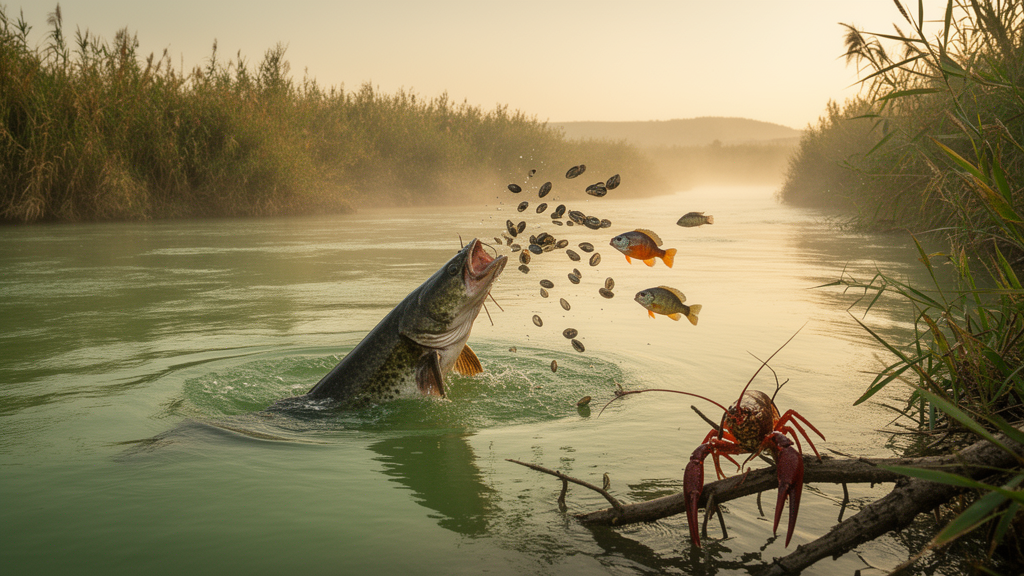
Semi-natural enclosure experiments in Spain’s Lower Ebro River found that the invasive apple snail consumed more coontail than rice seedlings, while the invasive blue crab consumed apple snails more intensively than Asian clams. Model comparisons supported different functional-response shapes for each consumer–resource combination: Type II for apple snails feeding on coontail and blue crabs feeding on apple snails, and Type III for apple snails feeding on rice and blue crabs feeding on Asian clams.
The experiments, conducted in 2020 and 2021 near Tortosa, examined per-capita feeding effects among three co-occurring invasive species. Researchers placed 12 mesh enclosures along the riverbank, each divided into two 0.5-by-0.5-metre compartments. Of the 24 compartments, 10 tested apple snails, seven tested blue crabs, and the remainder were used for controls or temporary holding. The design used increasing prey quantities over seven days, including one day for setup and acclimation followed by six feeding days. By Day 6, both consumers were unable to consume all prey offered, indicating that consumption had approached saturation under the experimental conditions.
For the apple-snail experiment, the food resources were the invasive submerged macrophyte coontail and rice seedlings. Control compartments showed plant loss of 7% for coontail and 25% for rice, attributed to factors such as decomposition and drift rather than consumption. Blue crabs were offered apple snails and Asian clams, with molluscan biomass corrected to exclude shells. Laboratory measurements indicated that shells represented an average of 84% of Asian-clam wet weight, while a published value used for apple snails was approximately 54%. Two blue-crab treatments involving Asian clams were excluded after unusually high water temperatures above 30 °C caused unexpected mortality among harvested clams, leaving five complete replicates.
Statistical model selection, based primarily on Akaike’s information criterion and complemented by root mean square error and residual inspection, supported the prey-specific response classifications. At the highest prey availability on Day 6, apple snails consumed 0.70 ± 0.07 g of coontail per gram of consumer biomass, compared with 0.14 ± 0.06 g of rice seedlings per gram of apple-snail biomass, a difference with P < 0.001. Blue crabs consumed 0.40 ± 0.22 g of apple snails per gram of crab biomass and 0.12 ± 0.03 g of Asian clams per gram of crab biomass, a difference with P = 0.006. Because prey were offered separately, these comparisons represent feeding rates by prey type rather than direct measurements of preference.
Consumer mass changes did not follow the same pattern as consumption. Apple snails gained weight on both diets, with average gains of 6% on coontail and 50% on rice, although the difference was not statistically significant. Rice seedlings contain more dry matter, crude protein and gross energy than coontail, which may mean that snails require more coontail tissue to obtain similar nutritional benefits. Blue crabs lost weight on both diets, with one individual gaining weight. Crabs fed Asian clams lost an average of 18% of their mass, compared with 2% among crabs fed apple snails, a statistically significant difference. The authors identified nutritional requirements, confinement stress and the single-prey diet as possible explanations rather than established causes; stable-isotope evidence from the Ebro Delta indicates that blue crabs use diverse animal prey in nature.
The researchers combined Day 6 feeding rates with abundance data from a 12.5-km river stretch to explore potential trophic pressure. This exploratory scaling followed a framework in which impact equals per-capita effect multiplied by population abundance and invaded range. Before blue-crab establishment, the calculations estimated that apple snails consumed 2.97 ± 2.08 kg of rice biomass per day in 2017, equivalent to approximately 1,900 seedlings, and 14.87 ± 8.38 kg of coontail daily. Using 2022 abundance estimates after blue-crab establishment, estimated rice consumption fell to 0.13 ± 0.17 kg per day, or fewer than 86 seedlings, while coontail consumption was estimated at 0.65 ± 0.79 kg per day.
For blue crabs, the same calculations estimated potential daily consumption of 2.76 ± 1.82 kg of apple snails, approximately 57 individuals, and 0.86 ± 0.35 kg of Asian clams, approximately 171 individuals, within the studied transect. These figures are exploratory indicators of potential trophic pressure, not direct estimates of realised field impact. Enclosures restricted prey movement and removed access to natural refuges, while the single-prey treatments did not represent the mixed diets available in the river. Hydrology, habitat complexity, prey renewal, seasonal variability, alternative foods and animal movement could all alter natural feeding rates in either direction.
The findings identify a trophic sequence composed entirely of invaders in the Lower Ebro system: coontail can feed the apple snail, and the apple snail can feed the blue crab. They also show that the blue crab has two potentially opposing roles, suppressing an established invasive herbivore while consuming another invasive mollusc. This is consistent with feedbacks described as an invasional meltdown scenario, although the study did not directly test whether each invader increased the establishment or impact of another over time. The authors caution that management focused on one species in isolation may overlook trophic dependencies, noting that reducing invasive prey could redirect predators toward alternative resources, including native taxa, while removing an invasive predator could facilitate invasive prey recovery or spread.
Overall, the study provides experimental evidence of prey-specific feeding pressure and a method for scaling those effects, not a direct forecast of population changes in the open river. Its estimates are bounded by the enclosure conditions, limited replicate availability for one crab treatment, use of abundance data from different reference years and the simplifying assumption of single-prey feeding. Within those constraints, the results show how interactions among co-occurring aquatic invaders can structure trophic effects in a heavily modified freshwater ecosystem.
Subject of Research: Functional-response experiments quantify trophic interactions among invasive apple snails, blue crabs, coontail and Asian clams in the Lower Ebro River.
Article Title: Invasions feeding invasions: functional responses reveal trophic links among aquatic invasive species
Article References: Gallardo, B., Sánchez-Caro, C., Céspedes, V., Picazo, F., & Jiménez-Liébanas, L. (2026). Invasions feeding invasions: functional responses reveal trophic links among aquatic invasive species. NeoBiota, 108, 69-88. https://doi.org/10.3897/neobiota.108.190226
Image Credits: AI Generated
DOI: 10.3897/neobiota.108.190226
Keywords: aquatic invasive species, apple snail, blue crab, functional response, trophic interactions, Lower Ebro River, coontail, Asian clam, invasional meltdown, semi-natural enclosures, Invasions, feeding
Cite Scienmag News
Patricia Pace. (October 20, 2026). Invasions feeding invasions: functional responses reveal trophic links among aquatic invasive species. Scienmag. https://scienmag.com/invasions-feeding-invasions-functional-responses-reveal-trophic-links-among-aquatic-invasive-species/
Patricia Pace. "Invasions feeding invasions: functional responses reveal trophic links among aquatic invasive species." Scienmag, 20 October 2026, https://scienmag.com/invasions-feeding-invasions-functional-responses-reveal-trophic-links-among-aquatic-invasive-species/. Accessed 20 October 2026.
Patricia Pace. "Invasions feeding invasions: functional responses reveal trophic links among aquatic invasive species." Scienmag. October 20, 2026. https://scienmag.com/invasions-feeding-invasions-functional-responses-reveal-trophic-links-among-aquatic-invasive-species/


