


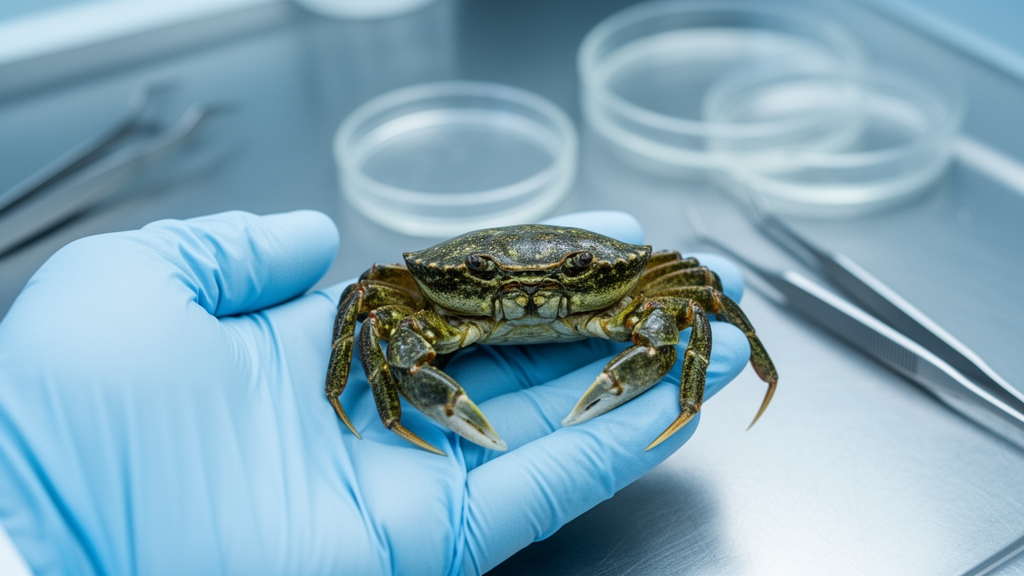
An observational case report describes a Chinese mitten crab, Eriocheir sinensis, collected from a commercial aquaculture farm in Nanjing, China, that had a typical female external phenotype but also possessed male first gonopods. The specimen was sampled in Gaochun District, Jiangsu Province, on 12 October 2025. Researchers characterized it as the first documented intersex individual of the species with a fully typical female abdomen, female-associated external traits and visible mature female gonads, as well as a pair of ossified, tubular male first gonopods.
The crab was initially identified as a normal female when collected. It appeared healthy and showed no visible signs of parasitic infection. During a gentle, non-invasive examination in which its abdomen was spread open to assess gonadal development and somatic condition, the researchers observed the two first gonopods. After this on-site observation, the animal was transported to the laboratory for morphometric measurement, then preserved in 95% ethanol and deposited as specimen JSFFRI/25002 in the Freshwater Fisheries Research Institute of Jiangsu Province.
Using a vernier caliper with a precision of 0.1 mm, the researchers recorded carapace length, carapace width, body height, frontal width and the distance between the first anterolateral teeth. The crab weighed 179.2 g. Its carapace was 70.1 mm long and 78.3 mm wide, with an overall rectangular form. Body height was 38.5 mm, frontal width was 17.3 mm, and the distance between the first anterolateral teeth was 41.2 mm. The ratios of the measured traits were reported to be consistent with Chinese national standards for E. sinensis.
Several external characteristics matched those of typical females. The left and right chelipeds and pereiopods were symmetrical, with sparse, short setae on the outer surfaces of the cheliped propodus and basal half of the dactylus; the inner surfaces were smooth and lacked setae. The abdomen was circular, a defining female form in this sexually dimorphic species. When spread open, the specimen had female gonopores on the fifth thoracic somite and normal setae on the second through fifth pairs of ovigerous pleopods. Mature female gonads were also visible through the first and second abdominal flaps.
Alongside those female characteristics, the specimen carried a pair of male first gonopods, the primary male copulatory structures. These gonopods were ossified and tubular, rather than the incompletely developed, weakly calcified structures previously reported in some intersex Chinese mitten crabs with rounded abdomens. No second gonopods or penises were detected, indicating that the animal did not possess a complete male reproductive tract. On the basis of this combination, the authors classified the specimen as an example of low-degree masculinization.
This phenotype differed from the intersex Chinese mitten crabs described in earlier reports, which had intermediate abdominal shapes such as elliptical, rectangular, asymmetrical or isosceles triangular. The crab reported by Lu and colleagues in 2024 also had a high degree of masculinization, with first gonopods, second gonopods, a penis and well-developed male gonadal tissue. By contrast, the Nanjing animal retained female abdominal and appendage characteristics, visible mature female gonads and normal female gonopores, while lacking second gonopods and a penis.
The study notes two established hormonal pathways associated with crustacean sexual differentiation. Crustacean female sex hormone is linked with female differentiation, whereas insulin-like androgenic gland hormone, produced by the androgenic gland, participates in male differentiation. Previous work cited by the authors found that CFSH-1 represses IAG expression from the third zoeal stage in E. sinensis. After the fourth zoeal stage, IAG expression rises and CFSH-1 expression declines substantially in male larvae, while female larvae show the opposite pattern. Reproductive-organ differentiation begins at the megalopa stage.
The authors suggest that multiple stresses during late larval development—including parasitism, exposure to endocrine-disrupting chemicals such as androgenic compounds, and abnormal water temperatures—may have disturbed hormonal signaling. Their proposed mechanism is a moderate increase in IAG expression while CFSH-1 expression remained sufficient to preserve female reproductive development, producing low-degree masculinization and male first gonopods. This is a hypothesis rather than a demonstrated cause: the examined specimen was not tested for those stressors, and no direct molecular measurements of IAG or CFSH-1 expression were reported.
The report is limited to one animal, with no invasive dissection or systematic histological analysis of the gonads and appendages. Its cause therefore cannot be established from the observed morphology, and the case does not show how frequently this phenotype occurs in farmed Chinese mitten crabs. The authors call for additional specimens, systematic histological analysis and quantification of IAG and CFSH-1 transcription to test the proposed mechanism and clarify the developmental processes associated with this unusual intersex phenotype.
Subject of Research: A single-specimen case report of intersex Chinese mitten crab morphology and proposed hormonal mechanisms
Article Title: New record of intersex Chinese mitten crab, Eriocheir sinensis ( Malacostraca , Decapoda , Varunidae ), with typical female appearance and male gonopods, from Nanjing, eastern China
Article References: Tan, X., Deng, Y., Li, X., Zhong, L., & Zhou, J. (2026). New record of intersex Chinese mitten crab, Eriocheir sinensis (Malacostraca, Decapoda, Varunidae), with typical female appearance and male gonopods, from Nanjing, eastern China. Acta Ichthyologica et Piscatoria, 56, 343-346. https://doi.org/10.3897/aiep.56.199443
Image Credits: AI Generated
Keywords: Chinese mitten crab, Eriocheir sinensis, intersexuality, partial masculinization, gonopods, crustacean development, hormonal regulation, aquaculture, case report, record, intersex, Chinese
Cite Scienmag News
Ophelia Keating. (October 20, 2026). Aquaculture case report documents female-type Chinese mitten crab with male gonopods. Scienmag. https://scienmag.com/aquaculture-case-report-documents-female-type-chinese-mitten-crab-with-male-gonopods/
Ophelia Keating. "Aquaculture case report documents female-type Chinese mitten crab with male gonopods." Scienmag, 20 October 2026, https://scienmag.com/aquaculture-case-report-documents-female-type-chinese-mitten-crab-with-male-gonopods/. Accessed 20 October 2026.
Ophelia Keating. "Aquaculture case report documents female-type Chinese mitten crab with male gonopods." Scienmag. October 20, 2026. https://scienmag.com/aquaculture-case-report-documents-female-type-chinese-mitten-crab-with-male-gonopods/


