


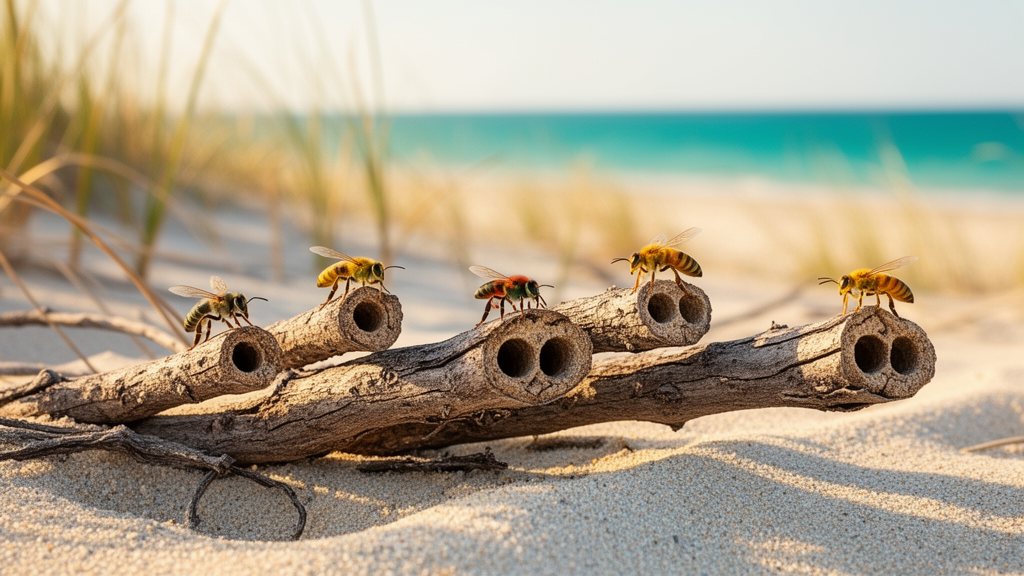
A field study of stem-nesting bees in coastal Hainan Province, China, found that dead twigs of the coastal shrub Scaevola taccada served as nesting substrates for five bee species from two families. Researchers examined 172 intact nests collected from S. taccada twigs at Wenchang City and Yongxing Island during sampling periods spanning September 2023 to December 2025. The observations document a multi-species association between the shrub and sympatric cavity-nesting bees, while not directly measuring population recovery, pollination performance or conservation outcomes.
The study combined field nest collection with laboratory dissection, microscopy, species identification, DNA barcoding and non-parametric statistical comparisons. Sampling at Wenchang occurred during four periods in 2025, while Yongxing Island was sampled during two periods in 2023 and 2024. The researchers collected naturally dead twigs showing entrance holes and wood dust and also placed 30-centimetre, sun-dried S. taccada twigs horizontally in PVC hives near the shrub’s natural habitat. Twig diameter and total nest length were not systematically recorded, limiting analysis of how nest traits relate to particular sizes or classes of twigs.
Five species were identified: Braunsapis hewitti, Ceratina dentipes, Ceratina smaragdula, Ceratina taiwanensis and Heriades sauteri. Morphological identification was supported by mitochondrial COI sequencing; sequences from four species showed more than 98% similarity to conspecific records in GenBank, while C. taiwanensis sequences matched a record identified as Ceratina okinawana taiwanensis. C. smaragdula was the most abundant species in the sample, accounting for 105 nests, or 61.05%. H. sauteri accounted for 38 nests, or 22.09%; C. taiwanensis for 18 nests, or 10.47%; B. hewitti for seven nests, or 4.07%; and C. dentipes for four nests, or 2.33%.
Nest entrance diameter differed significantly among species in a Kruskal-Wallis test (χ² = 89.67, df = 4, p < 0.0001). Mean entrance diameters were 4.13 ± 0.52 mm for C. taiwanensis, 4.08 ± 0.18 mm for C. smaragdula, 3.38 ± 0.40 mm for H. sauteri, 3.20 ± 0.26 mm for B. hewitti and 2.73 ± 0.31 mm for C. dentipes. The two largest means did not differ significantly after Bonferroni-corrected pairwise tests. These measured differences are consistent with resource partitioning, but the study did not experimentally test whether entrance size reduces competition or permits use of different cavity-size classes.
The four species that constructed discrete brood cells also differed significantly in cell number (χ² = 38.72, df = 3, p < 0.0001). H. sauteri and C. taiwanensis averaged 5.29 ± 2.63 and 5.39 ± 3.53 cells per nest, respectively, compared with 2.54 ± 1.68 for C. smaragdula and 2.25 ± 1.89 for C. dentipes. The first two species had significantly more cells than the latter two in corrected pairwise comparisons. The authors did not systematically analyse how sampling season or nest developmental stage contributed to this variation, so differences in maternal investment, reproductive phenology and the number of cells in individual nests cannot be separated.
The species divided into two observed nesting guilds. C. smaragdula, C. taiwanensis and C. dentipes excavated linear tunnels in the soft pith of dead twigs and divided brood cells with thin partitions made from chewed pith. H. sauteri and B. hewitti reused pre-existing abandoned cavities rather than routinely excavating new tunnels. B. hewitti created a single unpartitioned linear brood chamber, with immature bees arranged from the entrance toward the blind end and progressive feeding by the mother. H. sauteri instead used thick, dark-brown resin partitions, firm cylindrical pollen provisions and silken cocoons. The coexistence of excavators and secondary cavity users was observed in the sampled shrub, although the study did not quantify competition or experimentally evaluate niche differentiation.
Social and developmental observations also varied among the species. Female C. dentipes, C. smaragdula and C. taiwanensis guarded nest entrances, and prolonged maternal care was documented for C. smaragdula and C. taiwanensis. Two adult females were occasionally seen together at some C. taiwanensis entrances, suggesting possible facultative semi-social nesting, but the proportion of multifemale nests was not systematically recorded. C. dentipes was represented by only four nests, precluding detailed characterization of its reproductive biology. C. taiwanensis had the most variable cell counts, ranging from one to 11, while H. sauteri also ranged from one to 11.
Microscopic examination of C. smaragdula nest material recovered intact, recognizable pollen grains from pollen-nectar provisions and larval feces. The authors proposed examining both sources to characterize pollen use: provisions reflect material collected by adult females, while larval feces integrate diet across the feeding period. Such nest-based analysis could help future investigators identify pollen sources, although this study did not complete a comparative dietary analysis of all five species or quantify dietary overlap.
Because S. taccada forms dense coastal thickets and produces persistent dead twigs with soft internal pith, the study identifies native coastal shrubs as a potential source of nesting habitat in environments where suitable substrates may be limited. Artificial hives containing cut, sun-dried S. taccada twigs were occupied by bees, demonstrating that the material remained attractive in the researchers’ managed setup. The results therefore support a conservation implication rather than a demonstrated intervention: protecting or restoring native coastal shrubs may help retain nesting resources, and locally sourced twigs could be evaluated in coastal trap-nesting programs. The study did not measure whether shrub protection or artificial deployment increases bee abundance, survival or pollination, nor did it directly evaluate effects of climate warming on the observed Hainan populations.
Subject of Research: Natural-history study of five stem-nesting bee species using Scaevola taccada twigs in coastal Hainan, China
Article Title: Scaevola taccada as a keystone nesting resource for sympatric cavity-nesting bees and its implications for coastal biodiversity conservation
Article References: Liu, Z.-X., Warrit, N., Song, M.-H., Wang, R.-C., Hao, K., Luo, S.-X., & Chen, H.-Y. (2026). Scaevola taccada as a keystone nesting resource for sympatric cavity-nesting bees and its implications for coastal biodiversity conservation. Journal of Hymenoptera Research, 99, 1109-1135. https://doi.org/10.3897/jhr.99.206488
Image Credits: AI Generated
Keywords: Scaevola taccada, stem-nesting bees, coastal biodiversity, Hainan Island, nest architecture, cavity-nesting bees, Ceratina, Heriades sauteri, Braunsapis hewitti, pollinator conservation, Scaevola, taccada
Cite Scienmag News
Margaret Porter. (October 20, 2026). Scaevola taccada as a keystone nesting resource for sympatric cavity-nesting bees and its implications for coastal biodiversity conservation. Scienmag. https://scienmag.com/scaevola-taccada-as-a-keystone-nesting-resource-for-sympatric-cavity-nesting-bees-and-its-implications-for-coastal-biodiversity-conservation/
Margaret Porter. "Scaevola taccada as a keystone nesting resource for sympatric cavity-nesting bees and its implications for coastal biodiversity conservation." Scienmag, 20 October 2026, https://scienmag.com/scaevola-taccada-as-a-keystone-nesting-resource-for-sympatric-cavity-nesting-bees-and-its-implications-for-coastal-biodiversity-conservation/. Accessed 20 October 2026.
Margaret Porter. "Scaevola taccada as a keystone nesting resource for sympatric cavity-nesting bees and its implications for coastal biodiversity conservation." Scienmag. October 20, 2026. https://scienmag.com/scaevola-taccada-as-a-keystone-nesting-resource-for-sympatric-cavity-nesting-bees-and-its-implications-for-coastal-biodiversity-conservation/


