


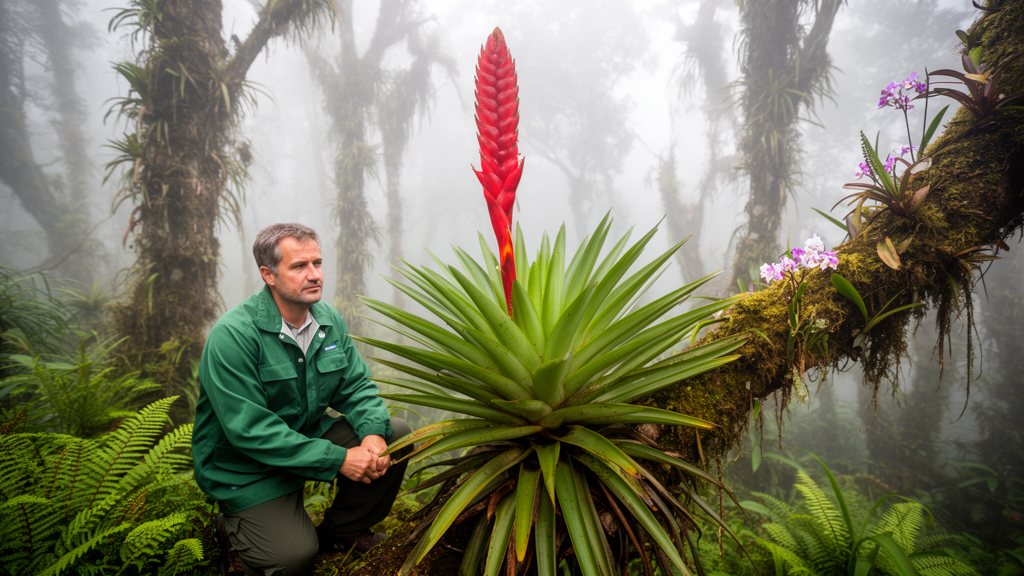
Researchers formally described Puya ukumari, a new montane bromeliad species known from five locations in the Kosñipata and Mapacho valleys of southeastern Peru. The field and taxonomic study documented the plant’s morphology, distribution, habitat, phenology, floral visitors, early regeneration and a preliminary conservation assessment, while noting that its full geographic and elevational range remains uncertain.
The discovery began in 2022, when researchers conducting fieldwork associated with dietary studies of collared Andean bears encountered a terrestrial Puya with an inflorescence that differed from the locally abundant Puya membranacea. Because few flowering individuals were found in inaccessible terrain, the team could not immediately undertake a formal taxonomic assessment. Field observations conducted from 2022 through 2025 covered elevations of approximately 700–3,800 metres around the Wayqecha and Manu Biological Stations.
Further evidence came in early 2025, when tracking data from collared bears showed repeated use of areas dominated by terrestrial bromeliads. Inspections revealed consistent differences in leaf morphology from P. membranacea. Researchers collected seeds along the Erickson Trail in Manu National Park in April 2025, documented a flowering individual in the Sunchubamba community in August, and collected the designated type specimen near Juan Velasco Alvarado in September. Additional flowering individuals recorded afterward provided material for fuller documentation of the flowers and fruits.
Puya ukumari is a polycarpic perennial that produces three to seven rosettes per clone. Flowering plants are generally 160–200 centimetres tall, with an extreme recorded range of 126–235 centimetres, while individual rosettes measure 70–120 centimetres in diameter and 75–90 centimetres high. Its thick, leathery leaves have serrated margins and spines. The inflorescence is simple, nodding, racemose and strobiliform, measuring 23–30 centimetres long and 11–12.5 centimetres wide.
The formal description distinguishes the species through a combination of its large stature, broad inflorescence, large floral bracts, lanate sepals and dark petals. Its sepals measure 30–33 by 15–18 millimetres and are densely covered in white woolly hairs, while the petals are bluish to nearly black and whitish toward their bases. Puya lineata is similar in several respects but is smaller, has a narrower inflorescence, smaller floccose sepals and blue petals. Puya nutans and P. strobilantha can also resemble the new species, but differ in dimensions, bract form and sepal structure; the available evidence supports morphological and geographic differentiation rather than a claim about evolutionary relatedness.
Known records place the species between approximately 2,300 and 3,300 metres above sea level in humid montane forest and forest–puna ecotone. It occupies terrain with a discontinuous canopy, rock outcrops, shallow soils and low densities of accompanying vascular plants. Individuals occur alone or in scattered groups of three to seven. Confirmed localities include Acobamba, Sunchubamba, Wayqecha, Pillahuata and Manu National Park. The authors caution that the plant may occur outside the documented elevational range and that additional surveys are required to establish its full distribution.
Direct observations and camera-trap records from 2025 through February 2026 documented visits by bees, including Apis mellifera, the hummingbird Boissonneaua matthewsii and bats of the genus Anoura. These repeated visits indicate an assemblage of potential floral visitors, but the study did not experimentally confirm effective pollination. Flowering was recorded from July through February, while fruiting individuals were observed from January through June, indicating an association between reproductive phenology and local climatic seasonality.
Germination observations were conducted under ambient montane forest conditions at Wayqecha Biological Station, about 2,900 metres above sea level. At a mean annual temperature of approximately 12 ± 5 °C, seeds entered an estimated dormancy period of about 30 days, germination began around 50 days after sowing, and seedlings reached the two-true-leaf stage after approximately 90 days. These observations describe early development at one site rather than the species’ full reproductive performance across its range.
Based on georeferenced records, the authors estimate an extent of occurrence of 33.16 square kilometres and an area of occupancy of 24 square kilometres, calculated with a standard 2 × 2-kilometre grid. They therefore propose a preliminary Endangered categorization under IUCN Red List criteria B1ab(iii)+2ab(iii), citing the five known locations, restricted area, continuing decline in habitat quality and threats including habitat degradation, livestock activity, fire and landslides. The Acobamba population is exposed to disturbance near roads, while livestock affects some Sunchubamba populations. Populations at Wayqecha and Manu National Park benefit from conservation protection. The proposed category has not been formally submitted to or assessed by the IUCN Red List and remains provisional pending a complete assessment.
Subject of Research: Taxonomic description, distribution and provisional conservation assessment of the montane bromeliad Puya ukumari in southeastern Peru
Article Title: Puya ukumari sp. nov. ( Bromeliaceae , Puyoideae ), a new montane bromeliad species from southeastern Peru
Article References: Yuca-Palomino, J. A., Mamani-Mayta, N. G., Champi-Charalla, L. A., Condori-Cuti, E., Llacta-Gomez, N., Treviño-Zevallos, I. F., Gouda, E. J., Forsyth, A., Whitworth, A., & Pillco-Huarcaya, R. (2026). Puya ukumari sp. nov. (Bromeliaceae, Puyoideae), a new montane bromeliad species from southeastern Peru. PhytoKeys, 280, 113-131. https://doi.org/10.3897/phytokeys.280.211255
Image Credits: AI Generated
DOI: 10.3897/phytokeys.280.211255
Keywords: Puya ukumari, new species, Bromeliaceae, montane forest, southeastern Peru, plant taxonomy, conservation assessment, floral visitors, Puya, ukumari, Puyoideae, montane
Cite Scienmag News
Margaret Porter. (October 20, 2026). Field study describes new montane Puya bromeliad from southeastern Peru. Scienmag. https://scienmag.com/field-study-describes-new-montane-puya-bromeliad-from-southeastern-peru/
Margaret Porter. "Field study describes new montane Puya bromeliad from southeastern Peru." Scienmag, 20 October 2026, https://scienmag.com/field-study-describes-new-montane-puya-bromeliad-from-southeastern-peru/. Accessed 20 October 2026.
Margaret Porter. "Field study describes new montane Puya bromeliad from southeastern Peru." Scienmag. October 20, 2026. https://scienmag.com/field-study-describes-new-montane-puya-bromeliad-from-southeastern-peru/


