


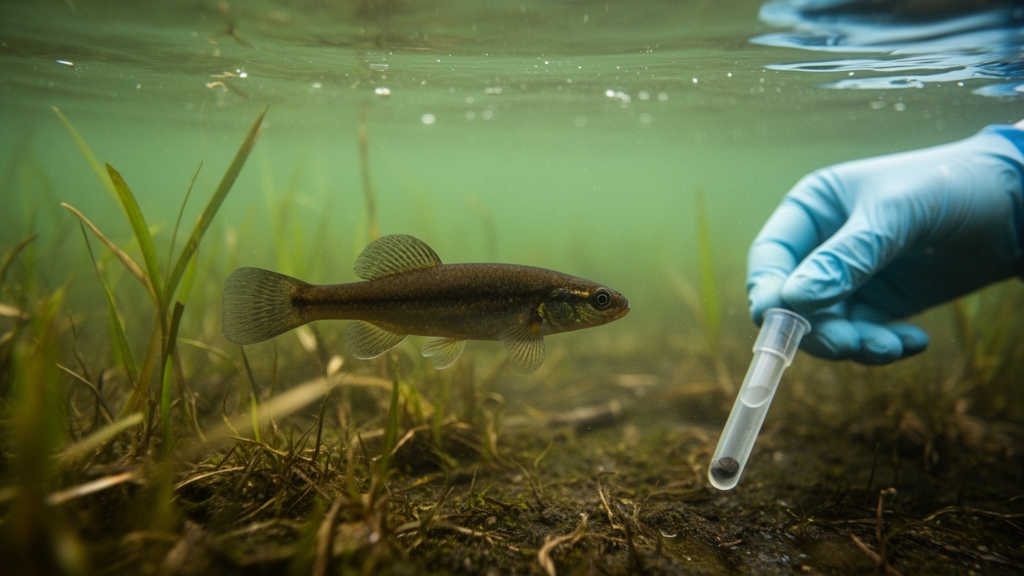
A microsatellite DNA study of Austria’s two remaining wild European mudminnow populations found significant genetic differentiation between the Fadenbach and Jesuitenbach stocks, indicating an absence of contemporary gene flow. The study also estimated the Fadenbach population’s contemporary effective population size at 36.9, despite broadly stable measures of neutral genetic diversity over about a decade.
The Austrian populations are remnants of a species historically recorded across several eastern Austrian floodplains and wetlands. The Fadenbach population, rediscovered in 1992 after the last Danube-floodplain record in 1975, and the Jesuitenbach population near Moosbrunn are now the only two presumed natural sites in the country. European mudminnow is classified as Vulnerable across Europe and Critically Endangered in Austria.
Researchers sampled the Fadenbach across 15 sections covering 3.3 km in October 2024, when sufficiently high water produced continuous flow, and revisited areas where fish had been detected in August 2025, when the system consisted of isolated pools and sampling was conducted by wading. Electrofishing at the Jesuitenbach was conducted mainly from boats in October 2024 and November 2025. The study also sampled four ex situ populations maintained in garden ponds and at the Vienna Zoo.
Overall, 640 fish were captured, and 191 fin-clip DNA samples were collected between October 2024 and November 2025. Samples included 50 Fadenbach fish, 61 Jesuitenbach fish and 80 fish from the four ex situ populations. Eight microsatellite loci were analyzed, and data of sufficient quality were obtained for 189 samples. The markers had low to moderate polymorphism, with two to 15 alleles per locus across all populations. After correction for multiple testing, no population showed significant deviations from Hardy–Weinberg expectations, linkage disequilibrium between loci, or a significant inbreeding coefficient.
All six populations were significantly differentiated in pairwise comparisons, with the highest FST values consistently involving Jesuitenbach. Bayesian clustering identified two principal groups: Jesuitenbach formed a distinct cluster, while Fadenbach and all four ex situ populations formed another. Excluding Jesuitenbach from the analysis, each captive population was largely distinct, although Fadenbach fish showed assignment to all four ex situ clusters. Principal component and discriminant analyses also separated Jesuitenbach consistently from the other populations.
The linkage-disequilibrium method estimated contemporary effective population size at 36.9 for Fadenbach, with a 95% confidence interval of 24.1 to 77.6. The corresponding Jesuitenbach point estimate was infinite, with a 95% confidence interval of 220.0 to infinity. The researchers cautioned that the infinite estimate reflects a limitation of the method and available marker resolution when effective population size exceeds what can be estimated, rather than evidence of an exceptionally large population. Neither wild population showed significant heterozygote excess in bottleneck testing, so the analysis did not provide evidence of a very recent severe reduction in effective population size.
A comparison with Fadenbach data collected in 2011–2015 found broadly similar neutral diversity about a decade later. Rarefied allelic richness standardized to 20 individuals was 4.25 in the present study, compared with 4.37 previously, while observed heterozygosity was 0.538 and 0.523, respectively, and expected heterozygosity was 0.549 and 0.500. The authors said this apparent stability should not be interpreted as demographic security: neutral genetic measures can respond more slowly than census size to recent or gradual declines, and bottleneck tests have limited power with a modest number of loci and samples.
Field evidence indicates that the Fadenbach population remains in immediate hydrological difficulty. No fish were detected during Habitats Directive monitoring in summer 2023 after extensive desiccation in winter 2022 and spring 2023. Surveys in 2024 and 2025 captured 34 and 47 individuals, respectively, and the 47 fish captured in 2025 were moved to a dedicated conservation pond at the Donau-Auen National Park. Declining groundwater levels have been linked to drainage, intensive agriculture, Danube riverbed incision, and climate-driven changes in precipitation and evapotranspiration. Emergency supplementation with water from Danube side arms may improve connectivity temporarily but can also introduce fish, including pumpkinseed and topmouth gudgeon, and increase sediment inputs.
The four analyzed ex situ stocks all clustered with Fadenbach and were distinct from Jesuitenbach, supporting their documented Fadenbach origin and showing no detectable admixture from another source. They nevertheless differed significantly from one another and from the wild source, consistent with founder effects and subsequent drift. The original numbers were approximately 15–20 fish for pond Wanzenböck, about 12 for pond Engelhartszell, 50 for the Vienna Zoo, and unknown for pond Pekny. The authors recommend integrating individuals from all four lines in future breeding programs to maximize diversity and reduce inbreeding, together with continued genetic monitoring. For the wild populations, they emphasize hydrological restoration, drought refuges, separate management of the genetically distinct units and, for Fadenbach, avoidance of supportive stocking under current conditions. These conclusions are based on neutral microsatellite markers, which cannot assess adaptive diversity or fully resolve functional genetic differences.
Subject of Research: Genetic differentiation and effective population size of Austria’s remaining wild European mudminnow populations
Article Title: Small, isolated, and critically endangered: conservation genetics of the European mudminnow ( Umbra krameri ) in Austria
Article References: Donabaum, R., Jung, M., Ratschan, C., & Koblmüller, S. (2026). Small, isolated, and critically endangered: conservation genetics of the European mudminnow (Umbra krameri) in Austria. Nature Conservation, 65, 115-134. https://doi.org/10.3897/natureconservation.65.188874
Image Credits: AI Generated
DOI: 10.3897/natureconservation.65.188874
Keywords: European mudminnow, Umbra krameri, conservation genetics, microsatellite markers, effective population size, Fadenbach, Jesuitenbach, Austria, floodplain habitats, genetic differentiation, Small, isolated
Cite Scienmag News
Juliet Wilcox. (October 20, 2026). Microsatellite study finds two genetically distinct wild European mudminnow populations in Austria. Scienmag. https://scienmag.com/microsatellite-study-finds-two-genetically-distinct-wild-european-mudminnow-populations-in-austria/
Juliet Wilcox. "Microsatellite study finds two genetically distinct wild European mudminnow populations in Austria." Scienmag, 20 October 2026, https://scienmag.com/microsatellite-study-finds-two-genetically-distinct-wild-european-mudminnow-populations-in-austria/. Accessed 20 October 2026.
Juliet Wilcox. "Microsatellite study finds two genetically distinct wild European mudminnow populations in Austria." Scienmag. October 20, 2026. https://scienmag.com/microsatellite-study-finds-two-genetically-distinct-wild-european-mudminnow-populations-in-austria/


