


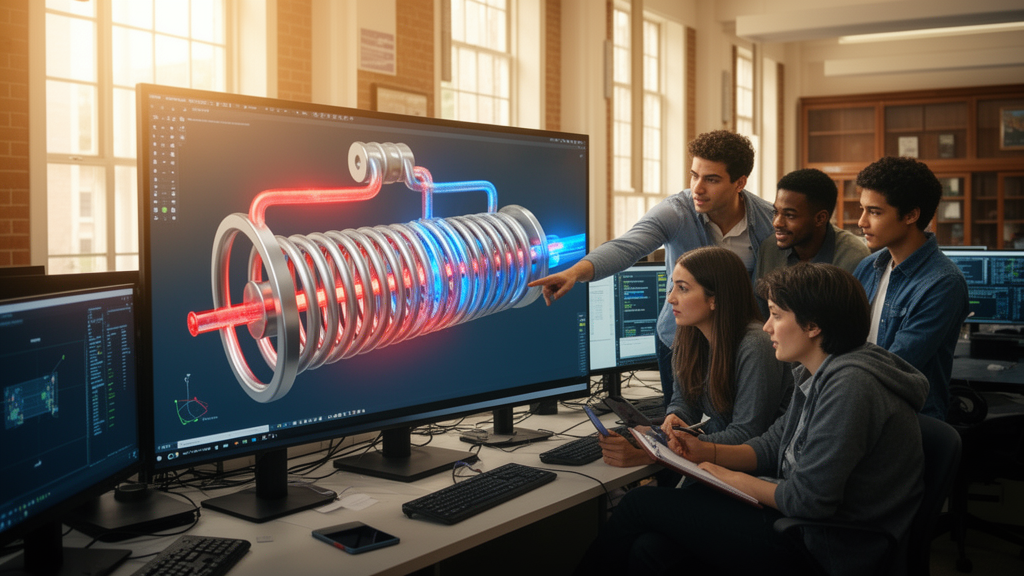
Chemical engineering students at Imperial College London are now learning the intricacies of heat exchanger design through a computer-based laboratory that uses COMSOL Multiphysics simulation software, according to a recent study published in Discover Education. Heat exchangers are fundamental to the chemical process industry, facilitating the transfer of heat between two fluids at different temperatures without allowing them to mix. Traditional teaching relies on analytical methods such as the log mean temperature difference (LMTD) approach and the effectiveness-NTU method, which yield closed-form equations suitable for coursework.
The computer-based lab is integrated into the 'Process Heat Transfer' module offered to undergraduate and postgraduate chemical engineering students. Over three-hour sessions, students build a digital model of a double pipe heat exchanger in COMSOL Multiphysics, defining the geometry, applying boundary conditions for velocity, pressure, and temperature, and then solving the coupled mass and heat transport equations. Once the model is built, students generate color-coded maps of the velocity, temperature, and pressure fields within both the inner tube and the surrounding annulus.
These visualizations reveal characteristic features of turbulent pipe flow, including a flat velocity profile across most of the pipe cross-section with steep gradients near the wall due to the no-slip condition. The pressure field shows that the annulus side experiences higher pressure drops than the inner tube, prompting class discussions about which fluid should be routed through which passage to minimize pumping costs. The temperature field demonstrates how the two streams exchange heat along the length of the exchanger.
Students observe that the stream with the lower heat capacity rate undergoes a larger temperature change, and that the temperature difference between the hot and cold fluids decreases with distance in a parallel-flow arrangement but is sustained along the entire length in counter-flow operation. This visual evidence helps explain why counter-flow heat exchangers achieve higher thermal effectiveness than parallel-flow designs. To validate the simulation results, students compare the computed heat transfer effectiveness against the analytical effectiveness-NTU relationship.
The agreement between the COMSOL simulations and theory is excellent, with relative deviations of less than 1.5 percent across all tested conditions. The exercise also introduces students to practical design trade-offs: while increasing the heat exchanger length raises effectiveness, the gains diminish beyond a certain point, and longer exchangers incur higher pressure drops and operating costs. The researchers evaluated the pedagogical impact using anonymous pre- and post-tests consisting of nine true/false questions targeting common misconceptions about heat exchanger operation.
The average number of correct answers increased from 7.35 to 8.12 out of nine, a statistically significant improvement confirmed by Welch's two-sample t-test (p = 0.030) with a moderate-to-large effect size (Hedges' g = 0.77). The largest gains appeared in questions related to counter-flow configuration, which was the primary exercise students completed during the session. Student feedback collected through an anonymous survey was overwhelmingly positive.
All respondents appreciated the opportunity to receive training on a computational software package, and 92 percent acknowledged that the laboratory helped them better understand heat exchanger operation. Approximately 73 percent expressed interest in applying the software to future projects, including final-year design projects and master's research. Students particularly valued the ability to visualize phenomena discussed in lectures and to interact with an industry-relevant tool.
The authors acknowledge several practical considerations for institutions wishing to adopt a similar approach. Because students typically have no prior experience with COMSOL Multiphysics, detailed installation guides, step-by-step video tutorials, and progressively released solution files are essential. In-class support from lecturers and teaching assistants is crucial during the early stages of model construction, particularly when students define geometries and boundary conditions.
Once a working model is established, students become more independent and focus on interpreting results and exploring alternative operating scenarios. The study's findings support the broader integration of simulation-based learning environments into engineering curricula. By developing a digital model that serves as a cognitive tool, the exercise encourages students to undertake parametric studies and explore more advanced problems, reinforcing theoretical concepts while building computational competencies increasingly demanded in modern engineering practice.
The module has since expanded to include plate-fin and shell-and-tube heat exchanger sessions, extending the same modeling workflow to more complex industrial geometries.
Subject of Research: A computer-based CFD laboratory using COMSOL Multiphysics for teaching heat exchanger design to chemical engineering students
Article Title: Teaching heat exchanger design using COMSOL Multiphysics in a computer-based lab
Article References: Pini, R., Büchner, D., Millan-Agorio, M., Eckel, A.-M., Hejazi, S. A. H., Zavate, A.-G., & Zhang, Y. (2026). Teaching heat exchanger design using COMSOL Multiphysics in a computer-based lab. Discover Education, 5(1), Article 911. https://doi.org/10.1007/s44217-026-02039-y
Image Credits: AI Generated
DOI: 10.1007/s44217-026-02039-y
Keywords: heat exchanger, COMSOL Multiphysics, computational fluid dynamics, chemical engineering education, process heat transfer, double pipe heat exchanger, active learning, simulation-based learning, counter-flow, effectiveness-NTU, student misconceptions, Imperial College London
Cite Scienmag News
Courtney Benton. (October 20, 2026). Research report: Teaching heat exchanger design using COMSOL Multiphysics in a computer-based lab. Scienmag. https://scienmag.com/research-report-teaching-heat-exchanger-design-using-comsol-multiphysics-in-a-computer-based-lab/
Courtney Benton. "Research report: Teaching heat exchanger design using COMSOL Multiphysics in a computer-based lab." Scienmag, 20 October 2026, https://scienmag.com/research-report-teaching-heat-exchanger-design-using-comsol-multiphysics-in-a-computer-based-lab/. Accessed 20 October 2026.
Courtney Benton. "Research report: Teaching heat exchanger design using COMSOL Multiphysics in a computer-based lab." Scienmag. October 20, 2026. https://scienmag.com/research-report-teaching-heat-exchanger-design-using-comsol-multiphysics-in-a-computer-based-lab/


